
Imagine walking into an old house where the electrical wires are neatly arranged along the wall inside a rectangular wooden channel with a protective cover. The wires are organized, protected, and easy to inspect without breaking the wall. This type of installation is known as casing and capping wiring.
Before modern concealed wiring systems became popular, many homes and offices used casing and capping wiring because it was simple, safe, and easy to maintain. Even today, electrical students and technicians study this wiring system to understand the evolution of electrical installations.
Understanding Casing and Capping Wiring Explained is important for anyone learning electrical engineering or working in electrical installation. It teaches how wires can be protected while remaining accessible for inspection and repairs.
In this detailed guide, you will learn:
- What casing and capping wiring is
- The casing and capping wiring working principle
- Types of casing and capping wiring systems
- Main components used in this wiring method
- Casing and capping wiring advantages and disadvantages
- Real-world casing and capping wiring applications
- Differences between casing and capping wiring and other systems
- Troubleshooting common wiring problems
This explanation is written in simple, clear language so beginners and junior technicians can understand it easily.
2. What is Casing and Capping Wiring?
Casing and capping wiring is an electrical wiring system where insulated wires are placed inside a rectangular channel called a casing, and then covered with a protective strip called a capping.
Simple Definition
Casing and capping wiring is a type of surface wiring where electrical wires are installed inside wooden or PVC channels and covered with a protective cap.
Simple Explanation
In this system, wires run inside a long rectangular channel fixed to a wall or ceiling. The casing holds the wires, and the capping covers them from above.
This design protects the wires while keeping them accessible for inspection and maintenance.
Practical Example
You may find casing and capping wiring in:
- Old residential houses
- Small offices
- Schools
- Temporary installations
Although modern buildings mostly use concealed wiring, casing and capping wiring remains an important concept in electrical education.
3. Casing and Capping Wiring Working Principle
The casing and capping wiring working principle is based on protecting electrical conductors inside an insulating channel while keeping them organized and separated.
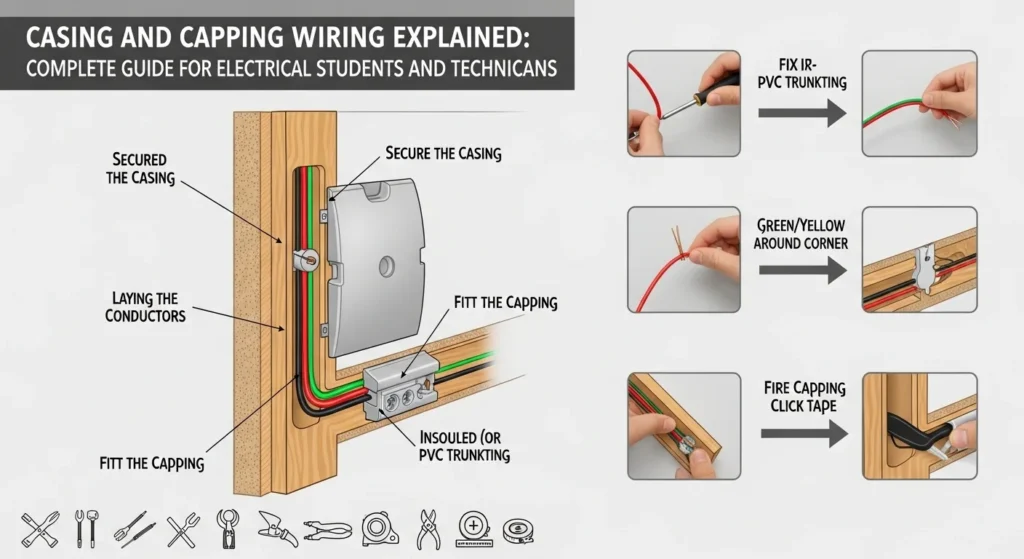
Step-by-Step Working Process
- Installation of Casing
- A rectangular casing channel is fixed to the wall or ceiling using screws.
- Wire Placement
- Insulated wires are laid inside the casing grooves.
- Wire Separation
- The casing has partitions to separate phase, neutral, and earth wires.
- Capping Installation
- A cover called capping is placed on top of the casing.
- Power Distribution
- Electricity flows through the wires to switches, sockets, and electrical devices.
Simple Analogy
Think of casing and capping wiring like placing cables inside a protective cable tray and closing it with a lid. The wires stay organized and protected from damage.
Key Safety Feature
The casing keeps wires separated, reducing the risk of:
- Short circuits
- Mechanical damage
- Wire entanglement
4. Types / Classification of Casing and Capping Wiring
There are mainly two types of casing and capping wiring based on the material used.
4.1 Wooden Casing and Capping Wiring
Wooden casing and capping wiring is a traditional method used to protect and organize electrical wires, particularly in residential and small commercial installations. In this system, wires are laid inside a wooden casing, which is a rectangular hollow wooden channel fixed to walls or ceilings. The capping, a removable wooden cover, is then placed on top to enclose the wires, keeping them safe from dust, moisture, and mechanical damage. This method allows for neat and organized wiring, while also making it easier to inspect, repair, or replace wires without damaging the wall. Wooden casing and capping are usually used with solid or flexible insulated wires and are preferred where surface wiring is needed without embedding cables into walls. This system is durable, economical, and provides good mechanical protection, though it is less common in modern electrical installations compared to PVC conduits.
Features
- Made from seasoned wood
- Rectangular wooden channels
- Wooden capping cover
Advantages
- Easy installation
- Good insulation
- Simple maintenance
Limitations
- Can be affected by moisture
- Vulnerable to insects and termites
4.2 PVC Casing and Capping Wiring
PVC casing and capping wiring is a modern, safe, and widely used method for surface electrical wiring. In this system, electrical wires are laid inside a PVC casing, which is a rigid, hollow channel made of durable plastic. A PVC capping, which is a removable cover, is then placed over the casing to completely enclose the wires. This method protects the wires from dust, moisture, insects, and mechanical damage while keeping the installation neat and organized. PVC casing and capping are lightweight, non-corrosive, and fire-resistant, making them more suitable than wooden casing for long-term safety. They are easy to install, inspect, and maintain, allowing wires to be replaced or repaired without damaging walls. This system is commonly used in homes, offices, and industrial buildings where surface wiring is required, offering both durability and safety.
Features
- Made from plastic material
- Lightweight and durable
- Resistant to moisture
Advantages
- Long lifespan
- Fire resistant
- Low maintenance
PVC casing and capping wiring is more reliable than the wooden version.
5. Main Components of Casing and Capping Wiring
Understanding the components helps electricians install and maintain the system properly.
1. Casing
The casing is the base channel that holds the wires.
Function
- Supports electrical wires
- Provides insulation
- Keeps wires organized
Casing often includes grooves for separate wires.
2. Capping
Capping is the protective cover placed on top of the casing.
Function
- Protects wires from dust and damage
- Improves safety
- Maintains neat appearance
3. Insulated Electrical Wires
Wires carry electrical current to electrical devices.
Common types include:
- PVC insulated wires
- Copper conductors
Function
- Conduct electricity safely
4. Screws and Fasteners
These components fix the casing to the wall.
Function
- Secure the wiring channel in place
5. Junction Boxes
Junction boxes are used where wires split into different circuits.
Function
- Provide safe wire connections
6. Casing and Capping Wiring Advantages
Understanding casing and capping wiring advantages and disadvantages helps technicians decide where it can be used.
Advantages
- Neat and organized wiring
- Better protection than cleat wiring
- Easy inspection and repair
- Lower cost compared to concealed wiring
- Simple installation
- Good mechanical protection
- Wires remain accessible
Because of these advantages, casing and capping wiring was widely used in older electrical systems.
7. Casing and Capping Wiring Disadvantages
Despite its benefits, this wiring method has several limitations.
Disadvantages
- Not suitable for modern buildings
- Wooden casing may catch fire
- Can be damaged by moisture
- Less durable compared to conduit wiring
- Not aesthetically suitable for luxury homes
- Termite damage possible in wooden casing
Due to these disadvantages, most modern buildings use concealed wiring systems.
8. Casing and Capping Wiring Applications
There are several casing and capping wiring applications in electrical installations.
1. Residential Buildings
Used in older homes where concealed wiring was not common.
2. Schools and Small Offices
Used for basic lighting and socket circuits.
3. Temporary Electrical Installations
Suitable for locations where wiring may need modification.
4. Educational Training Labs
Electrical training institutes use casing and capping wiring to teach wiring methods.
5. Workshops
Used for simple and accessible wiring installations.
9. Comparison: Casing and Capping Wiring vs Cleat Wiring
Understanding the difference between casing and capping wiring and cleat wiring is important for electrical students.
| Feature | Casing and Capping Wiring | Cleat Wiring |
|---|---|---|
| Protection | Moderate protection | Very low protection |
| Appearance | Neat | Poor |
| Installation | Moderate effort | Very simple |
| Cost | Medium | Very low |
| Durability | Better | Temporary |
| Safety | Higher | Lower |
Casing and capping wiring offers more protection and better appearance compared to cleat wiring.
10. Selection Guide: How to Choose the Right Wiring System
Choosing the right wiring method depends on several factors.
Consider the Following
- Type of Building
- Temporary buildings may use casing and capping wiring.
- Budget
- It is cheaper than concealed wiring.
- Maintenance Requirements
- Easy access for repairs.
- Safety Standards
- Modern buildings require higher safety standards.
Beginner Tip
Electrical students should practice casing and capping wiring because it helps them understand wire routing and circuit organization.
11. Common Problems & Solutions
Here are common problems found in casing and capping wiring systems.
1. Loose Capping
Cause
- Screws becoming loose
Solution
- Tighten screws regularly
2. Damaged Wires
Cause
- Rodents or mechanical damage
Solution
- Replace damaged wires immediately
3. Moisture Damage
Cause
- Water exposure
Solution
- Use PVC casing in humid areas
4. Overheating
Cause
- Overloaded circuits
Solution
- Reduce load and install proper protection devices
12. Future Trends in Electrical Wiring
Electrical wiring technology is evolving rapidly.
1. Concealed Wiring Systems
Modern houses use concealed conduit wiring inside walls.
Advantages include:
- Better appearance
- Improved safety
- Longer life
2. Smart Electrical Installations
Future electrical systems include:
- Smart switches
- Home automation
- Energy monitoring
3. Fire-Resistant Wiring Materials
Modern cables include:
- Fire-resistant insulation
- Improved safety features
These developments are replacing older wiring methods like casing and capping.
13. Conclusion
Understanding Casing and Capping Wiring Explained is essential for electrical students, engineers, and technicians. This wiring method was widely used in older electrical installations because it provided a simple way to organize and protect electrical wires.
In this article, we discussed the casing and capping wiring working principle, its types, main components, and practical applications. We also explored casing and capping wiring advantages and disadvantages and compared it with cleat wiring.
Although this wiring system is rarely used in modern buildings today, learning about it helps students understand the development of electrical wiring methods. It also provides a strong foundation for studying more advanced wiring systems like conduit wiring and concealed wiring.
For beginners, studying traditional wiring systems like casing and capping wiring builds essential knowledge that supports future work in electrical installation, maintenance, and system design.