
Imagine you are wiring a small workshop. You connect a powerful air compressor using a thin cable because it is cheaper and easily available. After a few hours of operation, the cable becomes hot, insulation starts melting, and the breaker trips repeatedly. In worst cases, it can even cause a fire.
This problem usually happens because of incorrect Cable Size Calculation.
Choosing the correct cable size is one of the most important tasks in electrical installation. A cable that is too small will overheat. A cable that is too large will increase project cost unnecessarily. Proper cable sizing ensures safety, efficiency, and long equipment life.
In this article, you will learn the Cable Size Calculation working principle, types of calculation methods, key factors affecting cable size, comparison methods, practical examples, applications, advantages and disadvantages, selection guide, and troubleshooting tips. I will explain everything in simple language, just like guiding a junior engineer at a real job site.
2. What is Cable Size Calculation?
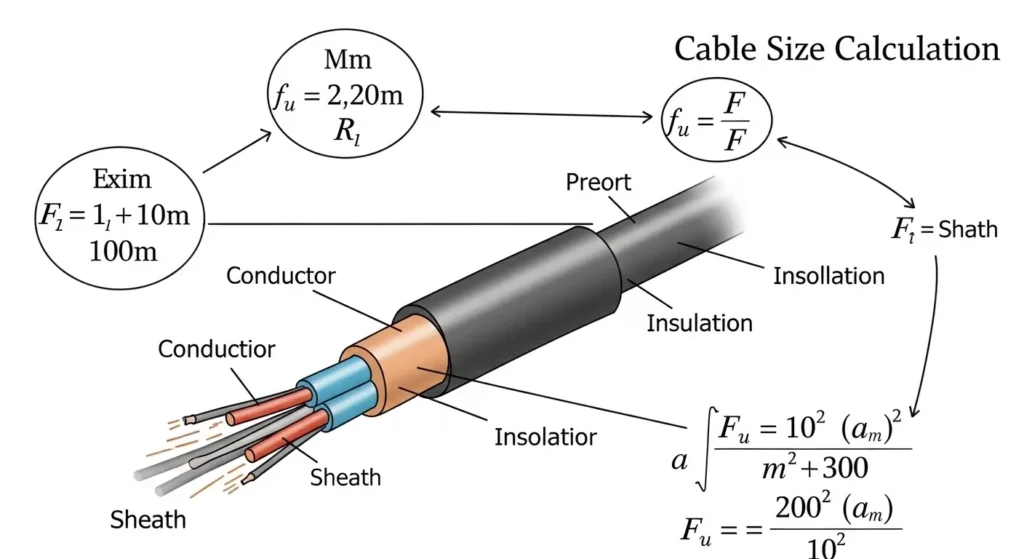
Cable Size Calculation is the process of determining the correct cross-sectional area of an electrical cable required to carry a specific load safely and efficiently.
Simple Definition
It is the method used to select a cable that can handle required current without overheating or causing excessive voltage drop.
Simple Explanation
When current flows through a cable, it produces heat. If the cable is too thin, it cannot carry the current safely. So we calculate the required cable size based on:
- Load current
- Voltage drop
- Installation condition
- Temperature
- Safety standards
Practical Example
If a 5 kW motor operates at 230V, we calculate the current first. Then we select a cable that can safely carry that current over the required distance.
3. Cable Size Calculation Working Principle
The Cable Size Calculation working principle is based on current-carrying capacity and voltage drop limits.
Let us understand step-by-step.
Step 1: Calculate Load Current
For single-phase:Current(I)=Power(P)/Voltage(V)
For three-phase:I=P/(√3×V×PowerFactor)
Step 2: Select Cable Based on Current Capacity
Choose a cable that can carry the calculated current safely.
Step 3: Check Voltage Drop
Long cables cause voltage drop. It should remain within acceptable limits (usually 3–5%).
Step 4: Consider Environmental Conditions
- Ambient temperature
- Installation method
- Grouping of cables
Easy Analogy
Think of a water pipe:
- More water flow = thicker pipe required
- Longer distance = more pressure drop
Electric current behaves similarly in cables.
4. Types / Classification
Cable sizing can be classified based on different factors.
4.1 Based on Current Carrying Capacity
This method focuses on how much current the cable can safely carry without overheating.
Used mainly for:
- Short cable runs
- Indoor installations
4.2 Based on Voltage Drop
This method ensures that voltage at the load end remains within limits.
Used for:
- Long-distance wiring
- Rural installations
4.3 Based on Short Circuit Capacity
Cables must withstand fault current for a short time.
Used in:
- Industrial systems
- High-power installations
4.4 Based on Installation Method
Cable size changes depending on installation type:
- In air
- Buried underground
- In conduit
- On cable tray
Each method affects heat dissipation.
5. Main Components in Cable Size Calculation
To perform proper Cable Size Calculation, we must understand these key factors.
5.1 Load Power
Total power connected to the cable.
5.2 Supply Voltage
Single-phase or three-phase system.
5.3 Power Factor
Important for accurate current calculation.
5.4 Cable Length
Longer cable increases voltage drop.
5.5 Conductor Material
- Copper
- Aluminum
5.6 Insulation Type
- PVC
- XLPE
These factors directly affect cable size.
6. Cable Size Calculation Advantages
Understanding the Cable Size Calculation advantages and disadvantages is important for every engineer.
Advantages
- Prevents overheating
- Reduces fire risk
- Improves system efficiency
- Minimizes voltage drop
- Extends equipment life
- Ensures compliance with safety standards
Real-World Benefits
- Stable motor performance
- Lower maintenance cost
- Safe home and industrial wiring
Correct cable sizing saves money in the long term.
7. Disadvantages / Limitations
Although essential, there are practical challenges:
- Requires technical knowledge
- Calculation errors can cause damage
- Environmental factors may change performance
- Overdesign increases project cost
Improper estimation can either waste money or reduce safety.
8. Cable Size Calculation Applications
The Cable Size Calculation applications are seen everywhere in electrical systems.
8.1 Residential Wiring
- Lighting circuits
- Socket outlets
- Air conditioners
8.2 Industrial Installations
- Motors
- Control panels
- Heavy machinery
8.3 Commercial Buildings
- HVAC systems
- Elevators
- Data centers
8.4 Renewable Energy Systems
- Solar panel wiring
- Battery banks
8.5 Underground Distribution
- Utility power supply
Every electrical project requires proper cable size selection.
9. Comparison Section
Difference Between Copper and Aluminum Cable Selection
Many students ask about the difference between copper and aluminum cable in cable sizing.
| Feature | Copper Cable | Aluminum Cable |
|---|---|---|
| Conductivity | High | Lower |
| Size Required | Smaller | Larger |
| Cost | Higher | Lower |
| Weight | Heavy | Light |
| Durability | Better | Moderate |
This difference between copper and aluminum cable affects Cable Size Calculation significantly.
10. Selection Guide
Choosing the correct cable requires careful steps.
1. Calculate Load Current
Use correct formula for single or three phase.
2. Choose Conductor Type
Copper for high efficiency, aluminum for cost saving.
3. Check Voltage Drop
Keep within 3–5% limit.
4. Consider Installation Method
Underground cables need larger size due to heat.
5. Add Safety Margin
Add 20% extra capacity for future expansion.
6. Follow Electrical Standards
Always follow local electrical codes.
For beginners: Never guess cable size. Always calculate.
11. Common Problems & Solutions
Q1: Cable overheating?
Reason: Undersized cable.
Solution: Recalculate load and upgrade cable.
Q2: Voltage low at load end?
Reason: Excessive voltage drop.
Solution: Increase cable size.
Q3: Breaker tripping frequently?
Reason: High current or short circuit.
Solution: Check load and cable rating.
Q4: Insulation damage?
Reason: High temperature or overload.
Solution: Replace with higher rated cable.
Q5: Unequal current in phases?
Reason: Unbalanced load.
Solution: Balance load properly.
Routine testing prevents system failure.
12. Future Trends
Cable technology is improving continuously.
Smart Cable Monitoring
Sensors to detect temperature and overload.
Fire-Resistant Cables
Used in hospitals and high-rise buildings.
High-Efficiency Materials
Improved conductor alloys.
Sustainable Manufacturing
Eco-friendly insulation materials.
Future systems will focus on safety, monitoring, and energy efficiency.
13. Conclusion
Cable Size Calculation is one of the most critical tasks in electrical engineering. It ensures that cables carry load safely without overheating or excessive voltage drop.
Understanding the Cable Size Calculation working principle, applications, and the difference between copper and aluminum cable helps engineers make smart decisions.
Each project requires careful analysis of load current, voltage drop, installation conditions, and safety standards. Proper cable sizing improves efficiency, reduces fire risk, and extends equipment life.
As an electrical professional, always calculate cable size accurately instead of guessing. Strong fundamentals in cable selection will make you a confident and responsible engineer.