
Imagine a large thermal power plant producing electricity for thousands of homes. Inside the plant, boilers burn fuel such as coal, gas, or oil to generate steam. This steam drives turbines that produce electricity. During this process, a huge amount of heat escapes with the exhaust gases through the chimney. If this heat is not reused, the plant wastes valuable energy and burns more fuel than necessary.
To solve this problem, engineers use a device called an Air Preheater. This equipment captures heat from hot exhaust gases and uses it to warm the incoming air before it enters the furnace. Preheating the air improves combustion efficiency and reduces fuel consumption.
Air preheaters are widely used in thermal power plants, industrial boilers, furnaces, and large heating systems. They help improve efficiency, reduce operational costs, and make energy systems more sustainable.
For electrical students, engineers, technicians, and beginners, understanding the Air Preheater working principle, types, and Air Preheater applications is very important. In this article, you will learn how air preheaters work, their components, advantages, disadvantages, and their role in modern energy systems.
What is an Air Preheater?
An Air Preheater is a heat exchange device used in boilers and furnaces to preheat combustion air by using the heat from exhaust flue gases.
In simple terms, it transfers heat from hot gases leaving the boiler to the fresh air entering the furnace. This process increases combustion efficiency and reduces fuel consumption.
Simple Explanation
When fuel burns inside a boiler furnace, it produces hot gases. These gases normally leave through the chimney. Instead of wasting this heat, an air preheater captures part of it and transfers it to the air that will be used for combustion.
As a result, the incoming air becomes hot before entering the furnace, which improves the burning process.
Practical Example
In a coal-fired thermal power plant, air required for combustion is supplied by a forced draft fan. Before entering the furnace, this air passes through the air preheater, where it absorbs heat from flue gases. The heated air then enters the furnace and helps the coal burn more efficiently.
Air Preheater Working Principle
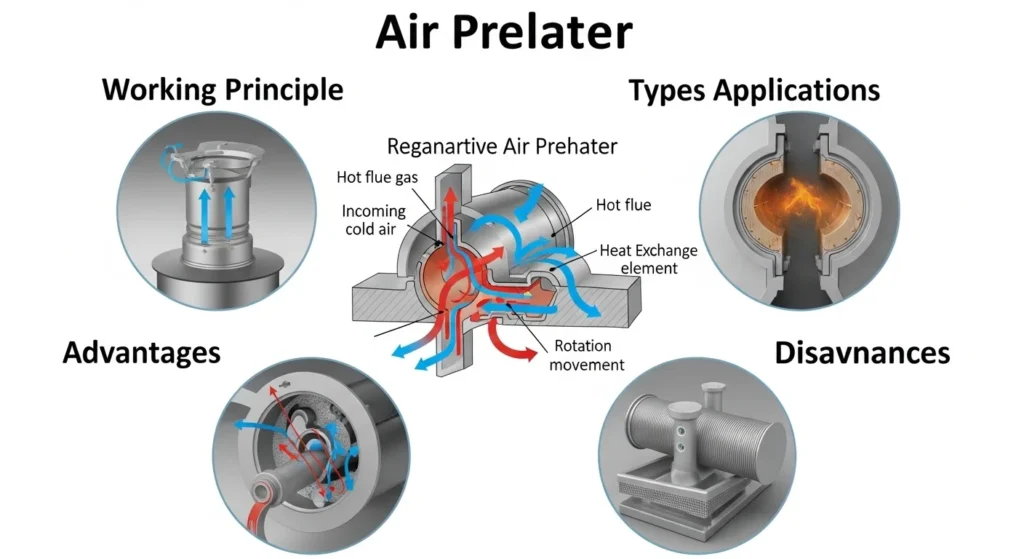
The Air Preheater working principle is based on heat transfer between hot exhaust gases and cold incoming air without mixing the two streams.
Step-by-Step Working Process
- Hot Flue Gas Flow
- After combustion, hot gases leave the boiler and enter the air preheater.
- Cold Air Entry
- Fresh air from the atmosphere is supplied by a fan into the air preheater.
- Heat Transfer
- Heat from the hot flue gases passes through metal surfaces to the cold air.
- Air Temperature Increase
- The air temperature rises before entering the furnace.
- Improved Combustion
- Hot air helps fuel burn more completely and efficiently.
- Lower Exhaust Temperature
- After giving away heat, the flue gases exit the system at a lower temperature.
Simple Analogy
Think of an air preheater like warming your hands near a heater before starting work. The warmer air entering the furnace makes the burning process faster and more efficient.
Types of Air Preheater
Air preheaters are classified based on their design and method of heat transfer.
Recuperative Air Preheater
A recuperative air preheater transfers heat continuously through a solid wall separating hot gases and cold air.
Features:
- Fixed heat transfer surface
- Continuous operation
- Simple construction
These are commonly used in smaller boilers and industrial heating systems.
Regenerative Air Preheater
In this design, heat is stored in a rotating heat storage element and then transferred to incoming air.
Features:
- Rotating heat storage system
- Higher efficiency
- Common in large power plants
Tubular Air Preheater
This type uses a bundle of tubes for heat transfer.
Features:
- Hot gases flow inside tubes
- Air flows around the tubes
- Strong and durable design
Rotary Air Preheater
This is the most commonly used design in large power plants.
Features:
- Rotating heat transfer surface
- Compact structure
- Very efficient heat recovery
Main Components of an Air Preheater
An air preheater consists of several important components that help transfer heat effectively.
Heat Transfer Surface
These surfaces transfer heat between flue gases and incoming air.
Common materials include:
- Steel plates
- Metal tubes
- Corrugated sheets
Casing or Housing
The casing encloses the entire unit and protects internal components. It also directs airflow through the system.
Rotating Element
In regenerative or rotary air preheaters, the rotating element absorbs heat from flue gases and transfers it to incoming air.
Seals
Seals prevent the mixing of flue gases and air streams.
Drive System
The drive system uses an electric motor to rotate the heat transfer element in rotary air preheaters.
Air and Gas Ducts
These ducts guide the movement of air and exhaust gases through the equipment.
Air Preheater Advantages
Understanding the Air Preheater advantages and disadvantages helps engineers decide whether to use this equipment in energy systems.
Advantages
- Improves boiler efficiency
- Reduces fuel consumption
- Recovers waste heat from flue gases
- Improves combustion performance
- Reduces exhaust gas temperature
- Lowers operating costs
- Increases overall thermal efficiency
Real-World Benefits
In large power plants, installing an air preheater can improve efficiency by 5–15%, resulting in major fuel savings.
Air Preheater Disadvantages / Limitations
Although air preheaters are very useful, they also have some limitations.
Limitations
- High initial installation cost
- Requires regular maintenance
- Possible corrosion from acidic flue gases
- Dust accumulation may reduce efficiency
- Air leakage in rotary air preheaters
Proper maintenance is essential to maintain good performance.
Air Preheater Applications
There are many Air Preheater applications in industrial and power generation systems.
Thermal Power Plants
Air preheaters are widely used in coal-fired power plants to improve boiler efficiency.
Industrial Boilers
Many factories use air preheaters to reduce fuel consumption in heating systems.
Cement Industry
Cement kilns use air preheaters to increase combustion efficiency.
Steel Industry
Steel manufacturing plants use air preheaters in furnaces to improve fuel efficiency.
Waste Heat Recovery Systems
Air preheaters are used in systems designed to recover heat from exhaust gases.
Comparison: Air Preheater vs Economizer
Understanding the difference between air preheater and economizer is important in boiler systems.
| Feature | Air Preheater | Economizer |
|---|---|---|
| Function | Heats combustion air | Heats feedwater |
| Heat Source | Flue gases | Flue gases |
| Purpose | Improve combustion | Improve boiler efficiency |
| Working Medium | Air | Water |
| Location | Before furnace | Before boiler |
Key Difference
The main difference between air preheater and economizer is that an air preheater heats incoming air while an economizer heats the boiler feedwater.
Selection Guide
Choosing the correct air preheater depends on several factors.
Important Factors
- Boiler capacity
- Fuel type
- Operating temperature
- Maintenance requirements
- Space availability
Tips for Beginners
- Select corrosion-resistant materials.
- Ensure proper sealing to avoid air leakage.
- Choose designs that allow easy cleaning and maintenance.
Common Problems and Solutions
Why does an air preheater lose efficiency?
Dust and ash deposits can reduce heat transfer.
Solution: Regular cleaning of heat transfer surfaces.
What causes air leakage?
Damaged seals or improper installation.
Solution: Inspect and replace seals regularly.
Why does corrosion occur?
Sulfur compounds in flue gases can form acids that corrode metal parts.
Solution: Use corrosion-resistant materials.
Why does air temperature drop?
Fouling on heat transfer surfaces reduces heat transfer efficiency.
Solution: Perform routine maintenance and cleaning.
Future Trends in Air Preheater Technology
Air preheater technology is improving with modern engineering developments.
Advanced Materials
New heat-resistant materials increase durability and efficiency.
Smart Monitoring Systems
Sensors and automation systems help monitor temperature, pressure, and performance.
Improved Heat Recovery Designs
Modern designs focus on maximum heat recovery with minimal energy loss.
Energy-Efficient Industrial Systems
Future industries will rely more on waste heat recovery technologies to reduce fuel consumption.
Conclusion
An Air Preheater is an important heat recovery device used in boilers and furnaces to improve energy efficiency. It captures heat from exhaust gases and uses it to warm the air entering the combustion chamber. This process improves combustion, reduces fuel consumption, and increases overall system efficiency.
Understanding the Air Preheater working principle, components, and Air Preheater applications is essential for electrical and mechanical engineering students as well as technicians working in industrial environments.
Although air preheaters require maintenance and have some limitations, their advantages make them an essential part of modern power plants and industrial boilers. With advancements in materials, automation, and energy efficiency technologies, air preheaters will continue to play a key role in future energy systems.