
Imagine standing in an open field where large wind turbines slowly rotate in the breeze. As the wind moves the blades, these massive machines quietly generate electricity that powers homes, schools, hospitals, and industries. What looks like simple spinning blades is actually a complex system designed to convert natural wind energy into electrical power.
With the increasing demand for clean and renewable energy, wind power has become one of the fastest-growing energy sources in the world. Many countries are investing heavily in wind farms to reduce dependence on fossil fuels and lower carbon emissions. At the heart of every wind turbine is a generator that converts mechanical rotation into electrical energy.
Understanding wind turbine generator types is essential for electrical students, engineers, and technicians who want to work in renewable energy systems. Different generator designs are used depending on efficiency requirements, turbine size, and grid connection methods.
In this article, you will learn about wind turbine generator types, their working principle, key components, advantages and disadvantages, and real-world wind turbine generator applications. We will also compare common generator technologies and provide a practical selection guide for beginners.
By the end of this guide, you will have a clear understanding of how wind turbine generators work and why they are critical for sustainable energy systems.
2. What is a Wind Turbine Generator?
A wind turbine generator is an electrical machine that converts mechanical energy from rotating wind turbine blades into electrical energy.
In simple terms, wind energy turns the turbine blades. These blades rotate a shaft connected to a generator. The generator then converts this rotation into electricity using electromagnetic induction.
Wind turbine generators are designed to operate under changing wind speeds and environmental conditions. They must be efficient, reliable, and capable of producing stable electrical power.
Practical Example
Consider a wind farm located in a coastal area where wind is strong and consistent. Each turbine captures wind energy through its blades. As the blades rotate, the generator inside the turbine produces electricity that is sent to the power grid.
This electricity can supply thousands of homes with clean and renewable energy.
3. Wind Turbine Generator Working Principle
The wind turbine generator working principle is based on electromagnetic induction, which is the same principle used in most electrical generators.
When a conductor moves inside a magnetic field, an electric current is generated.
Step-by-Step Process
- Wind Energy Capture
Wind blows across the turbine blades, causing them to rotate. - Mechanical Rotation
The rotating blades turn the main shaft connected to the generator. - Gearbox Operation (if present)
Some turbines use a gearbox to increase the rotational speed. - Generator Rotation
The shaft rotates the rotor inside the generator. - Electricity Generation
The rotating magnetic field produces electrical current in the stator windings. - Power Transmission
The electricity is conditioned and delivered to the power grid.
Simple Analogy
Think of a bicycle dynamo that powers a light when the wheel spins. A wind turbine generator works in a similar way, but on a much larger scale.
4. Types / Classification of Wind Turbine Generators
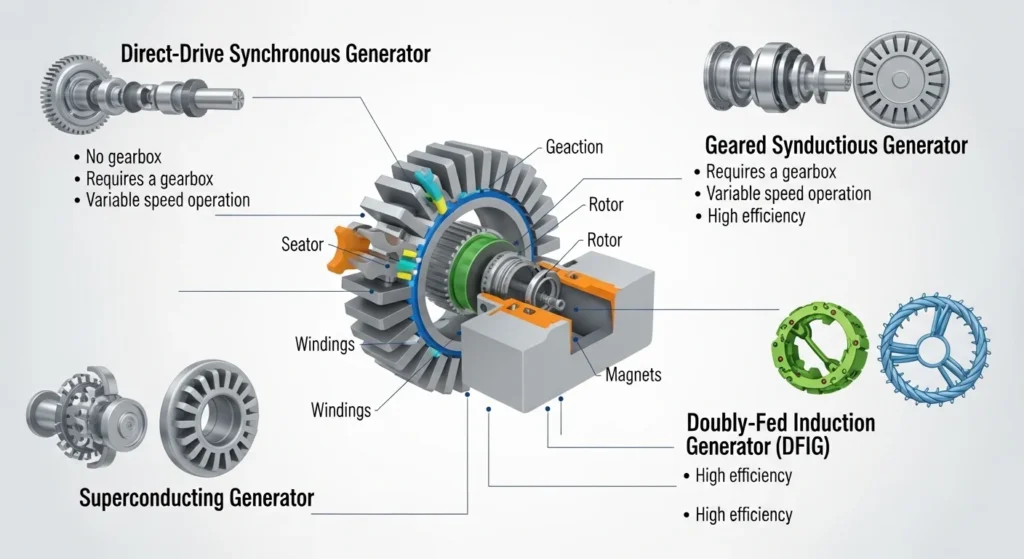
There are several wind turbine generator types used in modern wind power systems.
Synchronous Generator
A synchronous generator rotates at the same speed as the electrical grid frequency.
Features
- High efficiency
- Stable voltage output
- Suitable for large wind turbines
These generators are often used in large wind farms connected directly to the electrical grid.
Asynchronous Generator (Induction Generator)
An asynchronous generator, also known as an induction generator, is widely used in wind turbines.
Features
- Simple design
- Low maintenance
- Cost-effective
However, it requires reactive power from the grid for proper operation.
Doubly Fed Induction Generator (DFIG)
The Doubly Fed Induction Generator (DFIG) is one of the most commonly used generator types in modern wind turbines.
Features
- Variable speed operation
- High energy efficiency
- Improved power control
DFIG systems allow wind turbines to operate efficiently under varying wind speeds.
Permanent Magnet Synchronous Generator (PMSG)
Permanent magnet generators use strong magnets instead of field windings.
Features
- High efficiency
- Compact design
- Reduced maintenance
These generators are widely used in modern large-scale wind turbines.
Direct Drive Generators
Direct drive systems eliminate the gearbox and connect the rotor directly to the generator.
Features
- Lower mechanical losses
- Reduced maintenance
- Higher reliability
However, they require larger and more expensive generators.
5. Main Components of a Wind Turbine Generator
Wind turbine generators consist of several important components.
Rotor
The rotor contains magnets or field windings that rotate to create a magnetic field.
Stator
The stator is the stationary part of the generator that contains electrical windings where electricity is produced.
Shaft
The shaft transfers mechanical rotation from the turbine blades to the generator.
Gearbox
In some turbines, a gearbox increases the rotational speed before it reaches the generator.
Power Electronics
Power converters control voltage, frequency, and power quality before sending electricity to the grid.
Cooling System
Generators produce heat during operation. Cooling systems prevent overheating.
6. Advantages of Wind Turbine Generators
Wind turbine generators offer many benefits for modern energy systems.
- Renewable and clean energy source
- No fuel consumption during operation
- Low environmental pollution
- Reduced greenhouse gas emissions
- Sustainable long-term power generation
- Low operating cost after installation
These benefits make wind energy one of the most important renewable energy sources today.
7. Disadvantages / Limitations
Despite their advantages, wind turbine generators also have some limitations.
- High initial installation cost
- Dependence on wind availability
- Noise from turbine operation
- Large land area required for wind farms
- Maintenance challenges in offshore installations
Understanding wind turbine generator advantages and disadvantages helps engineers design more efficient systems.
8. Wind Turbine Generator Applications
There are many wind turbine generator applications in modern energy systems.
Utility Power Generation
Large wind farms generate electricity for national power grids.
Residential Power Systems
Small wind turbines can supply electricity for homes in remote areas.
Rural Electrification
Wind generators provide electricity in areas where grid connection is difficult.
Offshore Wind Farms
Wind turbines installed in oceans generate large amounts of electricity.
Hybrid Renewable Systems
Wind turbines are often combined with solar power and battery storage systems.
9. Comparison Section
Difference Between Synchronous Generator and Induction Generator
| Feature | Synchronous Generator | Induction Generator |
|---|---|---|
| Speed | Constant speed | Variable speed |
| Grid Support | Can operate independently | Requires grid connection |
| Efficiency | High | Moderate |
| Complexity | More complex | Simpler design |
| Cost | Higher | Lower |
Understanding the difference between synchronous generator and induction generator is important when designing wind turbine systems.
10. Selection Guide
Choosing the correct wind turbine generator depends on several factors.
Power Capacity
Determine the power output required for the application.
Wind Conditions
Different generators perform better under specific wind speeds.
Grid Connection
Select generators compatible with the local power grid.
Maintenance Requirements
Choose systems with reliable performance and easy maintenance.
Budget
Consider installation cost, maintenance cost, and operational efficiency.
These factors help engineers select the most suitable wind turbine generator type.
11. Common Problems & Solutions
Q1: Why does a wind turbine generator stop producing power?
This may occur due to low wind speed, mechanical faults, or electrical system issues.
Solution: Inspect turbine blades, electrical connections, and control systems.
Q2: Why does the generator overheat?
Overheating may result from poor cooling or excessive electrical load.
Solution: Check cooling systems and ensure proper load management.
Q3: Why does power output fluctuate?
Wind speed changes can cause power fluctuations.
Solution: Use advanced power electronics and control systems.
Q4: Why is the turbine making unusual noise?
Noise may indicate gearbox wear or blade imbalance.
Solution: Perform regular maintenance and inspection.
12. Future Trends in Wind Turbine Generators
Wind energy technology continues to evolve rapidly.
Larger Wind Turbines
Modern turbines are becoming larger to capture more wind energy.
Offshore Wind Expansion
Offshore wind farms are growing due to stronger and more consistent wind conditions.
Advanced Generator Designs
New generator technologies are improving efficiency and reducing maintenance.
Smart Monitoring Systems
Digital sensors and monitoring systems help detect problems early and improve reliability.
Hybrid Renewable Energy Systems
Wind turbines are increasingly integrated with solar power and energy storage systems.
13. Conclusion
Wind turbine generators are essential components of modern renewable energy systems. They convert natural wind energy into electrical power that can supply homes, industries, and entire cities.
In this article, we explored different wind turbine generator types, their working principle, major components, advantages and disadvantages, and real-world wind turbine generator applications. We also compared different generator technologies and provided a practical selection guide.
For electrical students, engineers, and technicians, understanding wind turbine generators is an important step toward working in the growing renewable energy sector. As technology continues to advance, wind energy systems will become more efficient, reliable, and environmentally friendly.
Learning about wind turbine generators today prepares engineers to design the sustainable energy systems of tomorrow.