
Imagine you are charging your mobile phone. The electricity from your wall socket is AC (alternating current), but your phone battery needs DC (direct current). Inside the charger, there is a small electronic component that allows current to flow in only one direction and blocks it in the opposite direction. That small but powerful device is called a diode.
Without diodes, modern electronics would not function properly. From mobile chargers and televisions to industrial power supplies and solar panels, diodes play a critical role in controlling current flow.
Understanding what is a diode is very important for electrical students, engineers, technicians, and beginners. It is one of the most basic and essential semiconductor devices. In this complete guide, you will learn the diode working principle, types, components, diode applications, diode advantages and disadvantages, comparison with similar devices, and practical selection tips — explained in simple and clear English.
What is a Diode?
A diode is a two-terminal semiconductor device that allows current to flow in one direction and blocks it in the opposite direction.
Simple Explanation
A diode works like a one-way valve in a water pipe:
- Water flows in one direction.
- Water is blocked in the reverse direction.
Similarly:
- Current flows in forward direction.
- Current is blocked in reverse direction.
Practical Example
In a mobile charger, diodes convert AC into DC by allowing only one half of the AC waveform to pass. This process is called rectification.
So, when we ask what is a diode, the simple answer is:
It is a device that controls the direction of current flow.
Diode Working Principle
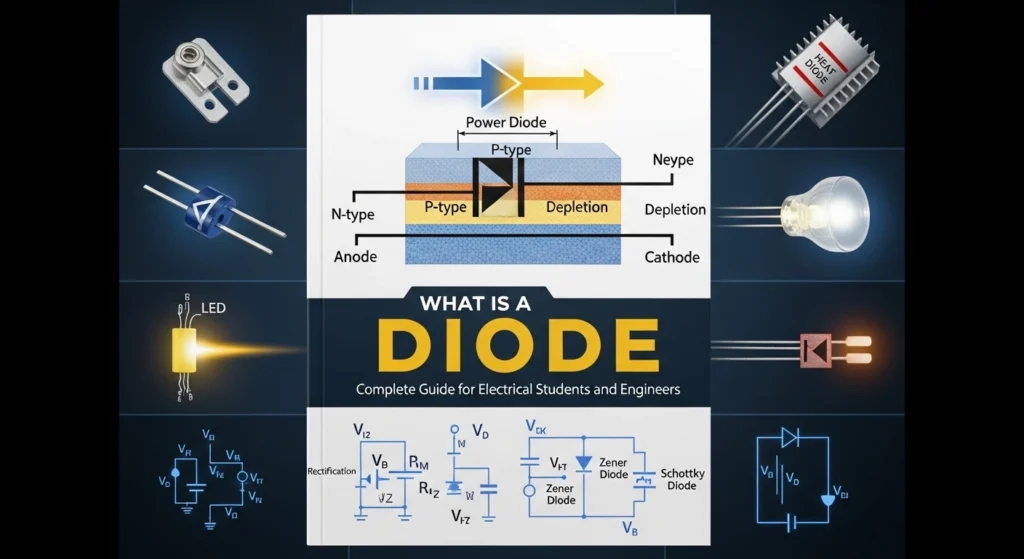
The diode working principle is based on the P-N junction.
A diode is made by joining two types of semiconductor materials:
- P-type (positive type)
- N-type (negative type)
Let’s understand this step-by-step.
Step 1: Formation of P-N Junction
When P-type and N-type materials are joined:
- Electrons from N-side move to P-side
- Holes from P-side move to N-side
- A depletion region is formed
This depletion region acts as a barrier.
Step 2: Forward Bias Condition
When:
- Positive terminal connected to P-side
- Negative terminal connected to N-side
The barrier becomes weak.
Current flows easily.
This is called forward bias.
Step 3: Reverse Bias Condition
When:
- Positive terminal connected to N-side
- Negative terminal connected to P-side
The barrier becomes strong.
Current does not flow (except very small leakage current).
This is called reverse bias.
Simple Analogy
Think of it like a door:
- Push from correct side → Door opens
- Push from wrong side → Door stays closed
That is the diode working principle in simple words.
Types / Classification of Diodes
There are many types of diodes based on function and application.
Rectifier Diode
- Used for AC to DC conversion
- High current capacity
- Common in power supplies
Zener Diode
- Used for voltage regulation
- Works in reverse breakdown region
- Maintains constant output voltage
Light Emitting Diode (LED)
- Emits light when forward biased
- Used in indicators and lighting
- Low power consumption
Schottky Diode
- Low forward voltage drop
- High-speed switching
- Used in switching power supplies
Photodiode
- Converts light into current
- Used in sensors and solar cells
Tunnel Diode
- Very fast operation
- Used in high-frequency circuits
Varactor Diode
- Used as variable capacitor
- Common in RF tuning circuits
Understanding the difference between Zener diode and normal diode is very important for beginners. A normal diode blocks reverse current, while a Zener diode is designed to operate safely in reverse breakdown.
Main Components of a Diode
A diode has simple but important internal parts.
P-Type Semiconductor
- Contains holes as majority carriers
- Connected to anode terminal
N-Type Semiconductor
- Contains electrons as majority carriers
- Connected to cathode terminal
Depletion Region
- Acts as barrier
- Controls current flow
Anode
- Positive terminal
Cathode
- Negative terminal
- Marked with a band on diode body
Each part plays an important role in current control.
Advantages of Diode
Here are the main diode advantages and disadvantages. First, advantages:
- Simple construction
- Small size
- Low cost
- Reliable operation
- High efficiency in rectification
- Fast switching (in special types)
Real-world benefit: Diodes make power supplies compact and efficient.
Disadvantages / Limitations
- Allows current only in one direction
- Limited voltage and current rating
- Heat generation at high current
- Can be damaged by reverse overvoltage
- Not suitable for amplification
Engineers must consider these limitations during circuit design.
Diode Applications
Diode applications are everywhere in modern electronics.
Home Applications
- Mobile chargers
- TV power supplies
- LED lighting
Industrial Applications
- Rectifier circuits
- Motor drives
- UPS systems
Communication Systems
- Signal detection
- RF circuits
Renewable Energy
- Solar panel protection
- Blocking reverse current
Automotive Applications
- Alternator rectification
- Voltage regulation
Without diodes, electronic devices would not function properly.
Comparison Section
Difference Between Diode and Transistor
| Feature | Diode | Transistor |
| Terminals | 2 | 3 |
| Function | Allows one-way current | Amplifies or switches signals |
| Control | No control terminal | Has control terminal |
| Use | Rectification | Amplification & switching |
| Complexity | Simple | More complex |
Understanding the difference between diode and transistor helps in circuit design.
Selection Guide
Choosing the right diode depends on:
- Maximum current rating
- Reverse voltage rating
- Forward voltage drop
- Switching speed
- Application type
Tips for Beginners
- Always check datasheet ratings.
- Use safety margin (20–30%).
- Consider heat dissipation.
- Choose fast diodes for high-frequency circuits.
Never select a diode only based on price.
Common Problems & Solutions (FAQs Style)
Q1: Why does a diode overheat?
Due to excess current.
Solution:
Check current rating and use heat sink.
Q2: Why is output voltage low in rectifier?
Possible diode drop or faulty diode.
Solution:
Test diode using multimeter.
Q3: How to check a diode?
Use multimeter in diode mode.
- Forward bias → Low reading
- Reverse bias → OL reading
Q4: What happens if diode is connected wrong?
Circuit may not work or diode may burn.
Solution:
Always check anode and cathode marking.
Future Trends
Diode technology continues to improve.
Silicon Carbide (SiC) Diodes
- Higher efficiency
- Lower losses
- Used in electric vehicles
Gallium Nitride (GaN) Devices
- High-speed switching
- Smaller power supplies
Smart Power Electronics
- Integration with control circuits
- Improved energy efficiency
Future diodes will support renewable energy and high-efficiency systems.
Conclusion
So, what is a diode? It is a simple yet powerful semiconductor device that allows current to flow in only one direction. The diode working principle is based on the P-N junction and electromagnetic behavior of semiconductors.
We discussed types of diodes, diode applications, and diode advantages and disadvantages. We also compared diode with transistor and explained selection guidelines.
As a junior engineer, mastering diodes is the first step toward understanding power electronics and circuit design. Strong knowledge of basic components builds a strong foundation in electrical and electronics engineering.
Keep practicing circuit analysis and testing real components to strengthen your practical understanding.