
Imagine a large manufacturing factory that runs dozens of heavy machines, motors, and production lines all day. These machines require a stable and powerful electrical supply to operate smoothly. If the power supply fluctuates or becomes unstable, the entire production process may stop. This is where three phase generators play an important role.
A three phase generator is widely used in industries, commercial buildings, and power plants because it produces a continuous and efficient electrical supply. Compared to single phase generators, three phase systems provide higher power capacity and better performance for heavy electrical loads.
Understanding three phase generator types is very important for electrical students, engineers, technicians, and beginners who want to work with power generation systems. Different types of three phase generators are designed for specific applications such as industrial power generation, backup power systems, and renewable energy systems.
In this article, you will learn what a three phase generator is, the three phase generator working principle, different types, major components, advantages and disadvantages, applications, and how to select the right generator for different electrical systems.
2. What is Three Phase Generator Types?
A three phase generator is an electrical machine that converts mechanical energy into electrical energy and produces three alternating currents that are separated by 120 degrees.
In simple terms, it generates three separate electrical waves that work together to supply stable and continuous power.
Simple Explanation
Instead of producing a single electrical output like a single phase generator, a three phase generator produces three electrical outputs that operate together. This allows it to deliver more power efficiently.
Practical Example
Factories, hospitals, large buildings, and industrial plants usually use three phase generators to operate heavy machines, elevators, air conditioning systems, and large motors.
Because of their efficiency and power capacity, three phase generators are the standard choice for large electrical systems.
Understanding three phase generator types and applications helps engineers select the right generator for specific power requirements.
3. Working Principle
The three phase generator working principle is based on electromagnetic induction, which means electricity is generated when a conductor moves inside a magnetic field.
Step-by-Step Working Process
- Mechanical energy from a turbine or engine rotates the generator shaft.
- The rotor creates a rotating magnetic field.
- This rotating magnetic field cuts through stator windings.
- The movement induces voltage in the stator coils.
- Three separate voltage waves are generated with a phase difference of 120°.
Simple Analogy
Think of three people pushing a large wheel one after another at equal intervals. This creates smooth and continuous motion.
Similarly, three phase generators produce power in three waves, ensuring smooth and stable electricity supply.
This principle explains why three phase systems are more efficient than single phase systems.
4. Types / Classification
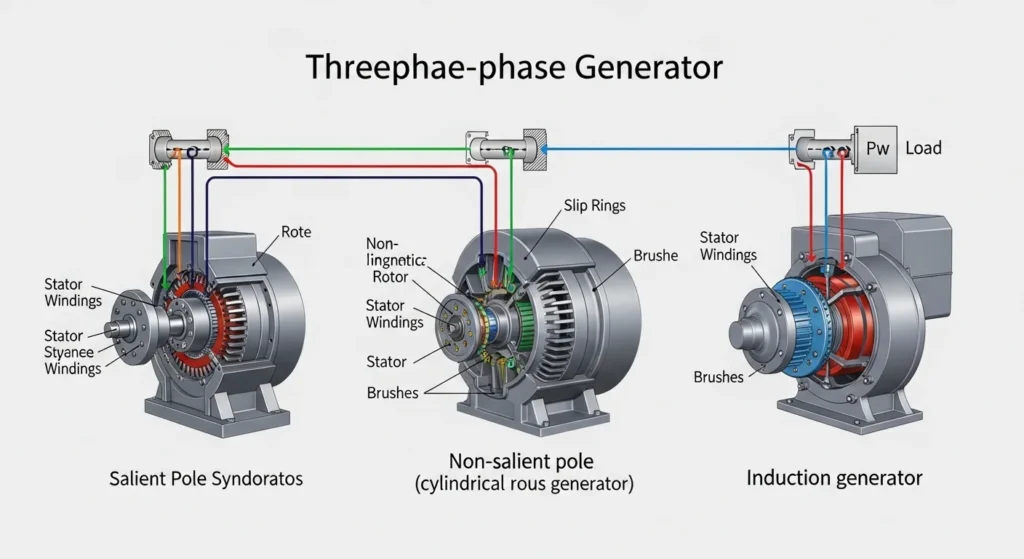
There are several three phase generator types based on design and application.
Synchronous Three Phase Generator
A synchronous generator operates at a constant speed that matches the electrical frequency.
Features:
- Stable voltage output
- High efficiency
- Commonly used in power plants
These generators are widely used for large-scale electricity generation.
Induction Three Phase Generator
An induction generator works using the same principle as an induction motor but in reverse.
Features:
- Simple design
- Low maintenance
- Reliable operation
These generators are often used in wind energy systems.
Brushless Three Phase Generator
Brushless generators eliminate brushes and slip rings.
Features:
- Lower maintenance
- Higher reliability
- Longer lifespan
These are commonly used in modern standby generators.
Permanent Magnet Three Phase Generator
These generators use permanent magnets to create the magnetic field.
Features:
- High efficiency
- Compact design
- Used in renewable energy systems
Wind turbines often use permanent magnet generators.
5. Main Components
A three phase generator consists of several important parts.
1. Stator
The stator is the stationary part of the generator.
It contains three separate windings where electrical voltage is produced.
2. Rotor
The rotor is the rotating part that creates a magnetic field.
It rotates inside the stator.
3. Shaft
The shaft transfers mechanical energy from the engine or turbine to the rotor.
4. Bearings
Bearings support the rotating shaft and reduce friction.
5. Voltage Regulator
The voltage regulator maintains constant output voltage.
6. Cooling System
Cooling systems prevent overheating during operation.
6. Advantages
Understanding three phase generator advantages and disadvantages helps engineers evaluate system performance.
Advantages
- High power output capability
- More efficient than single phase generators
- Smooth and continuous power supply
- Suitable for heavy industrial loads
- Lower power losses during transmission
Three phase systems are widely preferred in industrial environments because of these advantages.
7. Disadvantages / Limitations
Although three phase generators are very useful, they also have some limitations.
Disadvantages
- Higher installation cost
- More complex design
- Requires skilled technicians for installation
- Not necessary for small household loads
Despite these limitations, they remain essential for large electrical systems.
8. Applications
The three phase generator applications are extensive in modern electrical systems.
Industrial Applications
- Manufacturing factories
- Heavy machinery operation
- Large motors
Commercial Applications
- Hospitals
- Shopping malls
- Office buildings
Power Generation
- Hydroelectric plants
- Thermal power plants
- Wind energy systems
Backup Power Systems
Three phase generators are commonly used as backup power systems for critical facilities.
9. Comparison Section
Many students want to understand the difference between single phase and three phase generators.
| Feature | Single Phase Generator | Three Phase Generator |
|---|---|---|
| Power Output | Lower | Higher |
| Efficiency | Moderate | High |
| Applications | Homes | Industry and large buildings |
| Cost | Lower | Higher |
| Stability | Less stable | More stable |
Three phase generators are generally used where large power demand exists.
10. Selection Guide
Choosing the right three phase generator type requires careful consideration.
Important Factors
- Power requirement
- Type of load
- Installation location
- Fuel source
- Maintenance requirements
Tips for Beginners
- Calculate total electrical load before choosing a generator.
- Select reliable brands with proper voltage regulation.
- Consider future expansion needs.
- Ensure proper safety protection systems.
Proper selection ensures reliable and efficient power generation.
11. Common Problems & Solutions
Q1: Why does a generator produce unstable voltage?
This may happen due to a faulty voltage regulator.
Solution: Check and replace the voltage regulator if necessary.
Q2: Why does the generator overheat?
Overheating can occur due to overloading or poor ventilation.
Solution: Reduce load and improve cooling.
Q3: Why does the generator fail to start?
Possible causes include fuel issues or battery problems.
Solution: Check fuel supply and starting system.
Q4: Why does the generator produce unusual noise?
Noise may indicate mechanical issues such as worn bearings.
Solution: Inspect and maintain mechanical components regularly.
12. Future Trends
The future of three phase generator technology is evolving rapidly.
Renewable Energy Integration
More generators are being designed for renewable energy sources like wind and hydroelectric power.
Smart Generator Systems
Modern generators now include smart monitoring systems that track performance and detect faults.
Improved Efficiency
New designs aim to reduce energy losses and improve electrical output.
These technological advancements will make generators more efficient and environmentally friendly.
13. Conclusion
Three phase generators are essential machines in modern electrical power systems. They provide stable, efficient, and high-capacity electricity for industries, commercial buildings, and power plants. By generating three alternating currents separated by 120 degrees, they ensure smooth power delivery and improved efficiency compared to single phase systems.
Understanding three phase generator types, their working principle, components, and applications is important for electrical students and technicians. Each generator type—such as synchronous, induction, brushless, and permanent magnet generators—has specific advantages depending on the application.
Although these generators may involve higher installation costs and more complex design, their reliability and efficiency make them the preferred choice for large-scale electrical systems. With the growth of renewable energy and smart technologies, three phase generators will continue to play a critical role in modern power generation.