
Imagine electricity being generated at a power plant. The voltage produced by the generator may be around 11 kV. If we try to send this voltage directly over long distances, huge energy losses will occur in transmission lines. The solution is simple but powerful — increase the voltage before transmission.
This is where a step up transformer plays a critical role.
Understanding what is step up transformer is essential for electrical students, engineers, and technicians. Without step-up transformers, modern power transmission systems would not be efficient or economical. They allow electrical energy to travel hundreds of kilometers with minimal loss.
In this article, you will learn what is step up transformer, its working principle, types, main components, applications, advantages and disadvantages, comparison with related transformers, selection guide, and future trends. I will explain everything in simple and clear language, just like I would explain to a junior engineer in the field.
2. What Is Step Up Transformer?
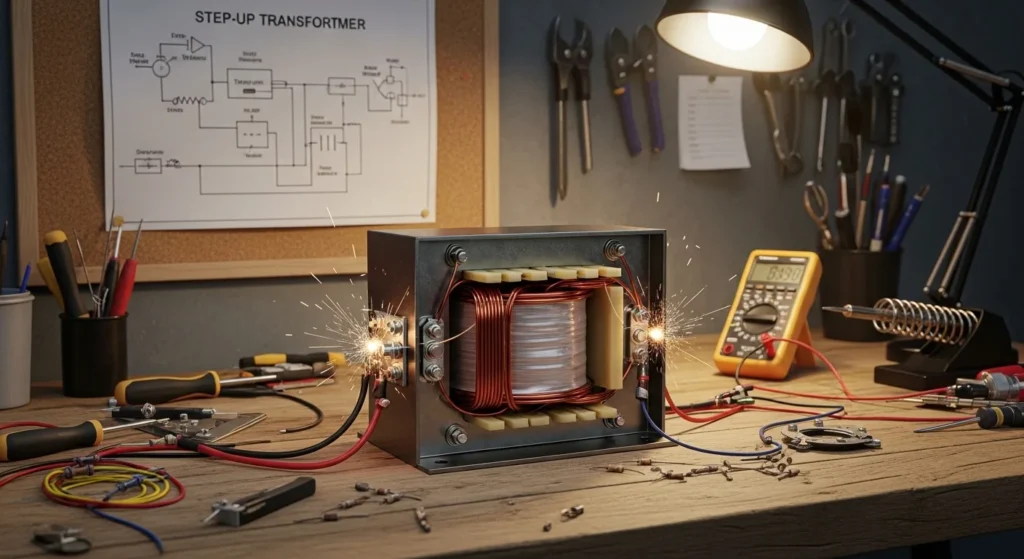
A step up transformer is an electrical device that increases voltage from the primary side to the secondary side while decreasing current.
In simple words, it takes low voltage electricity and converts it into higher voltage electricity.
The key characteristic of a step-up transformer is:
- Secondary voltage > Primary voltage
- Secondary turns > Primary turns
Practical Example
In a power station, electricity generated at 11 kV is stepped up to 132 kV or higher for transmission. This reduces current and minimizes line losses.
So when someone asks, “what is step up transformer?”, the simple answer is:
It is a transformer that increases voltage for efficient power transmission.
3. Step Up Transformer Working Principle
To understand the step up transformer working principle, we must understand electromagnetic induction.
A transformer works based on Faraday’s Law of Electromagnetic Induction.
Simple Analogy
Think of two coils placed close together. When electricity flows in the first coil, it creates a magnetic field. This magnetic field transfers energy to the second coil.
Step-by-Step Working Principle
- AC voltage is applied to the primary winding.
- Alternating current creates a changing magnetic field in the core.
- The magnetic field links with the secondary winding.
- Voltage is induced in the secondary coil.
- Because the secondary has more turns, induced voltage is higher.
Voltage ratio formula:
Vs / Vp = Ns / Np
Where:
Vs = Secondary voltage
Vp = Primary voltage
Ns = Secondary turns
Np = Primary turns
If secondary turns are double, voltage becomes double.
This explains the step up transformer working principle clearly.
4. Types / Classification
Step-up transformers can be classified based on application and construction.
1. Power Step-Up Transformer
Used in power generation stations.
Handles high voltage and large power.
2. Distribution Step-Up Transformer
Used in smaller systems.
Moderate voltage increase.
3. Instrument Step-Up Transformer
Used in measurement systems.
Increases low voltage signals.
4. Auto Step-Up Transformer
Uses single winding.
More compact and efficient for small voltage increases.
Each type serves different step up transformer applications.
5. Main Components
A step-up transformer consists of several key parts.
1. Primary Winding
Receives input voltage.
Has fewer turns in step-up transformer.
2. Secondary Winding
Delivers output voltage.
Has more turns than primary.
3. Magnetic Core
Usually made of laminated silicon steel.
Provides path for magnetic flux.
4. Insulation
Prevents short circuits between windings.
5. Cooling System
Oil or air cooling system removes heat.
Each component ensures safe and efficient operation.
6. Step Up Transformer Advantages and Disadvantages
Advantages
- Reduces transmission losses
- Improves efficiency of power delivery
- Enables long-distance transmission
- Simple and reliable design
- Requires low maintenance
Disadvantages / Limitations
- Cannot operate on DC supply
- Large size for high power ratings
- Installation cost can be high
- Energy losses due to core and copper losses
Understanding step up transformer advantages and disadvantages helps in proper system planning.
7. Applications
Step up transformer applications are found in many areas.
Power Generation
Used in power plants to increase voltage before transmission.
Renewable Energy Systems
Solar and wind plants use step-up transformers to connect to grid.
Industrial Applications
Used where machines require higher voltage.
Electronics
Used in small circuits requiring voltage boost.
Without step-up transformers, efficient power systems would not be possible.
8. Comparison Section
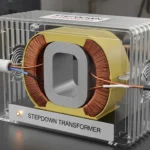
Many students ask about the difference between step up transformer and step down transformer.
| Feature | Step Up Transformer | Step Down Transformer |
|---|---|---|
| Voltage | Increases voltage | Decreases voltage |
| Turns Ratio | Secondary > Primary | Primary > Secondary |
| Current | Decreases current | Increases current |
| Application | Transmission | Distribution |
| Example | Power plant output | Household supply |
This table clearly explains the difference between step up transformer and step down transformer.
9. Selection Guide
Selecting the right transformer requires careful consideration.
1. Voltage Rating
Choose based on required output voltage.
2. Power Rating (kVA)
Must handle load demand safely.
3. Cooling Type
Air cooled for small systems.
Oil cooled for high power.
4. Insulation Level
Must match system voltage.
Tips for Beginners
- Never overload transformer.
- Ensure proper grounding.
- Install in ventilated area.
- Follow manufacturer specifications.
Proper selection ensures long life and efficiency.
10. Common Problems & Solutions
Q1: Why is transformer overheating?
Possible overload or poor cooling.
Q2: Can step up transformer work on DC?
No. It requires AC supply.
Q3: Why voltage is lower than expected?
Possible winding damage or low input voltage.
Q4: Why humming sound occurs?
Due to magnetic vibration in core.
Q5: How to maintain transformer?
Regular inspection, oil testing, and cleaning.
Preventive maintenance increases reliability.
11. Future Trends
Transformer technology is improving.
Smart Transformers
Equipped with sensors and monitoring systems.
Eco-Friendly Insulation
New insulating materials reduce environmental impact.
Compact Designs
Improved materials reduce size and weight.
Renewable Energy Integration
Modern grids use advanced step up transformer applications for solar and wind systems.
The future focuses on efficiency and smart monitoring.
12. Conclusion
Understanding what is step up transformer is fundamental for electrical engineering students and professionals. A step-up transformer increases voltage and reduces current, enabling efficient long-distance power transmission. We explored the step up transformer working principle, types, components, applications, advantages and disadvantages, and comparison with step-down transformers.
As a junior engineer, remember that transformers are the backbone of power systems. Proper selection, installation, and maintenance ensure reliable operation. Mastering the concept of what is step up transformer will strengthen your foundation in electrical power systems and prepare you for real-world engineering challenges.