
Imagine you are installing a three-phase motor in a workshop. You open the motor terminal box and see six terminals with metal links. The nameplate shows: “Star/Delta – 400/690V.” If you connect it incorrectly, the motor may draw excessive current or fail to start properly.
This is where understanding Star and Delta Connection becomes essential.
In three-phase electrical systems, the way we connect windings determines voltage, current, and performance. Star and Delta are the two most common connection methods used in motors, generators, and transformers. Choosing the correct connection directly affects safety, efficiency, and equipment life.
In this article, you will learn the Star and Delta Connection working principle, types, components, applications, advantages and disadvantages, the difference between star and delta connection, selection tips, and troubleshooting guidance. I will explain everything in simple language, just like a senior engineer guiding a junior technician in the field.
2. What is Star and Delta Connection?
Star and Delta Connection are two different methods of connecting three-phase windings in electrical systems.
Simple Definition
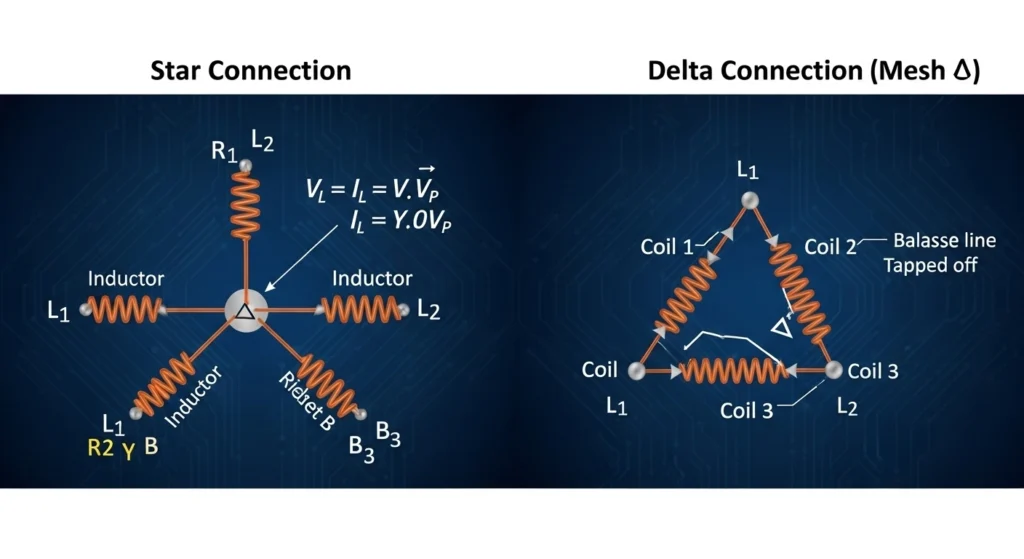
- Star Connection (Y Connection): One end of each winding is connected together at a common point called the neutral point.
- Delta Connection (Δ Connection): The end of each winding is connected to the start of the next, forming a closed loop.
Simple Explanation
In a three-phase system, we have three coils or windings. How we connect those coils changes the voltage and current behavior.
Practical Example
In a three-phase motor:
- At starting, it may be connected in Star to reduce current.
- After gaining speed, it switches to Delta for full power.
This is known as a Star-Delta starter.
3. Star and Delta Connection Working Principle
The Star and Delta Connection working principle depends on how voltage and current are distributed across windings.
Let us understand step-by-step.
Star Connection Working
- Three windings are used.
- One end of each winding is joined at a common neutral point.
- The other three ends are connected to the three-phase supply.
- Line voltage is √3 times the phase voltage.
- Line current equals phase current.
Delta Connection Working
- Three windings are connected end-to-end.
- They form a closed triangle (loop).
- Three supply lines are connected at each junction.
- Line voltage equals phase voltage.
- Line current is √3 times the phase current.
Easy Analogy
Think of three water pumps:
- In Star, all pumps share a common return pipe.
- In Delta, each pump connects to the next in a circular loop.
The arrangement changes how pressure (voltage) and flow (current) behave.
4. Types / Classification
4.1 Star (Y) Connection
In Star connection:
- Neutral point is available.
- Suitable for high-voltage, low-current applications.
- Common in power distribution systems.
Used where neutral grounding is required.
4.2 Delta (Δ) Connection
In Delta connection:
- No neutral point.
- Suitable for low-voltage, high-current applications.
- Common in motors and industrial loads.
Provides better torque in motors.
4.3 Star-Delta Starter
A combination method used in motors.
- Motor starts in Star (reduced current).
- Then switches to Delta (full power).
This reduces starting current and mechanical stress.
5. Main Components
To understand Star and Delta systems, you must know their key elements.
5.1 Three-Phase Windings
- Three separate coils
- 120° electrical phase difference
- Create rotating magnetic field in motors
5.2 Neutral Point (Star Only)
- Common junction point
- Allows grounding
- Provides phase-to-neutral voltage
5.3 Line Conductors
- Three supply wires (R, Y, B)
- Carry current from source
5.4 Terminal Links (Motor Applications)
- Metal connectors
- Used to configure Star or Delta
- Located inside motor terminal box
Each component plays an important role in system performance.
6. Star and Delta Connection Advantages
Understanding the Star and Delta Connection advantages and disadvantages is very important.
Star Connection Advantages
- Neutral point available
- Lower phase voltage
- Reduced insulation stress
- Suitable for high-voltage transmission
- Lower starting current in motors
Delta Connection Advantages
- Higher power output
- Better starting torque
- No neutral required
- Suitable for heavy loads
- Can continue operating even if one phase fails (open delta)
Real-World Benefits
- Flexible system design
- Efficient motor starting
- Balanced three-phase supply
7. Disadvantages / Limitations
Star Connection Limitations
- Lower torque in motors
- Requires more insulation for line voltage
- Not ideal for heavy loads
Delta Connection Limitations
- No neutral point
- Higher starting current
- Greater insulation stress
- More heating at start
Engineers must evaluate these practical limitations before choosing.
8. Star and Delta Connection Applications
The Star and Delta Connection applications are widely seen in electrical systems.
8.1 Power Distribution
- Star connection in substations
- Provides neutral for domestic supply
8.2 Three-Phase Motors
- Delta for running condition
- Star for starting condition
8.3 Transformers
- Star-Delta transformer connections
- Used for voltage conversion
8.4 Generators
- Star connection for grounding
- Improves system stability
8.5 Industrial Machinery
- Pumps
- Compressors
- Conveyor systems
These connections are fundamental in modern electrical engineering.
9. Comparison Section
Difference Between Star and Delta Connection
Many students ask about the difference between star and delta connection.
| Feature | Star Connection | Delta Connection |
|---|---|---|
| Symbol | Y | Δ |
| Neutral | Available | Not available |
| Line Voltage | √3 × Phase Voltage | Equal to Phase Voltage |
| Line Current | Equal to Phase Current | √3 × Phase Current |
| Starting Current | Low | High |
| Torque | Low | High |
| Application | Transmission | Motors & heavy loads |
This difference between star and delta connection is essential for system design.
10. Selection Guide
Choosing the correct connection depends on system requirements.
1. Voltage Level
- High voltage → Star
- Low voltage → Delta
2. Load Type
- Heavy load motors → Delta
- Light load or starting → Star
3. Neutral Requirement
- If neutral is needed → Star
4. Starting Current Limitation
- If starting current must be reduced → Use Star-Delta starter
5. Insulation Consideration
Higher voltage requires better insulation.
For beginners: Always check motor nameplate before connection.
11. Common Problems & Solutions
Q1: Motor not starting in Delta?
Reason: Incorrect terminal link connection.
Solution: Recheck wiring diagram.
Q2: Excessive starting current?
Reason: Direct Delta starting.
Solution: Use Star-Delta starter.
Q3: Unbalanced voltage in Star system?
Reason: Neutral issue.
Solution: Check grounding.
Q4: Motor overheating?
Reason: Wrong connection for rated voltage.
Solution: Verify supply voltage and connection type.
Q5: Fuse blowing repeatedly?
Reason: Short circuit between windings.
Solution: Insulation resistance test required.
Practical troubleshooting saves equipment from damage.
12. Future Trends
Electrical systems are becoming smarter.
Smart Motor Starters
Digital monitoring of current and voltage.
Automated Switching
PLC-based Star-Delta control systems.
Energy-Efficient Designs
Optimized winding design for lower losses.
Smart Grid Integration
Advanced transformer configurations.
Future systems will focus on energy efficiency and automation.
13. Conclusion
Star and Delta Connection are fundamental concepts in three-phase electrical systems. They determine how voltage and current behave in motors, transformers, and power distribution networks.
Understanding the Star and Delta Connection working principle, applications, and the difference between star and delta connection is essential for every electrical professional.
Each method has its own advantages and disadvantages. Star offers lower starting current and neutral availability, while Delta provides higher torque and power output. Selecting the correct configuration ensures safety, efficiency, and long equipment life.
As an electrical engineer, mastering these basics will strengthen your foundation and improve your practical skills in real-world installations.