
Imagine a hospital during a sudden power outage. Critical medical equipment such as ventilators, monitoring systems, and emergency lighting must continue working without interruption. In such situations, a reliable backup power system becomes essential. This is where a Standby Generator plays a crucial role.
A standby generator is a permanently installed backup power system designed to automatically supply electricity during a power failure. Unlike portable generators, standby generators operate automatically and can power an entire building within seconds after a power outage. They are commonly used in hospitals, data centers, homes, industries, and commercial buildings.
In modern electrical systems, uninterrupted power supply is extremely important. Power failures can cause data loss, equipment damage, production delays, and safety risks. A standby generator ensures that important operations continue even when the main utility power is unavailable.
For electrical students, engineers, technicians, and beginners, understanding the Standby Generator working principle is very important. In this article, you will learn what a standby generator is, how it works, its types, components, and major Standby Generator applications. We will also explain the Standby Generator advantages and disadvantages, troubleshooting tips, and future developments in backup power technology.
What is a Standby Generator?
A Standby Generator is a permanently installed backup power generator that automatically provides electricity when the main power supply fails.
Clear Definition
A standby generator is an automatic electrical generator system connected to a building’s electrical system that starts automatically during a power outage.
Simple Explanation
Unlike portable generators that require manual starting, standby generators detect a power failure and start automatically to supply electricity.
Practical Example
For example, in a residential house with a standby generator installed, when the main electricity supply stops, the generator automatically starts and supplies power to essential appliances such as lights, refrigerators, and security systems.
Standby Generator Working Principle
The Standby Generator working principle involves automatic power detection, generator startup, and power supply switching.
Step-by-Step Working Process
- Power Monitoring
- An automatic transfer switch constantly monitors the main utility power.
- Power Failure Detection
- When the system detects a power outage, it immediately sends a signal to start the generator.
- Generator Startup
- The generator engine starts automatically and begins producing electricity.
- Power Transfer
- The automatic transfer switch disconnects the main supply and connects the generator power to the building.
- Power Supply to Loads
- The generator supplies electricity to the connected circuits.
- Utility Power Restoration
- When the main power returns, the transfer switch reconnects the building to the utility supply.
Simple Analogy
Think of a standby generator like an emergency backup system in a hospital. When the main system stops working, the backup system immediately takes over to ensure everything continues running smoothly.
Types of Standby Generator
Standby generators are classified based on their size, fuel type, and application.
Air-Cooled Standby Generator
Air-cooled generators use air to cool the engine.
Features:
- Smaller size
- Lower cost
- Suitable for residential homes
These generators are commonly used in houses and small offices.
Liquid-Cooled Standby Generator
Liquid-cooled generators use coolant to maintain engine temperature.
Features:
- Higher power capacity
- Better cooling efficiency
- Suitable for industrial use
They are used in hospitals, factories, and large buildings.
Diesel Standby Generator
Diesel generators use diesel fuel for operation.
Features:
- High efficiency
- Long operating life
- Reliable performance
They are widely used in industries and large facilities.
Natural Gas Standby Generator
Natural gas generators operate using gas supplied through pipelines.
Features:
- Continuous fuel supply
- Cleaner operation
- Lower fuel storage requirements
They are popular for residential and commercial backup systems.
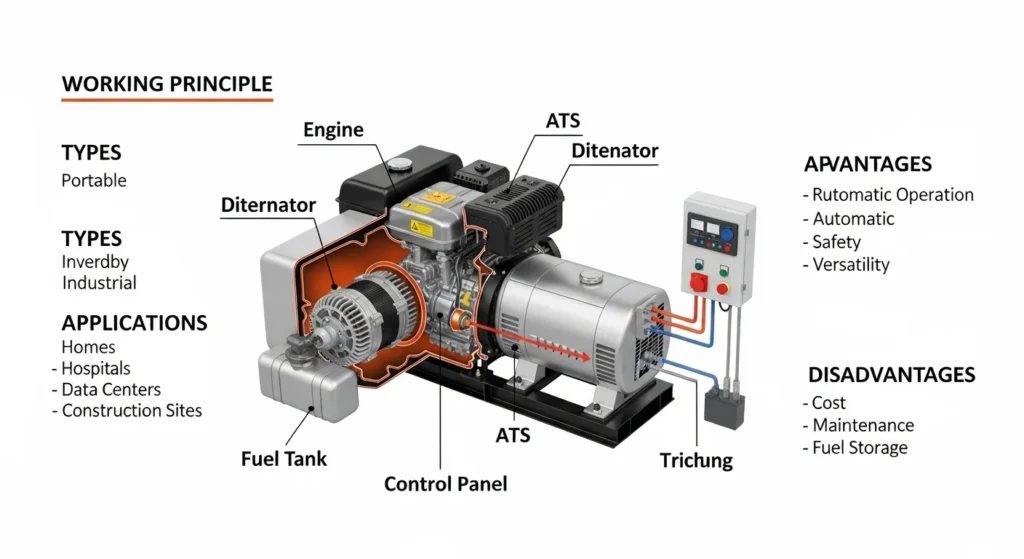
Main Components of a Standby Generator
A standby generator system consists of several important components.
Engine
The engine provides mechanical power by burning fuel.
Function:
- Drives the alternator.
Alternator
The alternator converts mechanical energy into electrical energy.
Function:
- Generates AC electricity.
Automatic Transfer Switch (ATS)
The ATS automatically switches the power source.
Function:
- Transfers electrical load between utility power and generator.
Fuel System
The fuel system stores and supplies fuel to the engine.
Function:
- Ensures continuous generator operation.
Control Panel
The control panel monitors generator operation.
Function:
- Displays voltage, current, and system status.
Cooling System
The cooling system prevents overheating.
Function:
- Maintains safe operating temperature.
Standby Generator Advantages
Understanding Standby Generator advantages and disadvantages helps engineers select suitable backup power solutions.
Advantages
- Automatic power backup during outages
- Reliable and continuous power supply
- Protects sensitive equipment
- Suitable for residential and industrial use
- Higher power capacity than portable generators
- Improves safety and productivity
Real-World Benefits
Standby generators ensure uninterrupted operations in hospitals, factories, offices, and homes.
Standby Generator Disadvantages / Limitations
Although standby generators are very useful, they also have some limitations.
Limitations
- High installation cost
- Requires regular maintenance
- Permanent installation required
- Fuel consumption during long outages
However, these disadvantages are usually acceptable considering the reliability they provide.
Standby Generator Applications
There are many important Standby Generator applications in modern electrical systems.
Residential Homes
Standby generators provide backup power for lighting, appliances, and security systems.
Hospitals
Hospitals rely on standby generators to power life-saving medical equipment.
Data Centers
Data centers use standby generators to protect important data and servers.
Industrial Plants
Factories use standby generators to avoid production interruptions.
Commercial Buildings
Offices and shopping centers install standby generators for reliable power supply.
Comparison: Standby Generator vs Portable Generator
Understanding the difference between standby generator and portable generator helps users select the correct system.
| Feature | Standby Generator | Portable Generator |
|---|---|---|
| Installation | Permanent | Temporary |
| Operation | Automatic | Manual |
| Power Capacity | High | Limited |
| Cost | Higher | Lower |
| Application | Homes and industries | Temporary backup |
Key Difference
The main difference between standby generator and portable generator is that standby generators operate automatically and are permanently installed systems.
Selection Guide
Choosing the right standby generator requires careful planning.
Power Capacity
Calculate the total electrical load of the building.
Fuel Type
Select a fuel source such as diesel, natural gas, or propane.
Automatic Transfer Switch
Ensure the generator includes a reliable ATS system.
Installation Location
Install the generator in a well-ventilated and safe location.
Maintenance Requirements
Choose generators with easy maintenance features.
Tips for Beginners
- Always consider future load expansion.
- Choose generators from reputable manufacturers.
- Follow electrical safety standards during installation.
Common Problems & Solutions
Why does the standby generator fail to start?
Possible reasons:
- Low fuel level
- Battery failure
- Faulty starter motor
Solution: Check fuel supply and battery condition.
Why is the generator overheating?
Possible causes:
- Cooling system failure
- Poor ventilation
Solution: Inspect cooling components and airflow.
Why does the generator shut down automatically?
Modern generators include safety protection systems.
Solution: Check for overload or low oil level.
Why is voltage output unstable?
Possible causes include alternator problems or control system faults.
Solution: Inspect electrical connections and voltage regulator.
Future Trends in Standby Generator Technology
Backup power technology continues to evolve.
Smart Generator Monitoring
Modern generators include remote monitoring and mobile control.
Hybrid Power Systems
Future systems may combine standby generators with solar and battery storage.
Low-Emission Engines
Manufacturers are developing environmentally friendly generators.
Advanced Automation
Improved control systems will increase efficiency and reliability.
Conclusion
A Standby Generator is an essential backup power system that automatically supplies electricity during power outages. These generators play a critical role in ensuring continuous operation of homes, hospitals, industries, and commercial buildings.
Understanding the Standby Generator working principle helps electrical students and technicians appreciate how modern backup power systems operate. Standby generators offer reliable power, automatic operation, and high power capacity, making them a preferred choice for critical power applications.
Although they require higher installation costs and regular maintenance, their ability to provide uninterrupted electricity makes them extremely valuable in modern electrical systems.
As technology advances, standby generators will continue to improve with smarter monitoring systems, cleaner energy solutions, and integration with renewable power technologies.