
Imagine you are repairing a broken mobile charger or assembling a small electronic circuit for a college project. You connect the wires carefully, but they still need a strong electrical joint to work properly. This is where a soldering iron becomes an essential tool.
A soldering iron is one of the most commonly used tools in electrical and electronics work. It helps create reliable electrical connections between wires, components, and circuit boards. Without proper soldering, many electronic devices such as televisions, computers, and mobile phones would not function correctly.
For electrical students, engineers, technicians, and hobbyists, understanding the soldering iron working principle and proper usage is extremely important. A well-soldered joint ensures good electrical conductivity and mechanical strength.
In this article, you will learn everything about a soldering iron, including its definition, working principle, types, components, applications, advantages and disadvantages. You will also learn how to choose the right soldering iron and solve common problems during soldering work.
What is a Soldering Iron?
A soldering iron is a handheld electrical tool used to melt solder (a metal alloy) in order to join two or more electrical components together.
In simple terms, a soldering iron works like a small heated pen that melts solder so that electrical connections can be formed between wires or electronic components.
The solder melts when it touches the heated tip of the soldering iron. Once it cools down, it solidifies and forms a strong electrical and mechanical connection.
Practical Example
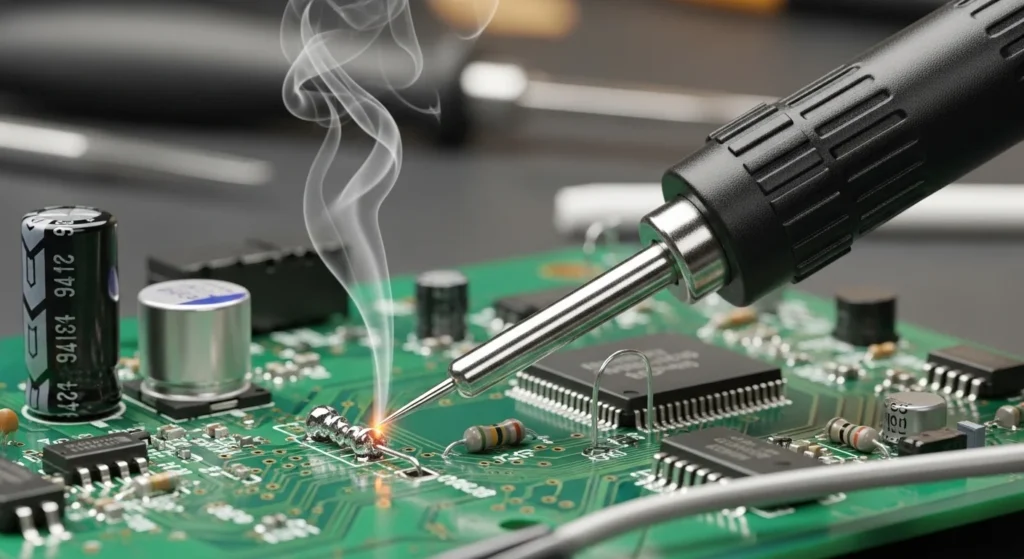
Suppose an electrical technician wants to connect a resistor to a printed circuit board (PCB). The technician heats the joint using a soldering iron and applies solder. The melted solder flows around the connection and creates a secure bond.
This is a basic example of how soldering irons are used in electronics repair and manufacturing.
Soldering Iron Working Principle
The soldering iron working principle is based on converting electrical energy into heat energy.
This heat melts solder, which then joins electronic components together.
Step-by-Step Working Process
- Electric power supplyThe soldering iron is connected to a power source, usually AC mains electricity.
- Heating element activationInside the soldering iron there is a heating element. When electricity flows through it, heat is produced due to electrical resistance.
- Heat transfer to tipThe heat generated by the heating element is transferred to the metal tip of the soldering iron.
- Melting the solderWhen the heated tip touches the solder wire, the solder melts and flows over the joint.
- Formation of solder jointAfter removing the soldering iron, the molten solder cools and solidifies, creating a strong electrical connection.
Simple Analogy
You can think of a soldering iron like a hot glue gun. Just as glue melts and sticks materials together, solder melts and connects electronic components.
Types of Soldering Iron
Different types of soldering irons are available depending on the application and level of precision required.
Pencil Soldering Iron
This is the most common type used by beginners and technicians.
It has a simple design and heats continuously when connected to power. Pencil soldering irons are affordable and suitable for small electronic repairs.
Temperature Controlled Soldering Iron
This type allows users to adjust the temperature according to the soldering task.
It provides better control and prevents overheating of sensitive electronic components.
Soldering Station
A soldering station includes a soldering iron connected to a control unit that regulates temperature.
These are widely used in professional electronics workshops and laboratories.
Cordless Soldering Iron
Cordless soldering irons operate using rechargeable batteries or gas.
They are useful for fieldwork where electrical power may not be available.
Soldering Gun
A soldering gun heats up very quickly and is used for heavy electrical work such as joining thick wires.
Main Components of a Soldering Iron
Understanding the parts of a soldering iron helps technicians use it effectively.
Heating Element
The heating element is the part that converts electrical energy into heat.
It is usually made from materials that can withstand high temperatures.
Soldering Tip
The soldering tip is the metal end of the soldering iron that transfers heat to the solder.
Different tip shapes are available for different types of work.
Handle
The handle provides insulation and allows the user to hold the soldering iron safely.
It is usually made of heat-resistant plastic or rubber.
Power Cord
The power cord connects the soldering iron to the electricity supply.
Temperature Controller
In advanced soldering irons, a temperature controller regulates the heat level to avoid overheating.
Advantages of a Soldering Iron
The soldering iron advantages and disadvantages should be understood before using the tool.
Advantages
- Provides strong electrical connections
- Simple and easy to use
- Affordable and widely available
- Essential for electronics repair
- Portable and lightweight
- Suitable for precise electronic work
- Used in both small repairs and large manufacturing
Because of these benefits, soldering irons are used by professionals and beginners alike.
Disadvantages / Limitations
Despite its usefulness, a soldering iron also has some limitations.
- Requires proper skill to avoid poor joints
- Risk of burns due to high temperature
- Overheating may damage electronic components
- Not suitable for very large metal joining tasks
- Requires ventilation due to solder fumes
Understanding these limitations helps technicians work safely and efficiently.
Soldering Iron Applications
The soldering iron applications are found in many industries and everyday electronics work.
Electronics Repair
Soldering irons are widely used to repair devices such as:
- Mobile phones
- Computers
- Televisions
- Chargers
Circuit Board Assembly
Manufacturers use soldering irons to assemble components on printed circuit boards.
Electrical Wiring
Technicians use soldering irons to join wires and connectors.
DIY Electronics Projects
Students and hobbyists use soldering irons for small electronic experiments and projects.
Industrial Electronics
Large-scale electronics industries use automated soldering systems for mass production.
Difference Between Soldering Iron and Soldering Gun
Understanding the difference between soldering iron and soldering gun helps in selecting the correct tool.
| Feature | Soldering Iron | Soldering Gun |
|---|---|---|
| Shape | Pen-like design | Pistol-like design |
| Heating Time | Slower heating | Very fast heating |
| Power | Lower power | Higher power |
| Applications | Electronics work | Heavy electrical connections |
| Precision | High precision | Less precise |
Both tools are useful, but soldering irons are generally preferred for delicate electronic work.
Selection Guide: How to Choose the Right Soldering Iron
Choosing the right soldering iron is important for good soldering results.
Consider Power Rating
Most small electronics work requires soldering irons between 20W and 60W.
Check Temperature Control
Temperature control helps protect sensitive components from overheating.
Choose the Right Tip
Different soldering tasks require different tip shapes such as pointed, chisel, or flat tips.
Look for Comfortable Design
A lightweight and ergonomic handle reduces hand fatigue during long work sessions.
Safety Features
Choose soldering irons with proper insulation and stable stands for safe operation.
Common Problems and Solutions
Why is my solder not melting?
Possible reasons:
- Soldering iron temperature is too low
- Tip is dirty or oxidized
- Poor contact with the joint
Solution: Clean the tip and increase temperature slightly.
Why does solder form a dull joint?
This is called a cold solder joint.
Solution: Reheat the joint properly until solder flows smoothly.
Why is my soldering tip turning black?
This happens due to oxidation.
Solution: Clean the tip regularly using a damp sponge or brass cleaner.
Why are components overheating?
This may happen if the soldering iron temperature is too high or the heating time is too long.
Solution: Use proper temperature settings and work quickly.
Future Trends in Soldering Technology
Soldering technology continues to improve with modern electronics manufacturing.
Smart Temperature Control
Modern soldering stations now include digital temperature control for precise heating.
Lead-Free Solder
Environmental regulations are encouraging the use of safer lead-free solder materials.
Automated Soldering Systems
Robotic soldering systems are widely used in large electronics manufacturing plants.
Portable Advanced Tools
New cordless soldering irons are becoming more efficient and portable for technicians.
These developments will make soldering safer, faster, and more precise.
Conclusion
A soldering iron is an essential tool for anyone working with electrical or electronic systems. It allows technicians and engineers to create strong electrical connections between wires and electronic components.
Understanding the soldering iron working principle, types, components, and applications helps users perform soldering tasks more effectively. From simple electronic repairs to complex circuit board assembly, soldering irons play a critical role in modern technology.
While the tool offers many benefits, users must also understand the soldering iron advantages and disadvantages and follow proper safety practices. Choosing the correct soldering iron and maintaining it properly ensures reliable results.
For electrical students and beginners, learning proper soldering techniques is a valuable skill that will be useful in many technical fields and real-world applications.