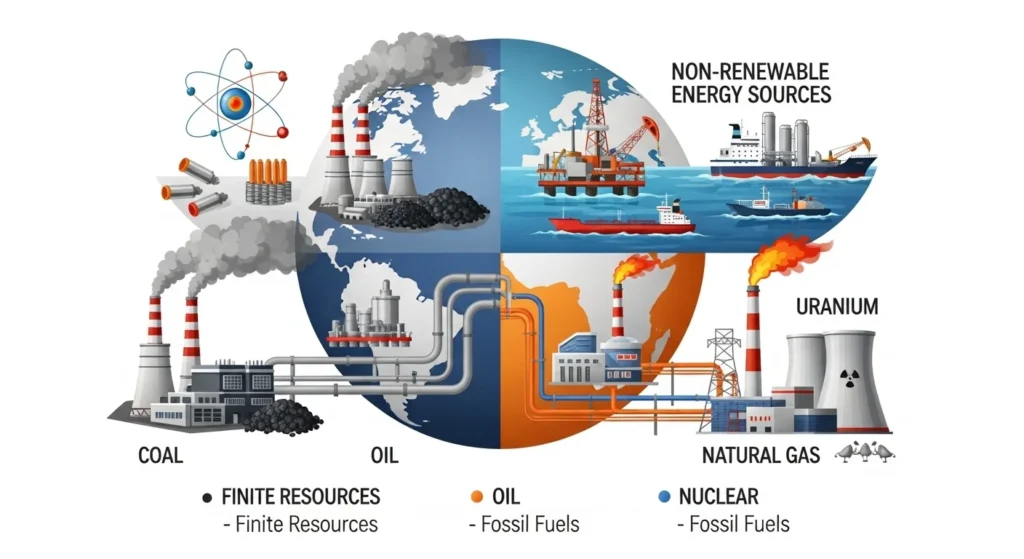

Think about a typical day in a modern city. Cars move on roads, factories produce goods, and homes are powered with electricity. Behind most of this energy supply are non-renewable energy sources such as coal, oil, natural gas, and nuclear fuel.
For more than a century, these energy sources have been the backbone of global power generation. Power plants burn fossil fuels to produce electricity, industries rely on them for heat and manufacturing processes, and transportation systems depend heavily on petroleum products.
However, non-renewable energy sources are limited in nature. They take millions of years to form, and once used, they cannot be replaced quickly. This makes it important for engineers, technicians, and energy planners to understand how they work and how they are used.
For electrical students and beginners, learning about these energy sources helps build a strong foundation in power generation and energy systems. In this article, you will learn the non-renewable energy sources working principle, types, major components, advantages, disadvantages, and real-world non-renewable energy sources applications. We will also explore the difference between renewable and non-renewable energy sources and discuss the future direction of energy systems.
What are Non-Renewable Energy Sources?
Non-renewable energy sources are natural resources that cannot be replenished quickly after they are used. These energy sources exist in limited quantities and may take millions of years to form through natural geological processes.
In simple terms, once these energy resources are consumed, they are not easily replaced within a human lifetime.
Key Characteristics
- Limited availability
- Formed over millions of years
- High energy density
- Widely used for electricity generation and fuel
Practical Example
Coal is a common example of a non-renewable energy source. It formed from ancient plants buried under the earth millions of years ago. When coal is burned in a thermal power plant, it produces heat energy that is converted into electricity.
This process powers many industries and cities around the world.
Non-Renewable Energy Sources Working Principle
The non-renewable energy sources working principle generally involves converting stored chemical or nuclear energy into heat energy, which is then transformed into electrical energy.
Most power plants follow a similar energy conversion process.
Step-by-Step Working Process
- Fuel ExtractionFossil fuels such as coal, oil, or natural gas are extracted from the earth.
- Fuel CombustionThe fuel is burned in a boiler or combustion chamber to produce heat.
- Steam GenerationHeat converts water into high-pressure steam.
- Turbine RotationSteam drives a turbine connected to a generator.
- Electricity GenerationThe generator converts mechanical energy into electrical energy.
- Power DistributionElectricity is transmitted through power lines to homes and industries.
Simple Analogy
Think of a steam engine train. Coal is burned to produce steam, which pushes pistons and moves the train. Similarly, power plants use steam to spin turbines that generate electricity.
Types / Classification of Non-Renewable Energy Sources
Non-renewable energy sources can be classified into several major types.
Coal
Coal is one of the oldest and most widely used fossil fuels.
It is mainly used in thermal power plants for electricity generation. Coal has a high carbon content and produces significant heat when burned.
Coal-based power plants still supply a large portion of global electricity.
Petroleum (Oil)
Petroleum is a liquid fossil fuel extracted from underground reservoirs.
It is refined into various products such as:
- Gasoline
- Diesel
- Kerosene
- Lubricating oil
Oil is primarily used in transportation and industrial machinery.
Natural Gas
Natural gas is a cleaner fossil fuel compared to coal and oil.
It mainly consists of methane and is used in:
- Gas power plants
- Heating systems
- Industrial processes
Natural gas power plants are known for their high efficiency and lower emissions.
Nuclear Energy
Nuclear energy is another form of non-renewable energy source.
It is produced through nuclear fission, where atoms of uranium split and release a large amount of heat energy.
This heat is used to produce steam that drives turbines and generators.
Nuclear power plants produce large amounts of electricity with very low greenhouse gas emissions.
Main Components of Non-Renewable Energy Systems
Non-renewable energy power plants include several important components.
Fuel Supply System
This system stores and transports fuel such as coal, oil, or gas to the power plant.
Boiler or Reactor
The boiler burns fuel to produce heat. In nuclear plants, the reactor produces heat through nuclear reactions.
Steam Turbine
High-pressure steam rotates the turbine blades.
This mechanical rotation is essential for electricity generation.
Generator
The generator converts mechanical energy from the turbine into electrical energy using electromagnetic induction.
Cooling System
The cooling system removes excess heat and condenses steam back into water.
Transmission System
Electricity produced by the generator is transmitted through power lines to the electrical grid.
Non-Renewable Energy Sources Advantages and Disadvantages
Understanding non-renewable energy sources advantages and disadvantages is important for energy planning.
Advantages
- High energy output from small fuel quantities
- Reliable and stable power generation
- Established infrastructure and technology
- Suitable for large-scale electricity production
- Easy fuel storage and transportation
These benefits make non-renewable energy systems practical for many power plants.
Disadvantages / Limitations
- Limited supply of fossil fuels
- Environmental pollution and greenhouse gas emissions
- Mining and drilling can damage ecosystems
- Fuel price fluctuations
- Nuclear waste disposal challenges
These limitations have encouraged the development of renewable energy alternatives.
Non-Renewable Energy Sources Applications
There are many non-renewable energy sources applications across different sectors.
Electricity Generation
Thermal power plants and nuclear power plants generate electricity using fossil fuels and nuclear energy.
Transportation
Petroleum fuels power cars, airplanes, ships, and heavy vehicles.
Industrial Processes
Many industries use fossil fuels for heating, manufacturing, and chemical production.
Residential Heating
Natural gas is commonly used for cooking and heating in homes.
Power Backup Systems
Diesel generators provide backup electricity during power outages.
Difference Between Renewable and Non-Renewable Energy Sources
Understanding the difference between renewable and non-renewable energy sources is essential for modern energy systems.
| Feature | Non-Renewable Energy | Renewable Energy |
|---|---|---|
| Availability | Limited resources | Unlimited natural sources |
| Environmental Impact | Higher pollution | Environmentally friendly |
| Sustainability | Not sustainable long term | Sustainable |
| Fuel Cost | Can fluctuate | Mostly free natural resources |
| Examples | Coal, oil, natural gas | Solar, wind, hydro |
Selection Guide
Choosing the right energy source depends on several factors.
Energy Demand
Large-scale industries often require high energy output, which non-renewable sources can provide.
Resource Availability
The availability of fossil fuels in a region affects energy planning.
Cost Considerations
Initial infrastructure costs and fuel prices must be considered.
Environmental Regulations
Government policies may limit emissions from fossil fuel power plants.
For beginners studying power systems, understanding both renewable and non-renewable energy options is essential.
Common Problems & Solutions
Why do fossil fuel power plants produce pollution?
Burning fuels releases carbon dioxide and other pollutants.
Solution: Install emission control systems such as filters and scrubbers.
Why are fuel prices unstable?
Fuel prices depend on supply, demand, and global markets.
Solution: Diversify energy sources.
Why do nuclear plants require strict safety measures?
Nuclear reactions produce radioactive materials.
Solution: Use advanced containment and safety systems.
Why is fuel transportation expensive?
Fuel must be transported over long distances.
Solution: Improve supply chain efficiency.
Future Trends
Although non-renewable energy sources are limited, technology continues to improve their efficiency and environmental performance.
Clean Coal Technology
New technologies reduce pollution from coal-based power plants.
Carbon Capture Systems
Carbon capture systems reduce greenhouse gas emissions from fossil fuel plants.
Hybrid Power Systems
Future power systems may combine renewable and non-renewable sources for better reliability.
Advanced Nuclear Reactors
Next-generation reactors aim to improve safety and reduce nuclear waste.
Energy Transition
Many countries are gradually shifting from fossil fuels toward renewable energy systems.
Conclusion
Non-renewable energy sources have powered the modern world for more than a century. Coal, oil, natural gas, and nuclear energy provide reliable and high-capacity electricity for industries, transportation, and homes.
In this article, we explored the non-renewable energy sources working principle, types, main components, advantages, disadvantages, and applications. We also examined the difference between renewable and non-renewable energy sources to understand their role in modern power systems.
While these energy sources remain essential for global energy supply, their limitations and environmental impact are encouraging the transition toward cleaner alternatives.
For electrical students, engineers, and technicians, understanding both traditional and modern energy technologies is important for designing efficient and sustainable power systems in the future.
Continuous learning in energy engineering will help professionals adapt to the evolving global energy landscape.