
Imagine entering your home after working outside on a very hot day. The temperature is high, the air feels heavy, and the room is uncomfortable. You turn on the air conditioner, and within a few minutes the room becomes cool and relaxing. Many homes and offices around the world experience this comfort through a Midea air conditioner.
Air conditioning technology has become essential for modern living, especially in regions with high temperatures. Reliable cooling systems not only improve comfort but also protect equipment, improve productivity, and support healthy indoor environments. Among many global air conditioner brands, Midea air conditioner systems are widely recognized for their affordability, energy efficiency, and modern technology.
For electrical students, engineers, technicians, and beginners, understanding how these systems work is important. A Midea air conditioner combines refrigeration technology, electrical motors, sensors, and electronic control systems in a single integrated design.
In this article, we will explain the Midea air conditioner working principle, types, main components, advantages, disadvantages, and applications. We will also discuss the difference between Midea air conditioner and other air conditioner brands, helping beginners understand where these systems fit in the HVAC industry.
What is a Midea Air Conditioner?
A Midea air conditioner is a cooling system manufactured by Midea, a global HVAC manufacturer known for producing residential and commercial air conditioning equipment.
These air conditioners are designed to remove heat from indoor air and release it outside, creating a comfortable indoor environment.
Simple Explanation
A Midea air conditioner works like a heat transfer system. Instead of creating cold air directly, it removes heat from the room and transfers it outdoors using refrigerant.
Practical Example
For example, a small apartment living room may become very hot during the summer. Installing a Midea split air conditioner allows the system to cool the room quickly while maintaining stable temperature and humidity.
Because of their reliability and energy efficiency, Midea air conditioners are widely used in homes, offices, hotels, and commercial spaces.
Midea Air Conditioner Working Principle
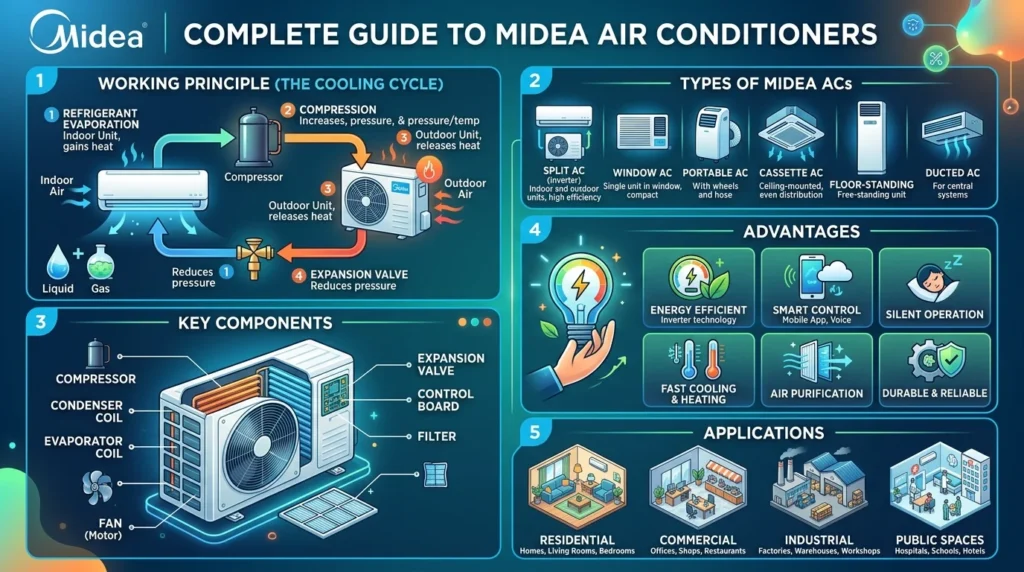
The Midea air conditioner working principle is based on the vapor compression refrigeration cycle, which is used in most modern air conditioning systems.
The system transfers heat from indoor air to the outside environment through a circulating refrigerant.
Step-by-Step Working Process
- Indoor air enters the evaporator
A fan inside the indoor unit draws warm air from the room.
- Heat absorption
The warm air passes over the evaporator coil containing cold refrigerant.
The refrigerant absorbs heat from the air.
- Refrigerant evaporation
After absorbing heat, the refrigerant changes from liquid to low-pressure gas.
- Compression stage
The compressor in the outdoor unit compresses the gas, increasing its pressure and temperature.
- Heat release through condenser
The hot refrigerant passes through the condenser coil. Outdoor air removes the heat and releases it into the environment.
- Condensation
The refrigerant cools and returns to liquid form.
- Expansion valve operation
The expansion valve lowers the refrigerant pressure and temperature.
- Cycle repeats
The refrigerant flows back to the evaporator and continues the cooling cycle.
Simple Analogy
You can imagine the air conditioner as a machine that carries heat from inside the room and throws it outside.
Types of Midea Air Conditioners
Midea manufactures several types of air conditioning systems designed for different applications.
Midea Split Air Conditioner
This is one of the most common types.
It consists of:
- Indoor unit (evaporator)
- Outdoor unit (compressor and condenser)
Split systems are popular because they are quiet and energy efficient.
Midea Window Air Conditioner
This type contains all components in a single unit.
Features include:
- Compact design
- Simple installation
- Suitable for small rooms
Midea Portable Air Conditioner
Portable air conditioners are movable units designed for temporary cooling.
Advantages include:
- Easy installation
- Mobility
- Ideal for rental spaces
Midea Cassette Air Conditioner
Cassette systems are installed in the ceiling and distribute air in multiple directions.
They are commonly used in:
- Offices
- Restaurants
- Commercial buildings
Midea Central Air Conditioning Systems
These systems are designed for large buildings, hotels, shopping malls, and industrial facilities.
They use duct systems to distribute cooled air throughout the building.
Main Components of a Midea Air Conditioner
Understanding the main components helps technicians maintain and repair the system effectively.
Compressor
The compressor is the heart of the air conditioner.
Functions include:
- Compressing refrigerant gas
- Increasing refrigerant pressure
- Circulating refrigerant through the system
Condenser Coil
The condenser coil releases heat from the refrigerant to the outdoor air.
A condenser fan improves heat transfer efficiency.
Evaporator Coil
The evaporator coil absorbs heat from indoor air.
As air passes over the coil, it becomes cooler before returning to the room.
Expansion Valve
The expansion valve reduces refrigerant pressure before it enters the evaporator.
This creates the low temperature required for cooling.
Indoor Fan
The indoor fan distributes cool air throughout the room.
Proper airflow ensures uniform cooling.
Air Filters
Air filters remove dust and particles from indoor air.
Clean filters improve air quality and system efficiency.
Electronic Control Board
Modern Midea air conditioners include electronic control systems that manage:
- Temperature settings
- Compressor operation
- Fan speed
- Safety protection functions
Midea Air Conditioner Advantages
Understanding Midea air conditioner advantages and disadvantages helps engineers evaluate their performance.
Key Advantages
- Energy-efficient operation
- Advanced inverter technology
- Quiet operation
- Modern design
- Reliable cooling performance
- Easy installation in many models
- Smart control options in newer systems
Real-World Benefits
Energy-efficient Midea air conditioners can significantly reduce electricity consumption compared to older systems.
Disadvantages / Limitations
Despite their advantages, Midea air conditioners also have some limitations.
Common Disadvantages
- Some models require professional installation
- Spare parts availability may vary by region
- Initial cost may be higher for inverter models
- Maintenance is required for optimal performance
- Incorrect installation can reduce efficiency
Understanding these limitations helps technicians maintain systems properly.
Midea Air Conditioner Applications
The Midea air conditioner applications cover a wide range of residential and commercial environments.
Residential Applications
Midea air conditioners are commonly used in:
- Bedrooms
- Living rooms
- Apartments
- Houses
Commercial Applications
In commercial spaces, they are used in:
- Offices
- Restaurants
- Retail stores
- Hotels
Industrial and Technical Applications
Midea systems may also be used for cooling:
- Server rooms
- Laboratories
- Equipment rooms
These spaces require stable temperature control to protect sensitive equipment.
Difference Between Midea Air Conditioner and Other Air Conditioner Brands
Understanding the difference between Midea air conditioner and other air conditioner brands helps buyers choose the right product.
| Feature | Midea Air Conditioner | Other Brands |
|---|---|---|
| Price | Generally affordable | Often higher |
| Technology | Advanced inverter systems | Similar technologies |
| Energy Efficiency | High efficiency models available | Varies by brand |
| Product Range | Wide variety of systems | Depends on manufacturer |
| Availability | Widely distributed globally | Depends on region |
Many customers choose Midea because it provides good performance at competitive prices.
Selection Guide
Choosing the correct air conditioner requires evaluating several technical factors.
Cooling Capacity
Cooling capacity is measured in BTU or tons.
The unit must match the room size.
Energy Efficiency
Look for models with high Energy Efficiency Ratio (EER) or inverter technology.
Installation Environment
Consider the available installation space for indoor and outdoor units.
Noise Level
For bedrooms and offices, select models designed for quiet operation.
Smart Features
Modern Midea air conditioners offer:
- Remote control
- Wi-Fi connectivity
- Smart temperature management
These features improve user convenience.
Common Problems and Solutions
Technicians frequently encounter similar issues with air conditioning systems.
Why is the Midea air conditioner not cooling properly?
Possible causes:
- Dirty air filters
- Low refrigerant level
- Blocked condenser coil
Solution: Clean filters and inspect refrigerant charge.
Why is water leaking from the indoor unit?
Cause:
Blocked condensate drain line.
Solution:
Clean the drainage pipe to restore proper water flow.
Why is the air conditioner making noise?
Possible reasons include loose mounting components or fan obstruction.
Solution:
Inspect installation brackets and fan blades.
Why does the system frequently start and stop?
Possible cause:
Thermostat sensor or control board issue.
Solution:
Check the control system and temperature sensors.
Future Trends
The HVAC industry is continuously evolving, and air conditioner technology is improving.
Smart Air Conditioning Systems
Future systems will integrate with smart homes and allow remote monitoring through mobile apps.
AI-Based Energy Optimization
Advanced systems will automatically adjust cooling based on room occupancy and weather conditions.
Eco-Friendly Refrigerants
New refrigerants are being developed to reduce environmental impact.
Higher Energy Efficiency
Next-generation inverter compressors will further reduce energy consumption.
These innovations will make air conditioning systems more efficient, intelligent, and environmentally friendly.
Conclusion
Midea air conditioners have become an important part of modern HVAC solutions. Their combination of affordability, energy efficiency, and advanced technology makes them suitable for homes, offices, and commercial buildings.
In this article, we explored the Midea air conditioner working principle, types, components, advantages, disadvantages, and applications. Understanding these systems helps electrical students and technicians learn how refrigeration cycles, compressors, and electronic control systems work together to provide cooling.
We also discussed the difference between Midea air conditioner and other air conditioner brands, helping readers understand how these systems compare in terms of cost, technology, and performance.
For engineers and technicians, learning about air conditioning systems is essential because HVAC technology continues to play a major role in modern buildings. Proper selection, installation, and maintenance ensure reliable and efficient cooling for many years.