
Imagine a large cargo ship traveling across the ocean for several weeks. Onboard, there are navigation systems, lighting, communication equipment, refrigeration units, and safety devices that must work continuously. Even in the middle of the sea, electricity is essential for the ship’s operation. Without reliable power generation, modern ships could not function safely or efficiently.
This is where marine generators play a critical role. A marine generator produces electrical power onboard ships and marine vessels. It ensures that all electrical systems continue to operate even when the vessel is far from land-based power sources.
Understanding marine generator types is important for electrical students, engineers, and marine technicians. Different ships require different generator designs depending on power demand, fuel availability, and operating conditions.
In this article, we will explore the main marine generator types, their working principle, components, advantages and disadvantages, and real-world marine generator applications. We will also compare different types and provide practical tips for selecting the right marine generator.
By the end of this guide, you will have a clear understanding of how marine generators work and why they are essential in modern marine engineering.
2. What is a Marine Generator?
A marine generator is an electrical machine installed on ships or marine vessels to generate electricity using mechanical energy from an engine or turbine.
In simple terms, it works like a small power plant on a ship. It converts mechanical energy from fuel-powered engines into electrical power for onboard systems.
Marine generators are specially designed to operate in harsh environments such as:
- High humidity
- Saltwater exposure
- Continuous vibration
- Limited space on vessels
Practical Example
Consider a fishing vessel operating far from shore. The ship requires electricity for navigation lights, radar systems, refrigeration for fish storage, and communication equipment.
A marine generator provides this electricity continuously during the entire voyage.
Without marine generators, modern ships would not be able to operate safely or efficiently.
3. Marine Generator Working Principle
The marine generator working principle is based on electromagnetic induction. This is the same principle used in most electrical generators.
When a conductor moves within a magnetic field, it produces electrical current.
Step-by-Step Working Process
- Fuel Combustion
A diesel engine or turbine burns fuel to produce mechanical energy. - Mechanical Rotation
The engine rotates the generator shaft. - Magnetic Field Interaction
Inside the generator, a rotating magnetic field interacts with stationary coils. - Electricity Generation
This motion produces electrical current through electromagnetic induction. - Power Distribution
The generated electricity is supplied to the ship’s electrical systems.
Simple Analogy
Think of a bicycle dynamo used to power a small light. When the wheel rotates, it spins the dynamo and produces electricity. Marine generators work in a similar way but at a much larger scale.
4. Types / Classification of Marine Generators
There are several marine generator types used in ships depending on power capacity and operating conditions.
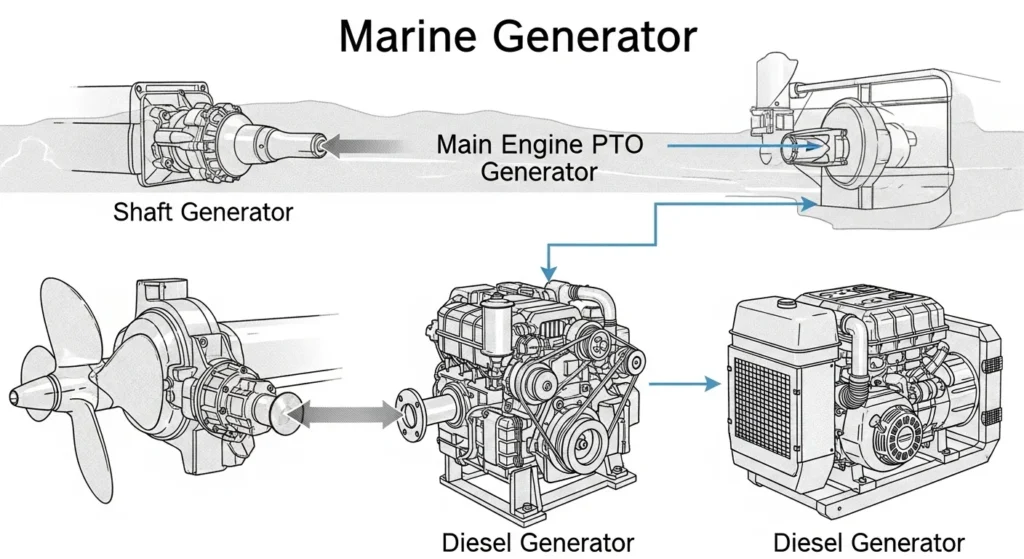
Diesel Marine Generators
Diesel generators are the most common type used in ships.
They use diesel fuel to drive an engine connected to an electrical generator.
Features
- High reliability
- Good fuel efficiency
- Suitable for continuous operation
Diesel marine generators are widely used in cargo ships, fishing vessels, and passenger ships.
Gas Turbine Generators
Gas turbine generators use a gas turbine instead of a piston engine.
Air and fuel are burned in a turbine chamber to produce high-speed rotation.
Features
- High power output
- Compact size
- Suitable for high-speed ships
These generators are often used in naval ships and large vessels requiring high power.
Shaft Generators
A shaft generator is connected directly to the ship’s main propulsion shaft.
When the ship’s main engine runs, the shaft rotates the generator and produces electricity.
Features
- Saves fuel
- Uses existing engine power
- Reduces operating costs
Shaft generators are commonly used in modern commercial vessels.
Auxiliary Generators
Auxiliary generators provide backup or additional power for ships.
They operate independently of the main propulsion system.
Features
- Backup power supply
- Reliable emergency support
- Flexible operation
They are often used in combination with main generators.
Hybrid Marine Generators
Hybrid marine generators combine traditional engines with renewable energy sources or battery systems.
Features
- Lower fuel consumption
- Reduced emissions
- Improved energy efficiency
Hybrid systems are becoming popular in environmentally friendly ships.
5. Main Components of a Marine Generator
A marine generator consists of several important parts that work together to produce electricity.
Engine
The engine provides mechanical power to rotate the generator.
Most marine generators use diesel engines because of their efficiency and durability.
Alternator
The alternator converts mechanical energy into electrical energy using electromagnetic induction.
Fuel System
The fuel system stores and supplies fuel to the engine.
It includes fuel tanks, pumps, and filters.
Cooling System
Marine generators produce heat during operation. Cooling systems prevent overheating and maintain safe operating temperatures.
Control Panel
The control panel monitors generator performance and controls voltage, frequency, and load distribution.
Voltage Regulator
This device ensures stable voltage output to protect electrical equipment on the ship.
6. Advantages of Marine Generators
Marine generators offer several practical benefits.
- Reliable power supply for ships
- Continuous operation during long voyages
- Supports navigation and safety equipment
- High durability in harsh marine environments
- Fuel-efficient operation in modern designs
- Flexible installation options for different vessel sizes
These advantages make marine generators essential for safe maritime operations.
7. Disadvantages / Limitations
Despite their importance, marine generators also have some limitations.
- High initial installation cost
- Regular maintenance required
- Fuel consumption can be significant
- Noise and vibration during operation
- Environmental emissions from fuel combustion
Understanding the marine generator advantages and disadvantages helps engineers choose the right system for each vessel.
8. Marine Generator Applications
Marine generators are used in many types of vessels and marine systems.
Cargo Ships
Provide power for navigation, lighting, communication, and cargo handling equipment.
Passenger Ships
Support air conditioning, entertainment systems, kitchens, and lighting.
Fishing Vessels
Supply electricity for refrigeration and navigation equipment.
Naval Ships
Power radar systems, weapons systems, and advanced electronics.
Offshore Platforms
Used in oil rigs and offshore installations to supply electrical power.
These marine generator applications demonstrate how critical generators are in marine industries.
9. Comparison Section
Difference Between Diesel Generator and Shaft Generator
| Feature | Diesel Generator | Shaft Generator |
|---|---|---|
| Power Source | Independent diesel engine | Ship propulsion shaft |
| Fuel Consumption | Higher | Lower |
| Operation | Works anytime | Works when engine runs |
| Installation | Separate unit | Connected to main shaft |
| Efficiency | Reliable | Very fuel-efficient |
Understanding the difference between diesel generator and shaft generator helps engineers select the appropriate system.
10. Selection Guide
Choosing the correct marine generator requires careful planning.
Consider Power Requirements
Calculate the total electrical load of the vessel including:
- Navigation equipment
- Lighting
- Refrigeration
- Communication systems
Fuel Efficiency
Select generators that offer good fuel economy to reduce operating costs.
Space Availability
Ships have limited space, so compact generator designs are often preferred.
Maintenance Needs
Choose systems with easy maintenance and reliable spare part availability.
Safety Standards
Ensure the generator meets marine safety regulations and classification society standards.
These tips help beginners select the right marine generator for specific applications.
11. Common Problems & Solutions
Q1: Why does a marine generator fail to start?
Possible causes include fuel supply issues, battery problems, or starter motor faults.
Solution: Check fuel lines, battery voltage, and starter connections.
Q2: Why is the generator overheating?
Overheating may occur due to cooling system failure or blocked air vents.
Solution: Inspect the cooling system and ensure proper ventilation.
Q3: Why does voltage fluctuate?
Voltage instability may occur due to a faulty voltage regulator or load imbalance.
Solution: Inspect the voltage regulator and balance electrical loads.
Q4: Why is the generator making excessive noise?
Excessive noise may indicate loose components or mechanical wear.
Solution: Perform regular inspections and tighten mechanical parts.
12. Future Trends in Marine Generators
Marine power generation technology continues to evolve.
Hybrid Power Systems
Many modern ships are adopting hybrid systems that combine generators with battery storage.
LNG-Powered Generators
Liquefied natural gas (LNG) generators reduce emissions and improve environmental performance.
Smart Generator Control
Digital monitoring systems allow engineers to track generator performance in real time.
Renewable Energy Integration
Some vessels are experimenting with solar panels and wind assistance systems to reduce generator load.
These innovations will improve efficiency and reduce environmental impact in the marine industry.
13. Conclusion
Marine generators are essential power sources for ships and offshore vessels. They ensure that critical systems such as navigation, lighting, communication, and safety equipment operate reliably during long voyages.
In this article, we explored different marine generator types, their working principle, key components, advantages and disadvantages, and real-world marine generator applications. We also compared common generator systems and discussed how to select the right generator for a vessel.
Understanding marine generators is an important skill for electrical students, engineers, and technicians involved in marine technology. As modern ships become more advanced, efficient and environmentally friendly generator systems will play an even greater role in maritime operations.
Continuous learning and practical experience will help engineers design safer, more efficient marine power systems for the future.