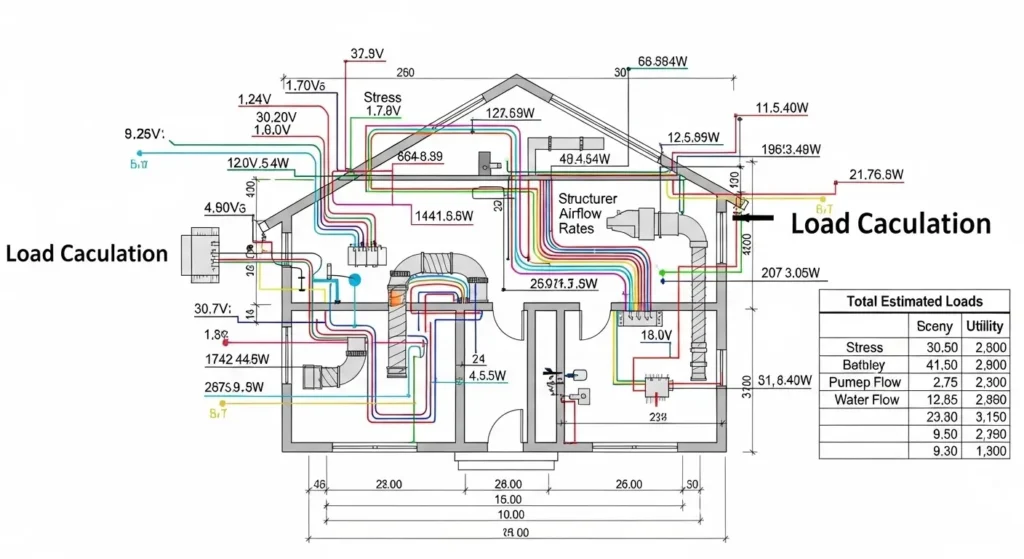

Imagine you are designing the electrical wiring for a new house. The owner wants air conditioners in every room, an electric oven in the kitchen, a water pump, and multiple lighting points. You install wiring without properly calculating the total load. After a few weeks, the main breaker starts tripping, wires heat up, and voltage becomes unstable.
This situation clearly shows the importance of Load Calculation for House.
Before selecting cables, circuit breakers, and the main distribution board, we must calculate the total electrical load of the house. Proper load calculation ensures safety, prevents overheating, reduces fire risk, and guarantees smooth operation of appliances.
In this article, you will learn the Load Calculation for House working principle, types of load calculations, components involved, practical formulas, applications, advantages and disadvantages, comparison methods, selection tips, troubleshooting, and future trends. I will explain everything in simple language, just like guiding a junior electrician at a real job site.
2. What is Load Calculation for House?
Load Calculation for House is the process of estimating the total electrical power required by all appliances, lighting, and equipment in a residential building.
Simple Definition
It is a method used to determine how much electrical power (in watts or kilowatts) a house will consume.
Simple Explanation
Every electrical appliance consumes power. When many appliances run together, the total demand increases. Load calculation helps us determine:
- Main breaker size
- Cable size
- Distribution board capacity
- Transformer requirement (if needed)
Practical Example
If a house has:
- 10 LED lights (10W each)
- 4 fans (75W each)
- 2 air conditioners (1500W each)
We calculate total power and select wiring accordingly.
3. Load Calculation for House Working Principle
The Load Calculation for House working principle is based on summing individual appliance loads and applying demand factors.
Step-by-Step Process
- List all electrical appliances.
- Note their power ratings (W or kW).
- Add total connected load.
- Apply diversity or demand factor.
- Convert total power to current.
- Select cable and breaker accordingly.
Basic Formula
Current(I)=Power(P)/Voltage(V)
For single-phase system:I=P/230V
How to calculate home load?
Calculating home electrical load means finding the total power (watts or kilowatts) used by all appliances in your house. This helps you choose the correct wiring size, circuit breaker, inverter, generator, or solar system. ⚡
Below is the simple step-by-step method electricians use.
1. List All Electrical Appliances in Your Home
Write down every appliance and its power rating (Watts). You can find it on the nameplate or label of the device.
Example list:
| Appliance | Quantity | Power (W) | Total |
|---|---|---|---|
| LED Bulb | 10 | 12 W | 120 W |
| Ceiling Fan | 5 | 75 W | 375 W |
| Refrigerator | 1 | 200 W | 200 W |
| TV | 1 | 120 W | 120 W |
| Washing Machine | 1 | 500 W | 500 W |
| Air Conditioner | 1 | 1500 W | 1500 W |
2. Multiply Power by Quantity
Use this formula:Total Load=Power×Quantity
Example:
- Fan = 75 W × 5 = 375 W
3. Add All Appliance Loads
Add all totals together.
Example:
- Lights = 120 W
- Fans = 375 W
- Refrigerator = 200 W
- TV = 120 W
- Washing Machine = 500 W
- AC = 1500 W
Total Load:120+375+200+120+500+1500=2815W
So total home load = 2815 Watts (≈ 2.8 kW)
4. Convert Watts to Kilowatts (kW)
kW=1000Watts
Example:2815W÷1000=2.8kW
5. Add Safety Margin
Electricians usually add 20–25% extra capacity.
Example:2.8kW+25%≈3.5kW
So your house needs about 3.5 kW capacity.
6. Calculate Current (Optional for Wiring)
Formula:I=VP
Where:
- I = Current (Ampere)
- P = Power (Watts)
- V = Voltage (230V in Pakistan)
Example:I=2302815≈12.2A
So the load current ≈ 12 Amps.
Quick Example (Small House)
| Appliance | Total Load |
|---|---|
| Lights | 120 W |
| Fans | 300 W |
| TV | 120 W |
| Fridge | 200 W |
Total = 740 W ≈ 0.74 kW
✅ Summary
- List all appliances
- Note their power rating (W)
- Multiply by quantity
- Add all watts
- Convert to kW
- Add 20–25% safety margin
Easy Analogy
Think of water taps in a house.
- Each tap represents an appliance.
- If all taps run at full flow, total demand is high.
- In reality, not all taps run together.
Similarly, we apply diversity factor in electrical load calculation.
4. Types / Classification
There are different methods used in Load Calculation for House.
4.1 Connected Load Calculation
This is the total power rating of all installed appliances.
Example:
If total appliances equal 15 kW, connected load is 15 kW.
4.2 Demand Load Calculation
Not all appliances run at the same time.
Demand load = Connected load × Demand factor
Used for realistic estimation.
4.3 Maximum Demand Calculation
The highest load expected at any time.
Important for selecting main breaker and service cable.
4.4 Single-Phase Load Calculation
Used in small houses.
Typically 230V supply.
4.5 Three-Phase Load Calculation
Used in large houses with heavy appliances.
Supply is 400V three-phase.
5. Main Components in Load Calculation
To perform proper Load Calculation for House, consider the following:
5.1 Lighting Load
- LED bulbs
- Tube lights
- Decorative lights
5.2 Socket Load
- TV
- Refrigerator
- Chargers
5.3 Power Load
- Air conditioners
- Geysers
- Electric ovens
5.4 Motor Load
- Water pump
- Garage motor
5.5 Future Expansion
Always consider extra capacity for future appliances.
Each component adds to total house demand.
6. Load Calculation for House Advantages
Understanding the Load Calculation for House advantages and disadvantages is essential.
Advantages
- Prevents overloading
- Reduces fire risk
- Ensures correct breaker selection
- Improves voltage stability
- Increases system reliability
- Supports future expansion
Real-World Benefits
- Safe home wiring
- Lower maintenance cost
- Stable appliance performance
Proper planning avoids electrical accidents.
7. Disadvantages / Limitations
Although very important, there are some practical limitations:
- Requires accurate appliance data
- Wrong estimation causes undersizing
- Future load may increase
- Depends on user behavior
Incorrect load calculation may cause financial loss or safety risk.
8. Load Calculation for House Applications
The Load Calculation for House applications are seen in many areas.
8.1 Residential Buildings
- Small houses
- Apartments
- Villas
8.2 Electrical Design Projects
- Wiring design
- Panel board design
8.3 Solar System Planning
- Determining inverter size
- Battery capacity calculation
8.4 Generator Sizing
- Backup power systems
8.5 Utility Connection Approval
- Required for new meter connection
It is the foundation of every residential electrical design.
9. Comparison Section
Difference Between Connected Load and Demand Load
Many beginners confuse these two terms.
| Feature | Connected Load | Demand Load |
|---|---|---|
| Definition | Total installed power | Expected running power |
| Calculation | Sum of all appliances | Connected load × Demand factor |
| Accuracy | Theoretical | Practical |
| Usage | Initial planning | Final design |
Understanding the difference between connected load and demand load is very important in Load Calculation for House.
10. Selection Guide
To perform accurate load calculation:
1. Make Appliance List
Write all present and future appliances.
2. Check Power Ratings
Use manufacturer nameplate ratings.
3. Apply Demand Factor
Do not assume all loads operate simultaneously.
4. Convert to Current
Use proper voltage formula.
5. Select Breaker
Choose breaker slightly higher than calculated current.
6. Select Cable
Use cable size based on calculated current and length.
7. Consider Safety Margin
Add 20–25% extra capacity.
For beginners: Never guess load. Always calculate carefully.
11. Common Problems & Solutions
Q1: Main breaker trips frequently?
Reason: Load exceeds calculated value.
Solution: Recalculate and upgrade breaker.
Q2: Voltage drops when AC starts?
Reason: Undersized wiring.
Solution: Increase cable size.
Q3: Lights flicker?
Reason: High motor starting current.
Solution: Separate power circuits.
Q4: Overheating of wires?
Reason: Incorrect load estimation.
Solution: Upgrade cable capacity.
Q5: Solar inverter overload error?
Reason: Wrong load calculation.
Solution: Recalculate total demand.
Routine inspection prevents serious damage.
12. Future Trends
Residential electrical systems are evolving.
Smart Energy Monitoring
Real-time load monitoring through apps.
Energy-Efficient Appliances
Lower power consumption devices.
Smart Homes
Automated load control systems.
Solar Integration
Hybrid systems with grid and battery backup.
Future homes will use intelligent load management systems.
13. Conclusion
Load Calculation for House is the foundation of safe and efficient residential electrical design. It ensures correct selection of cables, breakers, and service capacity.
Understanding the Load Calculation for House working principle, applications, and the difference between connected load and demand load helps engineers design reliable systems.
Each house has different power needs, so proper calculation prevents overloading, reduces fire risk, and improves system performance.
As an electrical professional, always calculate carefully before installation. Strong knowledge of load estimation will make you a confident and responsible engineer in residential projects.