
Think about the moment when you charge your smartphone at night and use it throughout the next day without worrying about power. The same technology that powers your phone also runs laptops, electric vehicles, drones, and even large renewable energy storage systems. This technology is based on the Lithium-Ion Battery.
In modern electrical and electronic systems, lithium-ion batteries have become one of the most important energy storage solutions. Their lightweight design, high energy capacity, and long life have made them the preferred choice for portable devices and advanced technology applications.
For electrical students, technicians, and engineers, understanding the Lithium-Ion Battery working principle and structure is essential. As industries move toward electric vehicles and renewable energy storage, lithium-ion batteries are becoming even more important.
In this article, you will learn what a Lithium-Ion Battery is, how it works, its main components, different types, advantages and disadvantages, applications, comparison with other batteries, and practical troubleshooting tips. The goal is to explain the concept clearly so beginners can understand this important modern battery technology.
2. What is Lithium-Ion Battery?
A Lithium-Ion Battery is a rechargeable battery that stores and releases electrical energy using lithium ions moving between two electrodes.
In simple words, it is an energy storage device that uses lithium ions as charge carriers to transfer energy during charging and discharging.
Unlike traditional batteries, lithium-ion batteries are lightweight and can store a large amount of energy in a small size.
Practical Example
Your smartphone battery is a lithium-ion battery. When you charge your phone, electrical energy is stored in the battery. When you use the phone, the battery releases this stored energy to power the device.
Because of their efficiency and compact design, lithium-ion batteries are widely used in modern electronic devices and renewable energy systems.
3. Lithium-Ion Battery Working Principle
The Lithium-Ion Battery working principle is based on the movement of lithium ions between two electrodes: the anode and the cathode.
Step-by-Step Working Process
- Battery Structure A lithium-ion battery contains two main electrodes:
- Anode (usually made of graphite)
- Cathode (made of lithium metal oxide)
- Electrolyte The electrolyte is a liquid or gel that allows lithium ions to move between electrodes.
- Discharging Process When the battery powers a device:
- Lithium ions move from the anode to the cathode
- Electrons flow through the external circuit
- Electrical energy is delivered to the device
- Charging Process When the battery is connected to a charger:
- Lithium ions move from the cathode back to the anode
- Energy is stored inside the battery again
Simple Analogy
Think of lithium ions like passengers moving between two stations. During charging they travel to one station, and during discharging they return to the other station, producing electricity in the process.
4. Types / Classification of Lithium-Ion Battery
Lithium-ion batteries come in several different chemical types depending on the materials used in the cathode.
Lithium Cobalt Oxide (LCO)
This is one of the earliest lithium-ion battery types.
Characteristics:
- High energy density
- Commonly used in smartphones and laptops
- Limited thermal stability
Lithium Iron Phosphate (LFP)
This type is known for safety and long life.
Features:
- Excellent thermal stability
- Long cycle life
- Used in solar energy systems and electric buses
Lithium Nickel Manganese Cobalt (NMC)
NMC batteries balance performance, safety, and cost.
Advantages:
- High energy density
- Long lifespan
- Widely used in electric vehicles
Lithium Nickel Cobalt Aluminum (NCA)
NCA batteries provide very high energy density.
Applications include:
- Electric vehicles
- Large energy storage systems
Lithium Titanate (LTO)
These batteries offer extremely fast charging capability.
Characteristics:
- Long lifespan
- High safety
- Used in specialized industrial applications
5. Main Components of Lithium-Ion Battery
A lithium-ion battery consists of several important components.
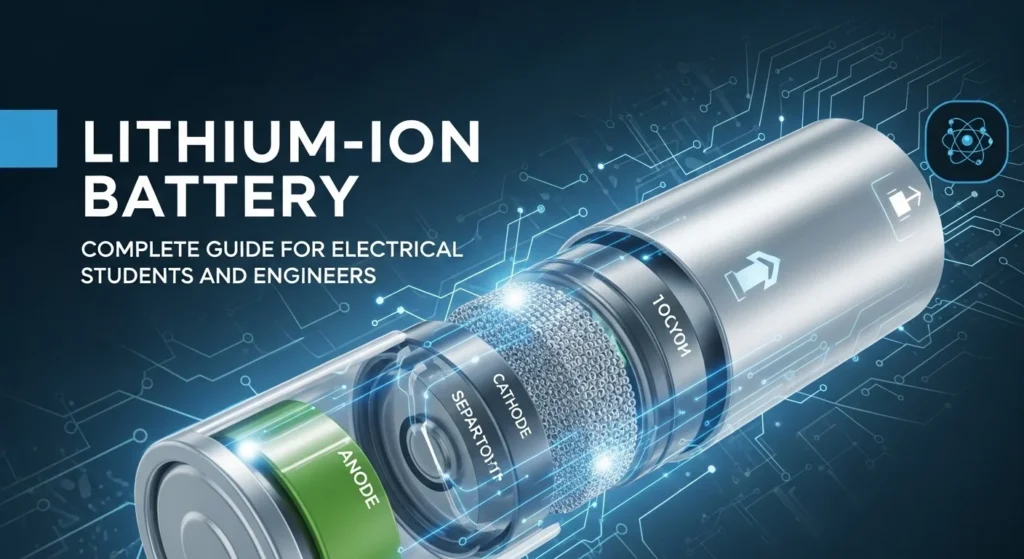
1. Anode
Usually made of graphite.
Function:
- Stores lithium ions during charging.
2. Cathode
Made of lithium metal compounds.
Function:
- Releases lithium ions during charging.
3. Electrolyte
A chemical solution that allows lithium ions to move between electrodes.
Function:
- Provides a path for ion movement.
4. Separator
A thin insulating material placed between anode and cathode.
Function:
- Prevents short circuits
- Allows ion movement.
5. Battery Management System (BMS)
An electronic system used in modern lithium batteries.
Function:
- Controls charging and discharging
- Prevents overheating
- Protects the battery from damage.
6. Lithium-Ion Battery Advantages
Understanding Lithium-Ion Battery advantages and disadvantages helps engineers choose suitable battery technology.
Advantages
- High energy density
- Lightweight design
- Long lifespan
- Fast charging capability
- Low maintenance
- High efficiency
- Suitable for portable electronics
- Environmentally cleaner compared to some older batteries
These advantages make lithium-ion batteries the most popular rechargeable battery technology today.
7. Lithium-Ion Battery Disadvantages / Limitations
Despite many advantages, lithium-ion batteries also have limitations.
Disadvantages
- Higher cost compared to lead-acid batteries
- Sensitive to high temperature
- Requires protection circuits
- Risk of overheating if damaged
- Limited lifespan after many charge cycles
Proper battery management systems help reduce these risks.
8. Lithium-Ion Battery Applications
The Lithium-Ion Battery applications are extremely wide in modern technology.
Consumer Electronics
- Smartphones
- Laptops
- Tablets
- Smartwatches
Electric Vehicles
- Electric cars
- Electric bikes
- Electric buses
Renewable Energy Systems
- Solar energy storage
- Wind power storage systems
Industrial Applications
- Power tools
- Drones
- Medical devices
Home Applications
- Portable electronics
- Backup power systems
Lithium-ion batteries are now central to modern energy technology.
9. Comparison Section
Difference Between Lithium-Ion Battery and Lead-Acid Battery
| Feature | Lithium-Ion Battery | Lead-Acid Battery |
|---|---|---|
| Weight | Lightweight | Heavy |
| Energy Density | High | Low |
| Lifespan | Long | Shorter |
| Charging Speed | Fast | Slower |
| Maintenance | Low | Requires maintenance |
| Cost | Higher | Lower |
This comparison helps engineers understand which battery type suits different applications.
10. Selection Guide
Choosing the right lithium-ion battery depends on several factors.
Capacity
Battery capacity is measured in Ampere-hours (Ah) or Watt-hours (Wh).
Higher capacity provides longer operation time.
Application Type
Different applications require different battery characteristics.
Examples:
- Smartphones → compact batteries
- Electric vehicles → high capacity batteries
Safety Features
Always choose batteries with proper Battery Management System (BMS).
Budget
Lithium-ion batteries are more expensive but provide better performance and lifespan.
11. Common Problems & Solutions
Even advanced batteries may face operational problems.
Problem 1: Battery Not Charging
Possible causes:
- Faulty charger
- BMS protection activated
Solution:
- Check charger compatibility
- Reset battery management system.
Problem 2: Battery Overheating
Cause:
- Excessive charging current
- Poor ventilation
Solution:
- Use proper charger
- Avoid high temperature environments.
Problem 3: Reduced Battery Capacity
Cause:
- Aging of battery cells
- Frequent deep discharge
Solution:
- Avoid full discharge cycles
- Replace battery when capacity becomes very low.
Problem 4: Battery Swelling
Cause:
- Internal chemical damage
Solution:
- Stop using battery immediately
- Replace the battery safely.
12. Future Trends
Lithium-ion battery technology continues to evolve.
Solid-State Batteries
New solid-state battery technology may improve safety and energy density.
Electric Vehicle Expansion
Demand for lithium-ion batteries will increase as electric vehicles become more common.
Renewable Energy Storage
Large lithium battery systems are being used to store solar and wind energy.
Recycling Technologies
Advanced recycling processes are being developed to recover lithium and other materials.
13. Conclusion
The Lithium-Ion Battery has become one of the most important energy storage technologies in modern electrical and electronic systems. From smartphones and laptops to electric vehicles and renewable energy storage, lithium-ion batteries play a critical role in powering today’s world.
Understanding the Lithium-Ion Battery working principle, structure, types, and applications is essential for electrical students and engineers. These batteries operate through the movement of lithium ions between electrodes, allowing efficient energy storage and delivery.
Although lithium-ion batteries have certain limitations such as higher cost and temperature sensitivity, their high energy density, lightweight design, and long lifespan make them superior to many traditional batteries.
For anyone studying electrical engineering or working in modern technology industries, learning about lithium-ion batteries is an important step toward understanding the future of energy storage systems.