
Imagine a sudden power outage at home while you are working on your laptop or watching television. In many areas, electricity interruptions are common, and people often use generators as backup power sources. However, traditional generators sometimes produce unstable power that can damage sensitive electronics such as laptops, smartphones, and modern televisions. This is where an Inverter Generator becomes very useful.
An inverter generator is a modern type of generator designed to produce clean, stable, and efficient electrical power. Unlike conventional generators, it uses advanced electronic circuits to control voltage and frequency. Because of this, inverter generators are widely used in homes, camping, outdoor events, and emergency power systems.
Understanding the Inverter Generator working principle is important for electrical students, engineers, technicians, and beginners. These generators represent an important advancement in portable power technology.
In this article, you will learn what an inverter generator is, how it works, its different types, and common Inverter Generator applications. We will also explain the Inverter Generator advantages and disadvantages, how to choose the right model, and the future of this technology in modern electrical systems.
What is an Inverter Generator?
An Inverter Generator is a type of portable generator that converts mechanical energy into clean and stable electrical power using electronic inverter technology.
Clear Definition
An inverter generator is a generator that produces AC power, converts it to DC, and then converts it back to controlled AC using an inverter circuit.
Simple Explanation
Unlike traditional generators that directly produce AC power, inverter generators process electricity through electronic circuits. This process improves power quality and makes it safe for sensitive devices.
Practical Example
For example, if you are camping outdoors and need to charge your laptop or phone, an inverter generator can provide stable power without risking damage to your devices.
Inverter Generator Working Principle
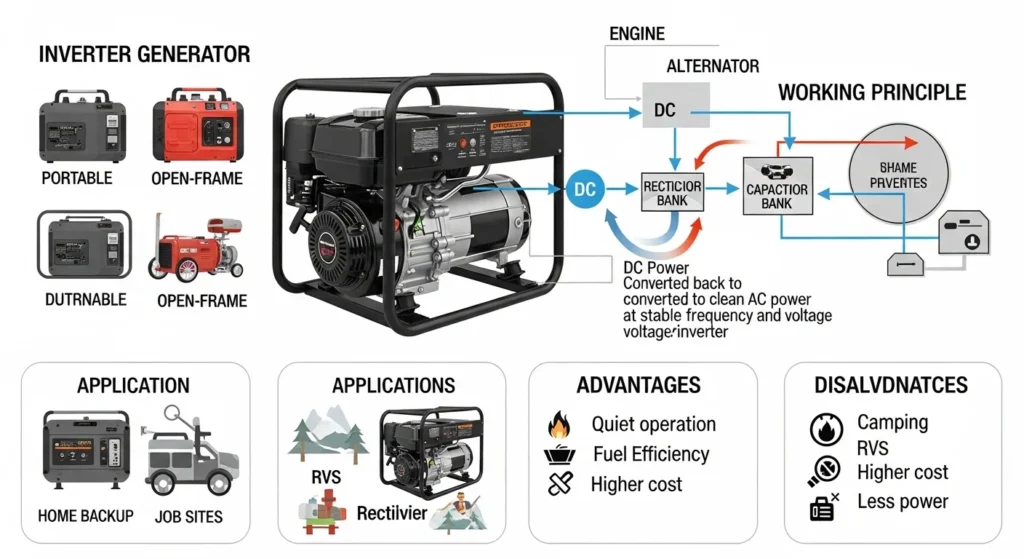
The Inverter Generator working principle involves multiple stages of energy conversion. The system first generates electrical energy and then stabilizes it through electronic control.
Step-by-Step Working Process
- Fuel Combustion
- The generator engine runs on fuel such as gasoline or propane.
- Mechanical Energy Production
- The engine rotates the alternator.
- AC Power Generation
- The alternator produces alternating current (AC).
- AC to DC Conversion
- The generated AC power is converted into direct current (DC).
- DC to Clean AC Conversion
- An inverter circuit converts the DC back to stable AC power.
- Stable Power Output
- The system produces clean and consistent electrical power.
Simple Analogy
Think of an inverter generator like a water filtration system. Water enters the filter, gets cleaned and stabilized, and then comes out in a better quality form. Similarly, electrical power is processed and stabilized before reaching the output.
Types of Inverter Generator
Inverter generators are available in different types depending on their design and application.
Portable Inverter Generator
Portable inverter generators are small and lightweight.
Features:
- Easy to carry
- Suitable for camping and outdoor activities
- Ideal for small home backup power
These are the most common inverter generators for personal use.
Standby Inverter Generator
Standby inverter generators are larger systems installed permanently in homes or buildings.
Features:
- Automatic power backup
- Higher power capacity
- Used in homes and offices
They automatically start when a power outage occurs.
Dual Fuel Inverter Generator
Dual fuel inverter generators can run on two types of fuel.
Features:
- Gasoline and propane compatibility
- Flexible fuel options
- Extended runtime
They are useful for emergency power situations.
Parallel Inverter Generator
Some inverter generators can connect together.
Features:
- Two generators combined for higher power
- Increased capacity
- Flexible usage
This feature is useful when additional power is required.
Main Components of an Inverter Generator
An inverter generator contains several important components that work together to produce stable power.
Engine
The engine provides mechanical energy by burning fuel.
Function:
- Drives the alternator.
Alternator
The alternator converts mechanical energy into electrical energy.
Function:
- Produces AC power.
Rectifier
The rectifier converts AC power into DC power.
Function:
- Prepares electricity for inverter processing.
Inverter Module
The inverter module converts DC power back to controlled AC power.
Function:
- Produces stable and clean electricity.
Control Panel
The control panel allows users to monitor and operate the generator.
Function:
- Displays voltage, load, and operating status.
Inverter Generator Advantages
Understanding Inverter Generator advantages and disadvantages helps in choosing the right generator.
Advantages
- Produces clean and stable electricity
- Safe for sensitive electronic devices
- Fuel efficient operation
- Lower noise levels
- Compact and portable design
- Adjustable engine speed based on load
Real-World Benefits
Because of these advantages, inverter generators are widely used for home backup, camping, and modern portable power solutions.
Inverter Generator Disadvantages / Limitations
Despite their benefits, inverter generators also have some limitations.
Limitations
- Higher purchase cost compared to conventional generators
- Limited maximum power capacity
- More complex electronics
- Repair costs can be higher
For heavy industrial loads, traditional generators may still be more suitable.
Inverter Generator Applications
There are many important Inverter Generator applications in daily life and professional environments.
Home Backup Power
Inverter generators are commonly used during power outages in homes.
Camping and Outdoor Activities
They provide portable electricity for lighting, cooking, and charging devices.
Construction Sites
Small inverter generators power tools and equipment.
Recreational Vehicles (RVs)
Many RV owners use inverter generators for portable power.
Emergency Power Systems
Hospitals and communication systems sometimes use inverter generators for backup.
Comparison: Inverter Generator vs Conventional Generator
Understanding the difference between inverter generator and conventional generator helps users select the right technology.
| Feature | Inverter Generator | Conventional Generator |
|---|---|---|
| Power Quality | Clean and stable | Less stable |
| Noise Level | Quiet operation | Noisy |
| Fuel Efficiency | Higher efficiency | Lower efficiency |
| Size | Compact and portable | Larger size |
| Cost | Higher | Lower |
Key Difference
The main difference between inverter generator and conventional generator is that inverter generators produce stable electronic-controlled power suitable for sensitive electronics.
Selection Guide
Choosing the right inverter generator depends on several important factors.
Power Requirement
Calculate the total power needed for appliances before selecting a generator.
Fuel Type
Choose generators that support convenient fuel options.
Noise Level
For home or camping use, low-noise models are recommended.
Portability
If you need mobility, select lightweight portable generators.
Safety Features
Look for overload protection and automatic shutdown systems.
Tips for Beginners
- Always check the generator wattage rating.
- Choose a reliable manufacturer.
- Ensure proper ventilation during operation.
Common Problems & Solutions
Why does the inverter generator not start?
Possible reasons:
- Empty fuel tank
- Dirty spark plug
- Low oil level
Solution: Check fuel, oil level, and spark plug condition.
Why is the generator producing low power?
Possible causes:
- Overloaded generator
- Faulty inverter module
Solution: Reduce load and inspect electrical components.
Why does the generator shut down automatically?
Many inverter generators have safety protection systems.
Solution: Check for overload or overheating.
Why is the generator overheating?
Overheating may occur due to poor ventilation.
Solution: Ensure proper airflow around the generator.
Future Trends in Inverter Generator Technology
Power generation technology is constantly evolving.
Smart Generators
Modern inverter generators include digital monitoring and smartphone connectivity.
Hybrid Power Systems
Future systems may combine inverter generators with solar power.
Improved Battery Integration
Battery storage systems may work together with inverter generators.
Eco-Friendly Designs
Manufacturers are developing low-emission and environmentally friendly generators.
Conclusion
An Inverter Generator is a modern and efficient power solution designed to provide clean and stable electricity. Unlike traditional generators, inverter generators use advanced electronic technology to convert and regulate electrical power.
Understanding the Inverter Generator working principle helps electrical students, technicians, and engineers appreciate how modern portable power systems operate. These generators are widely used in homes, outdoor activities, emergency power systems, and mobile power applications.
Although inverter generators may cost more initially, their benefits such as quiet operation, fuel efficiency, and safe power for electronics make them a valuable investment.
As technology advances, inverter generators will continue to evolve with smarter features, better efficiency, and integration with renewable energy systems.