
It is night, and suddenly the main power supply goes off. The lights turn off, fans stop, and everything becomes silent. But within a few seconds, your inverter system starts working. Lights come back. Your Wi-Fi and computer continue running without interruption.
This smooth backup power is only possible when inverter battery wiring is done correctly.
For electrical students, engineers, and technicians, understanding inverter battery wiring is very important. A small wiring mistake can cause low backup time, battery damage, overheating, or even fire hazards. Proper wiring ensures safety, long battery life, and efficient performance.
In this complete guide, you will learn:
- What is inverter battery wiring
- Inverter battery wiring working principle
- Types of wiring connections
- Main components and their functions
- Inverter battery wiring advantages and disadvantages
- Inverter battery wiring applications
- Difference between series and parallel battery connection
- Selection tips and troubleshooting
Let’s understand this topic step by step like a senior engineer guiding you in the field.
2. What Is Inverter Battery Wiring?
Inverter battery wiring is the method of connecting batteries to an inverter in a correct and safe way to supply backup electrical power.
In simple words:
It is the proper connection of battery positive and negative terminals to the inverter so that DC power can be converted into AC power.
Practical Example
Think of a water tank system:
- The battery is like a water tank storing energy.
- The inverter is like a pump converting stored water into flowing water.
- Wiring is the pipeline connecting both.
If the pipeline is weak or wrongly connected, the system will not work properly.
Similarly, inverter battery wiring must be strong, correct, and safe.
3. Inverter Battery Wiring Working Principle
To understand inverter battery wiring working principle, you must first understand how an inverter system works.
Step-by-Step Working
- Battery Stores DC Power
- Usually 12V, 24V, or 48V DC.
- Usually 12V, 24V, or 48V DC.
- Battery Connected to Inverter
- Through thick copper cables.
- Correct polarity is very important.
- Through thick copper cables.
- Inverter Converts DC to AC
- DC input → AC output (220V/230V).
- DC input → AC output (220V/230V).
- Load Receives Power
- Lights, fans, TV, computer, etc.
- Lights, fans, TV, computer, etc.
- Charging Mode
- When main supply returns, inverter charges the battery.
- When main supply returns, inverter charges the battery.
Important Points in Wiring
- Positive terminal (+) connects to positive inverter terminal.
- Negative terminal (–) connects to negative inverter terminal.
- Proper cable size must be used.
- Tight and clean connections are required.
Simple Analogy
Battery = Energy storage tank
Wires = Energy highway
Inverter = Energy converter machine
If the highway is narrow or damaged, traffic (current) will not flow properly.
That is the core idea of inverter battery wiring working principle.
4. Types / Classification of Inverter Battery Wiring
There are different types of inverter battery wiring depending on voltage and capacity requirements.
Single Battery Wiring (12V System)
- One 12V battery connected to inverter.
- Used in small home systems.
- Simple installation.
Best for:
Small loads like lights and fans.
Series Battery Connection
In this type:
- Positive of first battery connects to negative of second battery.
- Voltage increases.
- Capacity (Ah) remains same.
Example:
- Two 12V batteries in series = 24V system.
Used when inverter requires higher voltage.
Parallel Battery Connection
In this type:
- Positive to positive.
- Negative to negative.
- Voltage remains same.
- Capacity (Ah) increases.
Example:
- Two 12V 150Ah batteries in parallel = 12V 300Ah system.
Used for longer backup time.
Series-Parallel Connection
Combination of both methods.
- Used in large inverter systems.
- Common in commercial installations.
Understanding the difference between series and parallel battery connection is very important for proper system design.
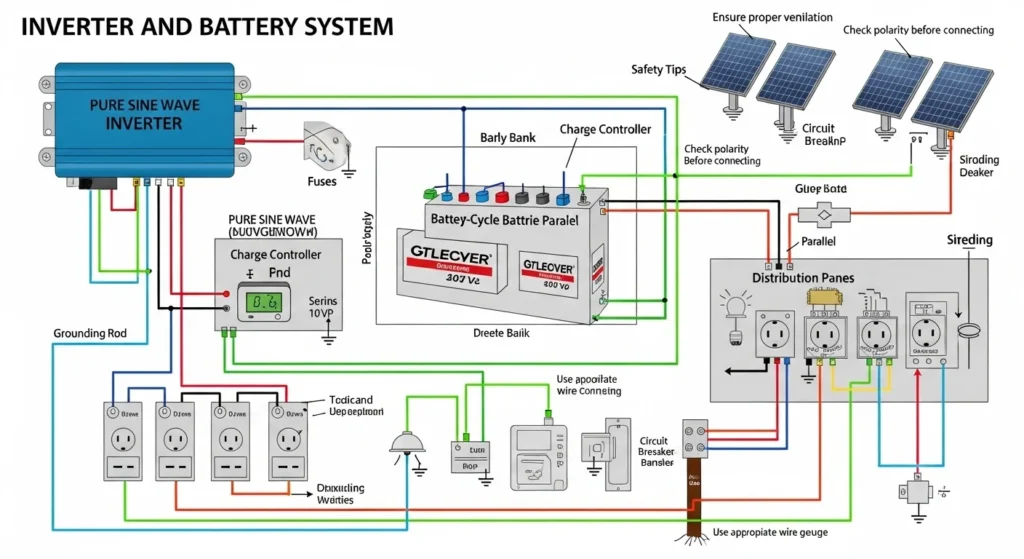
5. Main Components of Inverter Battery Wiring System
1. Battery
- Stores electrical energy.
- Types: Lead-acid, tubular, lithium-ion.
2. Inverter
- Converts DC to AC.
- Has charging circuit.
3. DC Cables
- Thick copper wires.
- Carry high current.
- Must be heat resistant.
4. Battery Terminals
- Connect cables to battery.
- Should be clean and tight.
5. Fuse or MCB
- Protects system from short circuit.
- Essential safety device.
6. Earthing System
- Protects from electric shock.
- Improves safety.
Each component plays a critical role in safe inverter battery wiring applications.
6. Inverter Battery Wiring Advantages and Disadvantages
Advantages
- Reliable power backup
- Easy installation
- Flexible voltage configuration
- Suitable for homes and offices
- Cost-effective solution
- Expandable system
These inverter battery wiring advantages and disadvantages must be understood before installation.
7. Disadvantages / Limitations
- Wrong wiring can damage inverter
- Risk of short circuit
- Battery maintenance required
- Heavy batteries (lead-acid type)
- High current requires thick cables
Improper wiring can reduce battery life significantly.
8. Inverter Battery Wiring Applications
Inverter battery wiring applications are widely seen in many areas.
Home Use
- Power backup during load shedding
- Small solar systems
Offices
- Computers and networking systems
- Security systems
Hospitals
- Emergency lighting
- Medical equipment backup
Industrial Use
- Control panels
- Small machinery
Solar Hybrid Systems
- Solar panels charge batteries
- Inverter supplies AC load
Correct wiring ensures stable performance in all applications.
9. Comparison Section
Difference Between Series and Parallel Battery Connection
| Feature | Series Connection | Parallel Connection |
| Voltage | Increases | Same |
| Capacity (Ah) | Same | Increases |
| Used For | High voltage inverter | Longer backup |
| Risk | Unequal charging | Current imbalance |
Choosing correct method depends on inverter rating and backup requirement.
10. Selection Guide
Before doing inverter battery wiring, consider:
1. Inverter Voltage Rating
- 12V inverter → 12V battery system
- 24V inverter → 24V battery system
2. Required Backup Time
- More backup → Higher Ah battery
- Use parallel connection if needed
3. Cable Size
- Use thick copper cables
- Avoid voltage drop
4. Safety Devices
- Always install fuse
- Use proper earthing
Tips for Beginners
- Never reverse polarity
- Tighten terminals properly
- Keep battery in ventilated area
- Avoid overloading inverter
Good planning prevents future problems.
11. Common Problems & Solutions
Q1: Inverter not turning ON?
Possible Causes:
- Loose wiring
- Low battery voltage
Solution:
- Check connections
- Measure battery voltage
Q2: Battery heating?
Cause:
- Loose terminal
- Overcharging
Solution:
- Tighten connections
- Check charging voltage
Q3: Short Backup Time?
Cause:
- Low battery capacity
- Old battery
Solution:
- Increase Ah rating
- Replace battery
Q4: Spark during connection?
Cause:
- Inverter switched ON
- Sudden current flow
Solution:
- Always switch OFF inverter before wiring
Proper maintenance improves safety and life.
12. Future Trends
Modern inverter battery wiring systems are improving with technology.
New Developments
- Lithium-ion battery systems
- Smart battery management system (BMS)
- Wireless monitoring
- Solar hybrid inverters
- Automatic load management
Lithium batteries reduce wiring complexity and improve efficiency.
In future, smart home systems will automatically manage inverter battery performance.
13. Conclusion
Inverter battery wiring is a critical part of any backup power system. Proper wiring ensures safe operation, longer battery life, and reliable power supply. We discussed inverter battery wiring working principle, types of connections, components, inverter battery wiring applications, and inverter battery wiring advantages and disadvantages.
Understanding the difference between series and parallel battery connection helps in designing the right system. Always focus on safety, correct polarity, and proper cable sizing.
As an electrical student or technician, mastering this topic will improve your practical skills and professional confidence. Good wiring means safe and efficient powerbackup.