
Imagine walking through a long hotel corridor or a large staircase in a building. At the bottom of the stairs, you turn on the light using a switch. When you reach the middle floor, you want to control the same light again without going back. This is where an intermediate switch becomes very useful. It allows a single light to be controlled from three or more different locations.
In modern electrical installations, convenience and safety are very important. Buildings such as homes, hospitals, schools, hotels, and offices often require lighting systems that can be controlled from multiple points. This is achieved by using two-way switches along with an intermediate switch in the circuit.
For electrical students, technicians, and engineers, understanding the intermediate switch working principle is essential when designing lighting circuits or installing wiring systems. Even though the switch itself looks simple, its internal connections allow flexible control of electrical circuits.
In this article, you will learn everything about the Intermediate Switch, including its definition, working principle, types, components, intermediate switch applications, advantages and disadvantages, troubleshooting, and how to select the right switch. The explanation is written in simple and practical language, similar to how a senior electrical engineer would guide a junior technician.
What is an Intermediate Switch?
An Intermediate Switch is an electrical switch used to control a single light or electrical device from three or more different locations. It is usually installed between two two-way switches in a lighting circuit.
In simple words, an intermediate switch is a four-terminal switch that changes the direction of current flow between two traveler wires.
Simple Explanation
When a lighting circuit requires control from only two locations, electricians use two-way switches. However, when control from three or more locations is required, an intermediate switch is added between the two two-way switches.
Practical Example
A common example of intermediate switch usage includes:
- Multi-floor staircases
- Long building corridors
- Large halls
- Hotels and hospitals
- Industrial buildings
For example, in a three-floor building staircase, the light may be controlled from the ground floor, first floor, and second floor using two two-way switches and one intermediate switch.
Intermediate Switch Working Principle
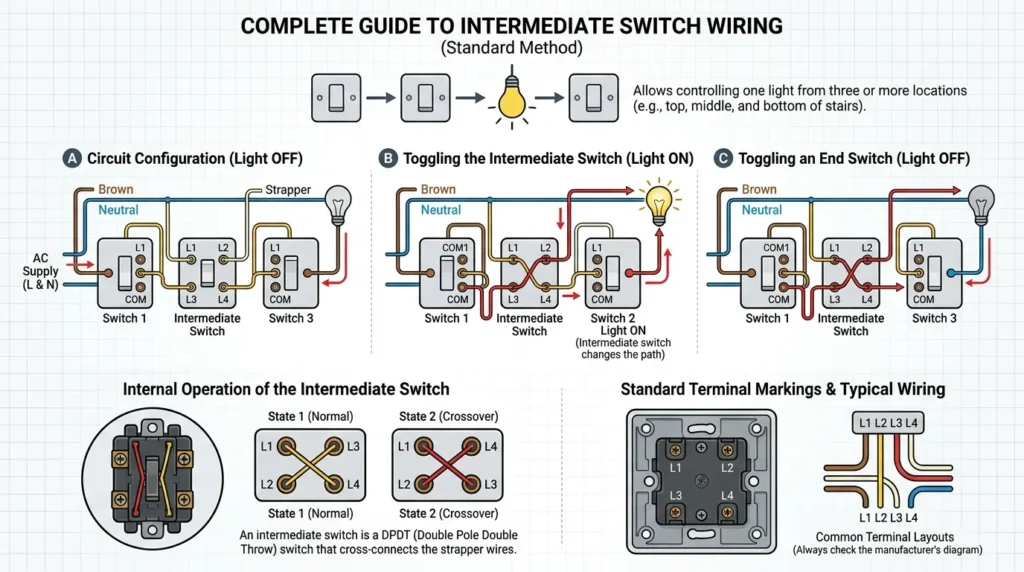
The intermediate switch working principle is based on changing the connection path between two pairs of wires called traveler wires.
Unlike normal switches, an intermediate switch does not directly connect the power supply to the load. Instead, it changes the direction of current between two circuits.
Step-by-Step Working Process
- Power enters the first two-way switch
The supply voltage is connected to the first two-way switch.
- Traveler wires carry the current
Two wires carry the electrical current from the first switch toward the intermediate switch.
- Intermediate switch changes connection
The intermediate switch either:
- Connects traveler wires straight, or
- Crosses the traveler wires.
- Current reaches second two-way switch
The current continues toward the final switch.
- Light turns ON or OFF
Depending on the switch positions, the circuit either completes or breaks.
Simple Analogy
Think of an intermediate switch like a railway track changer.
- In one position, trains move straight.
- In another position, the tracks cross and trains change direction.
Similarly, the intermediate switch changes the electrical path between wires.
Types / Classification of Intermediate Switches
Intermediate switches are mainly classified based on their design, mounting style, and application.
Standard Intermediate Switch
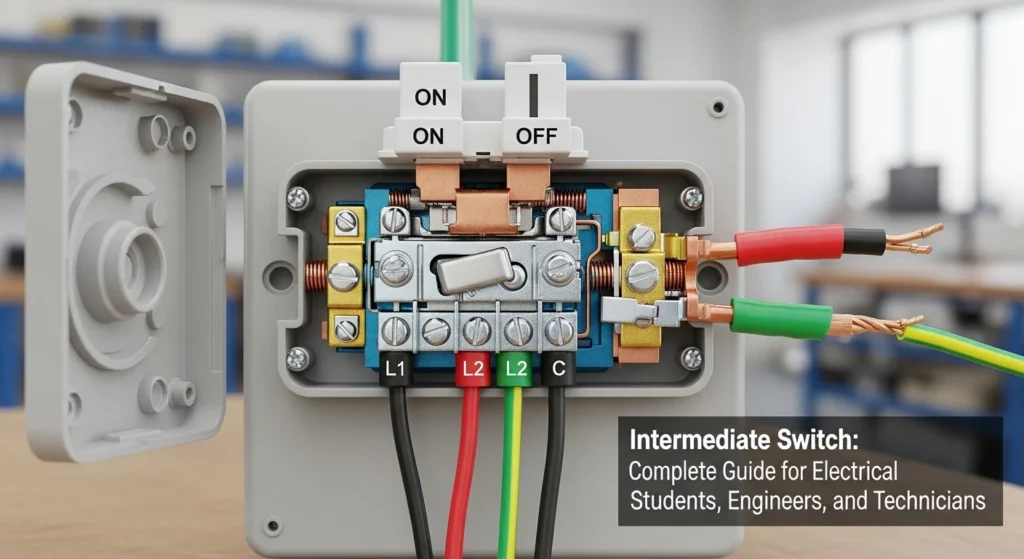
A Standard Intermediate Switch is a special type of electrical switch used to control a single light or electrical device from three or more different locations. It is commonly installed in large houses, staircases, hallways, corridors, hotels, and industrial buildings where multiple control points are needed. The intermediate switch works together with two-way switches to provide flexible and convenient control of lighting systems.
The working principle of a standard intermediate switch is based on changing the path of current flow between two-way switches. It operates using internal cross-connection contacts that either connect or reverse the electrical connections. This switching action allows the light or load to be turned ON or OFF from different positions. The operation follows the basic concept of Electric Circuit Theory, where changing the circuit path controls the flow of electric current.
A standard intermediate switch usually has four terminals and is installed between two two-way switches in a circuit. When the switch is pressed, the internal contacts cross-connect the wires, changing the state of the circuit. This makes it possible to control one lamp from multiple locations. For example, in a staircase, a user can switch the light ON at the bottom floor and switch it OFF at the top floor using different switches.
The main components of a standard intermediate switch include the switch mechanism, contact terminals, moving contact assembly, and insulating body. The insulating casing provides safety and protection from electric shock, while the internal contacts ensure smooth switching operation.
One of the main advantages of a standard intermediate switch is convenience. It improves user comfort by allowing lighting control from multiple points. It is also highly useful in large buildings and public areas. However, wiring for intermediate switching is more complex than normal one-way switching, and installation requires proper electrical knowledge.
Overall, a standard intermediate switch is an important component in modern electrical wiring systems. Its ability to control lighting from multiple locations makes it practical, efficient, and widely used in residential, commercial, and industrial applications.
This is the most common type used in home wiring systems.
Features:
- Four terminals
- Installed between two two-way switches
- Used for lighting control
Modular Intermediate Switch
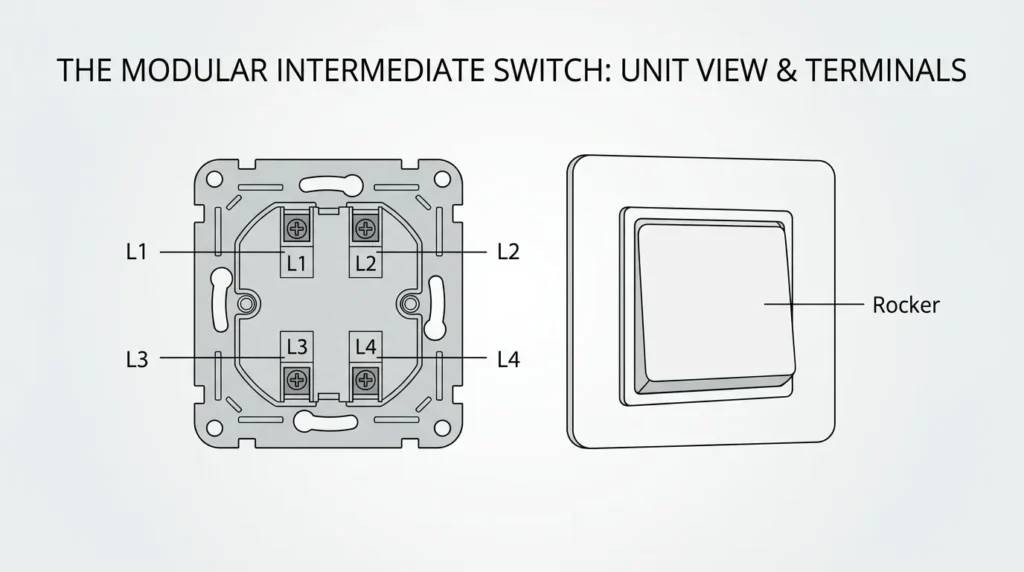
Modular switches are modern switches used in contemporary electrical panels.
A Modular Intermediate Switch is a modern electrical switching device used to control a single light or electrical load from three or more different locations. It is commonly used in homes, offices, hotels, staircases, and commercial buildings where convenient multi-location control is required. Unlike traditional switches, modular intermediate switches are designed with a stylish modular structure that offers better safety, appearance, and ease of installation.
The working principle of a modular intermediate switch is based on changing the electrical path between two-way switches. It works with two two-way switches in a circuit and uses internal cross-connection contacts to reverse the current path. When the switch is pressed, the internal mechanism changes the wire connections, allowing the light or load to turn ON or OFF from different locations. This operation follows the principle of Electric Circuit Theory, where controlling the circuit path changes the current flow.
A modular intermediate switch generally has four terminals and is installed between two two-way switches. Inside the switch, moving contacts shift between positions to create different current paths. The modular design allows the switch to fit neatly into modular switchboards, improving appearance and simplifying maintenance.
The main components of a modular intermediate switch include the switch actuator, moving contact mechanism, terminal connections, insulating housing, and modular frame. The insulating body is made from high-quality fire-resistant material to provide safety and durability.
One of the main advantages of a modular intermediate switch is its attractive design and easy installation. It provides smooth operation, better electrical safety, and compatibility with modern modular wiring systems. It is also easier to replace and maintain compared to older conventional switches. However, it is usually more expensive than traditional switches and requires proper wiring connections for correct operation.
Overall, a modular intermediate switch is an advanced and practical solution for multi-location lighting control. Its modern design, reliability, and user-friendly operation make it widely used in residential and commercial electrical installations.
Features:
- Compact design
- Attractive appearance
- Easy installation
These switches are widely used in modern homes and offices.
Heavy-Duty Intermediate Switch
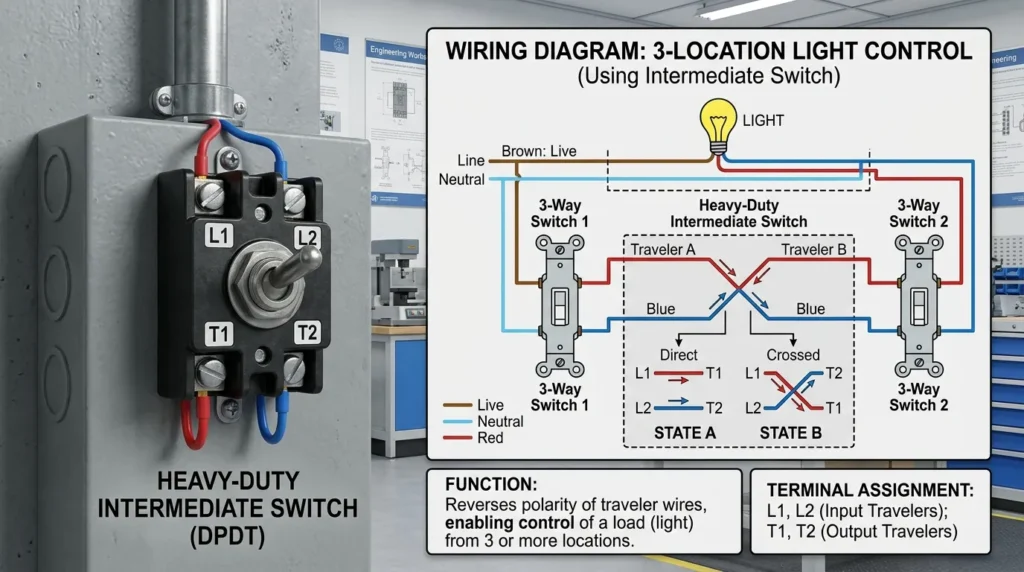
These switches are designed for industrial use.
A Heavy-Duty Intermediate Switch is a strong and durable electrical switching device designed to control a single electrical load from three or more locations in high-power or industrial applications. It is commonly used in factories, warehouses, large commercial buildings, staircases, and industrial control systems where frequent operation and higher current handling capacity are required. Compared to standard intermediate switches, heavy-duty switches are built with stronger materials and robust internal mechanisms for long-lasting performance.
The working principle of a heavy-duty intermediate switch is based on changing the electrical path between two-way switches in a multi-location control circuit. It uses internal cross-connection contacts that reverse the current path whenever the switch position changes. This operation follows the concept of Electric Circuit Theory, where altering the circuit connection changes the flow of electric current. The switch works together with two-way switches, allowing users to control a single device from multiple points.
A heavy-duty intermediate switch usually contains four terminals and a strong switching mechanism capable of handling higher electrical loads. The internal contacts are made from high-quality conductive materials to reduce wear and ensure reliable operation during continuous use. The outer body is generally made from heat-resistant and impact-resistant materials for additional safety.
The main components of a heavy-duty intermediate switch include reinforced contact terminals, cross-connection mechanism, heavy-duty actuator, insulating enclosure, and mounting frame. These components are specially designed to withstand frequent switching operations and harsh industrial conditions.
One of the main advantages of a heavy-duty intermediate switch is its high durability and ability to handle larger currents safely. It provides reliable operation in demanding environments and has a longer service life compared to standard switches. However, it is larger in size, more expensive, and requires professional installation due to more complex wiring.
Overall, a heavy-duty intermediate switch is an important component in industrial and commercial electrical systems. Its strong construction, reliable performance, and multi-location control capability make it ideal for heavy electrical applications where safety and durability are essential.
Features:
- High current capacity
- Strong internal contacts
- Durable materials
They are commonly used in large industrial lighting systems.
Waterproof Intermediate Switch
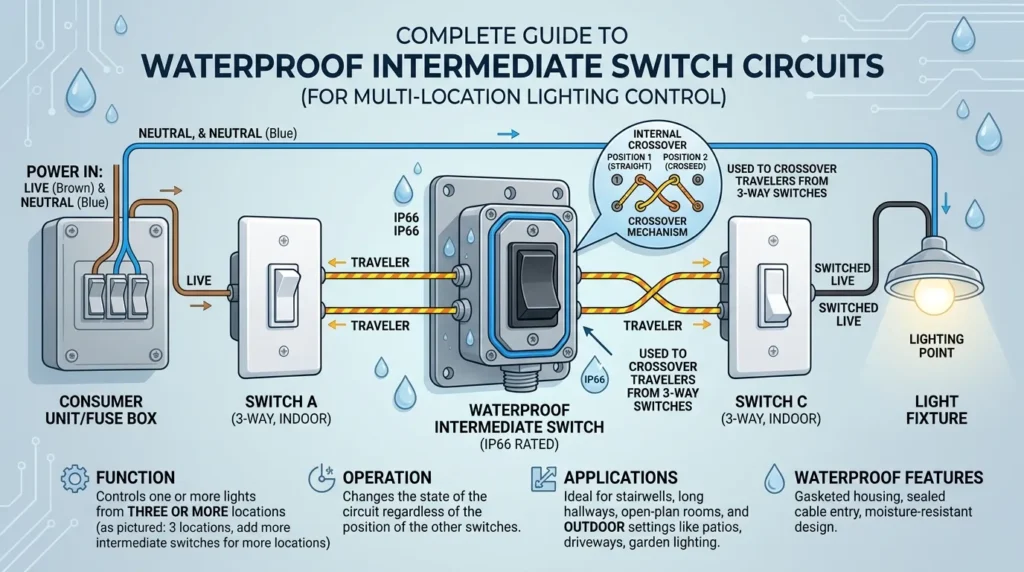
This switch is used in outdoor environments.
A Waterproof Intermediate Switch is a specially designed electrical switch used to control a single light or electrical device from three or more locations in wet or outdoor environments. It is commonly installed in bathrooms, gardens, swimming pool areas, factories, outdoor staircases, and industrial locations where moisture, dust, or water exposure may occur. The waterproof design protects the switch from water entry and ensures safe electrical operation in harsh conditions.
The working principle of a waterproof intermediate switch is similar to a standard intermediate switch. It works by changing the electrical path between two-way switches using internal cross-connection contacts. When the switch is operated, it changes the connection of wires, allowing the connected load to turn ON or OFF from multiple locations. This operation follows the principle of Electric Circuit Theory, where changing the circuit path controls current flow. The waterproof enclosure ensures that moisture does not affect the internal electrical parts.
A waterproof intermediate switch usually has four terminals and is installed between two two-way switches. Its major difference from normal switches is the sealed protective casing. The enclosure is made from strong, water-resistant, and corrosion-resistant materials. Rubber gaskets and protective covers prevent water and dust from entering the switch mechanism.
The main components of a waterproof intermediate switch include the switching mechanism, cross-connection contacts, waterproof enclosure, sealing gaskets, terminals, and protective cover. These components work together to provide safe and reliable switching in damp environments.
One of the main advantages of a waterproof intermediate switch is safety in wet conditions. It prevents electric shock risks caused by water exposure and improves durability in outdoor installations. It is also resistant to dust, corrosion, and environmental damage. However, it is more expensive than standard switches and may require careful installation to maintain waterproof protection.
Overall, a waterproof intermediate switch is an essential device for safe multi-location electrical control in outdoor and wet environments. Its protective design, reliability, and durability make it highly useful in residential, commercial, and industrial applications.
Features:
- Protection against water and dust
- Durable casing
- Suitable for outdoor installations
Examples include garden lighting and outdoor staircases.
Main Components of an Intermediate Switch: Complete Guide
An intermediate switch may appear similar to a standard wall switch from the outside, but internally it contains several important components that allow it to control a light or electrical load from three or more locations. These components work together to change the path of current between two-way switches, making multi-location switching possible. Understanding these parts helps electricians, technicians, and students better understand how intermediate switching systems operate.
Actuator (Switch Lever)
The actuator, commonly known as the switch lever or rocker, is the part that the user physically presses or toggles. When the actuator is operated, it moves the internal contact mechanism to change the electrical connection inside the switch. This action allows the lighting circuit to switch between ON and OFF states from multiple locations.
Internal Contact Mechanism
The internal contact mechanism is the most important part of an intermediate switch. It consists of metal contacts that either connect straight through or cross over the traveler wires. By changing these connections, the switch alters the current path and enables control of the same light fixture from different switch positions.
Terminals
Intermediate switches typically contain four terminals for wiring connections. These terminals are used to connect the traveler wires coming from the adjacent two-way switches. Proper terminal connections are essential for the correct operation of the switching circuit and to prevent wiring faults.
Spring Mechanism
The spring mechanism ensures smooth and reliable switching action. It helps the switch move quickly between positions and keeps the internal contacts firmly connected, reducing wear and improving long-term performance.
Insulated Housing
The insulated housing forms the outer body of the switch. It protects the internal components from dust, moisture, and accidental contact while helping prevent electrical shock. Modern housings are usually made from durable, flame-resistant insulating materials to improve safety.
Intermediate Switch Advantages and Disadvantages
Understanding the advantages and disadvantages of an intermediate switch helps determine whether it is the right choice for a particular electrical installation. While it offers excellent convenience and flexibility, it also has some limitations that should be considered during design and installation.
Advantages of an Intermediate Switch
One of the biggest advantages of an intermediate switch is its ability to control a single light or electrical load from three or more locations. This feature is extremely useful in large homes, commercial buildings, hotels, schools, hospitals, and long corridors where users may need access to lighting control from multiple points.
Intermediate switches improve convenience by eliminating the need to walk to a specific switch location. They also enhance safety in staircases, hallways, and passageways by allowing lights to be turned on or off from different positions. In addition, they are compatible with standard two-way switching systems and can be integrated into existing electrical installations with proper wiring.
Disadvantages and Limitations of an Intermediate Switch
Despite their benefits, intermediate switches require more wiring than standard one-way or two-way switches. The additional traveler wires increase installation complexity and may result in higher material costs. For beginners, understanding and wiring an intermediate switching circuit can be challenging because incorrect connections can prevent the system from functioning properly.
Intermediate switches are also generally more expensive than standard switches due to their additional internal contact mechanism and terminal arrangement. Proper installation requires a good understanding of electrical wiring principles to ensure safe and reliable operation.
An intermediate switch is an essential electrical switching device designed to control lighting from three or more locations. Its main components—including the actuator, internal contact mechanism, terminals, spring mechanism, and insulated housing—work together to provide reliable multi-location control. Although intermediate switches require additional wiring and installation knowledge, their convenience, safety benefits, and flexibility make them ideal for staircases, corridors, large rooms, and commercial buildings. For modern electrical installations where lighting control from multiple points is required, the intermediate switch remains one of the most practical and widely used solutions.
Intermediate Switch Applications: Where and Why They Are Used
The applications of an intermediate switch are widespread in modern electrical installations where a light or electrical load needs to be controlled from three or more different locations. By working together with two-way switches, an intermediate switch provides greater convenience, safety, and flexibility in both residential and commercial environments. Its ability to control lighting from multiple points makes it an essential component in buildings with large spaces, multiple floors, and long passageways.
Residential and Home Applications
In residential buildings, intermediate switches are commonly installed in areas where people need convenient access to lighting controls from different locations. They are widely used in staircase lighting systems, allowing lights to be switched on or off from the ground floor, upper floor, and intermediate landing. Large multi-story homes often use intermediate switches to improve convenience and reduce unnecessary movement. They are also frequently installed in long hallways, corridors, and large rooms where multiple access points require lighting control.
Commercial Building Applications
Commercial facilities benefit greatly from intermediate switching systems because they often have extensive corridors and multiple entrances. Hotels use intermediate switches in hallways and staircases to provide easy lighting control for guests and staff. Hospitals install them in corridors, wards, and emergency access routes to improve safety and accessibility. Office buildings and shopping malls also rely on intermediate switches to manage lighting efficiently across large spaces where users may enter or exit from different locations.
Industrial Applications
In industrial environments, intermediate switches are commonly used in factory corridors, production facilities, warehouses, and industrial staircases. Large industrial buildings often require lighting control from several locations to improve operational efficiency and worker safety. By allowing lights to be controlled from multiple points, intermediate switches help reduce energy waste and provide convenient access to lighting controls throughout the facility.
Public Infrastructure Applications
Intermediate switches are also widely used in public infrastructure projects. Railway stations, airports, parking garages, public buildings, educational institutions, and transportation terminals often require lighting systems that can be controlled from multiple locations. These installations improve safety, simplify facility management, and provide better accessibility for both staff and visitors.
Importance in Modern Electrical Installations
The widespread use of intermediate switches demonstrates their importance in modern electrical systems. They offer a practical solution for controlling lighting from multiple locations, making buildings safer, more convenient, and more energy-efficient. Whether used in homes, commercial facilities, industrial sites, or public infrastructure, intermediate switches continue to play a vital role in creating flexible and user-friendly lighting control systems.
Intermediate switches are essential wherever lighting needs to be controlled from three or more locations. Their applications range from residential staircases and hallways to hotels, hospitals, factories, airports, and railway stations. By providing convenient multi-location control, improving safety, and enhancing user comfort, intermediate switches have become an important part of modern electrical installation design.
Comparison: Intermediate Switch vs Two-Way Switch
Understanding the difference between intermediate switch and two-way switch helps electricians choose the correct circuit.
| Feature | Intermediate Switch | Two-Way Switch |
|---|---|---|
| Number of Terminals | Four | Three |
| Control Locations | Three or more | Two |
| Circuit Role | Installed between two-way switches | Start or end of circuit |
| Complexity | Slightly complex | Simple |
| Common Applications | Staircases and corridors | Room lighting |
Both switches work together to create multi-location lighting control systems.
Selection Guide: How to Choose the Right Intermediate Switch
Selecting the right intermediate switch is important for ensuring safe operation, reliable performance, and long service life. Since intermediate switches are commonly used in multi-location lighting control systems, choosing a switch that matches the electrical requirements and installation environment is essential. A properly selected switch not only improves convenience but also helps prevent electrical faults and maintenance issues.
Check the Voltage Rating
One of the first factors to consider is the voltage rating of the switch. The intermediate switch should be compatible with the voltage level of the electrical system in which it will be installed. Using a switch with an incorrect voltage rating can lead to poor performance, overheating, or potential safety hazards. Always verify that the switch meets the voltage requirements specified for the installation.
Verify the Current Capacity
The current rating of the switch is equally important. The switch must be capable of safely handling the electrical load connected to the lighting circuit. If the current exceeds the switch’s rated capacity, excessive heating and premature failure may occur. Selecting a switch with an appropriate current rating ensures safe and reliable operation under normal working conditions.
Choose High-Quality Materials
The quality of materials used in the switch directly affects its durability and performance. Intermediate switches made from high-grade insulating materials and corrosion-resistant contacts generally provide longer service life and better reliability. Investing in a quality switch can reduce maintenance costs and improve overall safety.
Consider the Installation Environment
The location where the switch will be installed should also influence the selection process. For outdoor installations or areas exposed to moisture, dust, or harsh conditions, waterproof or weatherproof intermediate switches are recommended. These switches offer additional protection and ensure reliable operation even in challenging environments.
Ensure Compatibility with Modern Electrical Systems
Many modern buildings use modular electrical panels and switch systems. Therefore, it is important to choose an intermediate switch that is compatible with the existing electrical accessories and panel design. Modular switches not only provide a cleaner appearance but also simplify installation, maintenance, and future upgrades.
Additional Safety Features
When selecting an intermediate switch, it is beneficial to look for products that comply with recognized electrical safety standards. Features such as flame-resistant housing, strong terminal connections, and high-quality contact mechanisms can further enhance safety and reliability.
Choosing the right intermediate switch requires careful consideration of voltage rating, current capacity, material quality, installation environment, and system compatibility. By selecting a high-quality switch that meets the electrical and environmental requirements of the installation, users can ensure safe, efficient, and long-lasting performance in residential, commercial, and industrial lighting control systems.
Common Intermediate Switch Problems and Troubleshooting Solutions
Like any electrical device, an intermediate switch can occasionally develop faults due to incorrect wiring, loose connections, wear and tear, or installation errors. Understanding these common problems and their solutions can help electricians, technicians, and homeowners quickly identify issues and restore proper operation. Proper troubleshooting also improves safety and prevents unnecessary replacement of electrical components.
Problem 1: Light Does Not Turn On
One of the most common issues in an intermediate switching system is a light that fails to turn on from any switch location. This problem is often caused by incorrect wiring connections, damaged traveler wires, or loose terminal connections. Since intermediate switches rely on proper wiring between two-way switches, even a single incorrect connection can interrupt the circuit.
Possible Cause: Incorrect wiring connection or loose traveler wires.
Solution: Carefully inspect all wiring connections, especially the traveler wires connected to the intermediate switch. Ensure that all terminals are connected according to the wiring diagram and that no wires are loose or damaged.
Problem 2: Light Operates from Only One Switch
Sometimes the light can be controlled from one switch location but not from the others. This usually indicates an error in the intermediate switch wiring or a faulty internal contact mechanism. The switch may not be correctly changing the connection path between the traveler wires.
Possible Cause: Incorrect intermediate switch wiring or faulty contacts.
Solution: Verify that all four terminals are connected correctly according to the circuit design. If the wiring is correct, inspect the switch for damaged or worn internal contacts and replace it if necessary.
Problem 3: Flickering or Unstable Light
A flickering light can indicate poor electrical contact within the switch or loose wiring connections. Over time, switch contacts may become worn, oxidized, or loose, causing intermittent electrical connections that result in flickering.
Possible Cause: Loose contacts, poor wiring connections, or worn switch components.
Solution: Tighten all terminal screws and inspect the wiring for loose connections. If the problem persists, replace the switch to ensure reliable operation.
Problem 4: Switch Feels Loose or Does Not Click Properly
An intermediate switch should operate smoothly and provide a firm switching action. If the switch feels loose, sticks, or fails to maintain its position, the internal spring mechanism or moving parts may be worn out.
Possible Cause: Internal mechanical wear or damaged switching mechanism.
Solution: Replace the intermediate switch with a new unit. Attempting to repair worn internal components is generally not recommended because it may compromise safety and reliability.
Preventive Maintenance Tips
Regular inspection and maintenance can help prevent many intermediate switch problems. Ensure that all connections remain tight, replace damaged switches promptly, and avoid overloading the circuit. Using high-quality switches and following proper installation practices can significantly improve system reliability and longevity.
Most intermediate switch problems are caused by incorrect wiring, loose connections, worn contacts, or mechanical wear. By understanding the common causes and applying the correct troubleshooting methods, users can quickly restore proper operation and maintain a safe, efficient, and reliable lighting control system.
Future Trends
Electrical switching technology continues to improve with modern innovations.
Future developments may include:
- Smart home compatible switches
- Touch-sensitive intermediate switches
- Wireless lighting control systems
- Energy-efficient smart lighting automation
With the rise of smart buildings and automation systems, traditional switches like intermediate switches may integrate with digital technologies.
Conclusion
The Intermediate Switch is an important component in electrical wiring systems that allows lighting to be controlled from three or more locations. It is commonly used in staircases, corridors, large buildings, and industrial facilities where convenient lighting control is required.
Understanding the intermediate switch working principle, types, intermediate switch applications, advantages and disadvantages is essential for electrical students, engineers, and technicians. When used correctly with two-way switches, it creates flexible and efficient lighting control systems.
By selecting the right switch type and installing it properly, electricians can ensure safe, reliable, and convenient lighting operation in modern electrical installations.