
Imagine a large oil refinery where hundreds of sensors continuously measure pressure, temperature, flow rate, and liquid levels. These measurements are sent to a control room where engineers monitor and control the entire process. For these signals to travel safely and accurately from the sensors to the control system, special cables are required. These cables are known as Instrumentation Cables.
In modern industries such as power plants, chemical factories, and automation systems, accurate signal transmission is extremely important. Even a small electrical interference can cause incorrect readings and lead to serious operational problems. Instrumentation cables are specially designed to carry low-voltage signals from measuring instruments to control equipment without interference.
For electrical students, engineers, and technicians, understanding instrumentation cables is essential because they are widely used in industrial control systems, automation networks, and monitoring equipment.
In this article, you will learn about Instrumentation Cable, including the instrumentation cable working principle, types, components, advantages, disadvantages, applications, and selection methods. By the end, you will clearly understand how these cables ensure accurate and reliable signal transmission in modern industrial systems.
2. What is Instrumentation Cable?
An Instrumentation Cable is a special type of electrical cable designed to transmit low-level electrical signals from instruments and sensors to monitoring and control systems.
These cables are commonly used in industrial environments where accurate data transmission is critical.
Simple Explanation
Instrumentation cables connect devices such as:
- Sensors
- Transmitters
- Controllers
- PLC systems
- Control panels
Their main purpose is to carry small electrical signals safely without interference from external electrical noise.
Practical Example
Consider a temperature sensor in a power plant boiler. The sensor measures temperature and sends a signal to the control system. This signal travels through an instrumentation cable to reach the control room.
If the cable were not properly shielded, electrical noise from nearby motors or power cables could distort the signal.
3. Instrumentation Cable Working Principle
The instrumentation cable working principle is based on transmitting small electrical signals through insulated and shielded conductors while protecting them from external interference.
These cables ensure that signals remain accurate and stable during transmission.
Step-by-Step Working
- Signal Generation
A sensor or instrument generates a low-level electrical signal. - Signal Transmission
The signal travels through the cable conductors. - Insulation Protection
Each conductor is insulated to prevent electrical leakage. - Shielding Protection
Metallic shielding blocks electromagnetic interference from nearby equipment. - Signal Reception
The signal reaches the control system, such as a PLC or monitoring device. - Data Processing
The control system interprets the signal and performs necessary actions.
Simple Analogy
Think of instrumentation cables like a secure communication channel.
- The signal is like a message.
- The conductor carries the message.
- The shielding protects the message from outside disturbances.
This design ensures reliable communication between instruments and control systems.
4. Types / Classification of Instrumentation Cables
Instrumentation cables are classified based on shielding, structure, and application.
Shielded Instrumentation Cable
Shielded cables include a metallic layer around the conductors.
Purpose:
- Protect signals from electromagnetic interference (EMI).
- Maintain signal accuracy.
These cables are widely used in industrial environments.
Unshielded Instrumentation Cable
Unshielded cables do not include protective shielding.
Applications:
- Low interference environments
- Short signal transmission distances
They are less expensive but offer less protection.
Twisted Pair Instrumentation Cable
These cables contain pairs of conductors twisted together.
Advantages:
- Reduces electrical noise
- Improves signal quality
Twisted pair design is very common in instrumentation wiring.
Armored Instrumentation Cable
Armored cables include a metal protective layer, usually steel.
Benefits:
- Mechanical protection
- Suitable for underground installation
- Protection against physical damage
Multi-Pair Instrumentation Cable
Multi-pair cables contain multiple twisted conductor pairs inside one cable.
Applications:
- Large industrial control systems
- Multiple sensors connected to control panels
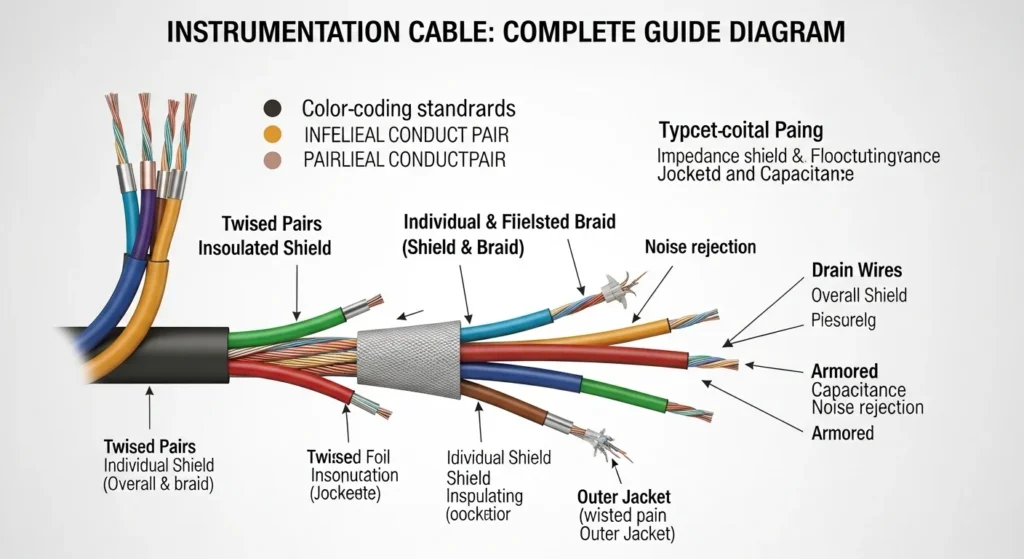
5. Main Components of Instrumentation Cable
Instrumentation cables consist of several important components that ensure reliable signal transmission.
Conductor
The conductor carries the electrical signal.
Common materials:
- Copper (most common)
- Tinned copper for corrosion resistance
Copper provides excellent conductivity for low-level signals.
Insulation
Insulation surrounds each conductor to prevent short circuits and signal leakage.
Common insulation materials include:
- PVC (Polyvinyl Chloride)
- XLPE (Cross-linked Polyethylene)
- PE (Polyethylene)
Twisted Pair Structure
Two conductors are twisted together to reduce electromagnetic interference.
This design improves signal quality.
Shielding
Shielding protects signals from external electrical noise.
Common shielding types:
- Aluminum foil shielding
- Copper braid shielding
Shielding blocks electromagnetic interference from nearby electrical equipment.
Inner Sheath
The inner sheath holds conductors and shielding together while providing extra protection.
Armoring (Optional)
Armoring protects the cable from mechanical damage in harsh environments.
Outer Sheath
The outer sheath protects the cable from:
- Moisture
- Chemicals
- Heat
- Mechanical stress
6. Instrumentation Cable Advantages
Instrumentation cables offer several important benefits in industrial systems.
- Accurate Signal Transmission
Maintains precise data communication. - Protection from Electrical Noise
Shielding reduces electromagnetic interference. - Reliable Industrial Communication
Suitable for sensitive measurement signals. - Improved System Stability
Prevents incorrect readings. - Durability
Designed for harsh industrial environments. - Long Service Life
High-quality materials increase cable lifespan.
These instrumentation cable advantages and disadvantages must be considered when designing control systems.
7. Instrumentation Cable Disadvantages / Limitations
Despite their advantages, instrumentation cables also have some limitations.
- Higher Cost compared to ordinary cables
- Complex Installation due to shielding requirements
- Sensitive to Poor Grounding if shielding is improperly connected
- Limited Power Transmission because they are designed for low-level signals
Proper installation techniques reduce these limitations.
8. Instrumentation Cable Applications
Instrumentation cables are widely used in industrial monitoring and control systems.
Industrial Automation
Used for connecting:
- Sensors
- Transmitters
- PLC systems
- Control panels
Power Plants
Instrumentation cables transmit signals from:
- Temperature sensors
- Pressure transmitters
- Flow meters
Oil and Gas Industry
Used in:
- Refineries
- Offshore platforms
- Pipeline monitoring systems
Chemical Plants
Instrumentation cables carry signals for process control and safety systems.
Building Automation
Modern smart buildings use instrumentation cables for:
- HVAC control systems
- Fire detection systems
- Security monitoring
These instrumentation cable applications highlight their importance in modern industry.
9. Comparison Section
Difference Between Instrumentation Cable and Power Cable
| Feature | Instrumentation Cable | Power Cable |
|---|---|---|
| Purpose | Signal transmission | Power transmission |
| Voltage Level | Low voltage signals | High voltage power |
| Shielding | Usually shielded | Often unshielded |
| Conductor Size | Small conductors | Large conductors |
| Applications | Sensors and control systems | Electrical power distribution |
Understanding the difference between instrumentation cable and power cable helps engineers choose the correct cable type.
10. Selection Guide
Choosing the right instrumentation cable requires careful evaluation.
Signal Type
Determine the type of signal being transmitted:
- Analog signals
- Digital signals
- Control signals
Shielding Requirement
If the environment contains heavy electrical equipment, choose shielded cables.
Environmental Conditions
Consider factors such as:
- Temperature
- Moisture
- Chemical exposure
Mechanical Protection
Use armored cables in areas where cables may face physical damage.
Distance of Signal Transmission
Longer distances require high-quality cables to maintain signal accuracy.
11. Common Problems & Solutions
Why is signal interference occurring?
Possible reasons:
- Poor shielding
- Nearby power cables
- Improper grounding
Solution: Ensure proper shielding and cable separation.
Why are signals fluctuating?
Possible causes:
- Damaged cable insulation
- Loose connections
- Electrical noise
Solution: Inspect connections and replace damaged cables.
Why is the signal lost completely?
This may happen due to:
- Broken conductor
- Cable damage
- Faulty sensor
Testing the cable continuity helps identify the issue.
12. Future Trends
Instrumentation cable technology continues to evolve with modern industrial requirements.
Smart Monitoring Cables
Future cables may include embedded sensors to monitor temperature and signal performance.
Improved Shielding Technology
Advanced shielding materials will reduce interference even in high-noise environments.
Fire-Resistant Instrumentation Cables
These cables maintain operation during fires, improving safety in industrial plants.
Eco-Friendly Cable Materials
Manufacturers are developing environmentally friendly insulation materials.
High-Speed Industrial Communication
Future instrumentation cables will support faster data transmission for advanced automation systems.
13. Conclusion
Instrumentation cables are a critical part of modern industrial control and monitoring systems. They allow accurate transmission of low-level signals from sensors and instruments to control equipment without interference.
Understanding the instrumentation cable working principle, types, components, and applications is essential for electrical students, engineers, and technicians working in industrial environments. These cables ensure reliable communication between measuring devices and control systems, helping maintain safe and efficient operations.
Although instrumentation cables may have higher cost and require proper installation techniques, their advantages in signal accuracy, interference protection, and durability make them indispensable in industries such as power generation, oil and gas, automation, and manufacturing.
As industrial technology continues to advance, instrumentation cables will play an even more important role in supporting modern smart monitoring and control systems.