
Imagine a situation where an air conditioner suddenly stops cooling or a ceiling fan refuses to start. In many cases, the real problem is not the motor or the wiring but a small electronic component called a capacitor. Capacitors are widely used in electrical equipment such as motors, power supplies, fans, and electronic circuits. When a capacitor fails, the entire system may stop working or perform poorly.
For electrical students, technicians, and engineers, knowing how to test capacitor is an essential skill. Proper testing helps identify faulty components quickly and prevents unnecessary replacement of other parts. It also helps improve system reliability and safety.
Capacitor failure can lead to problems like motor starting issues, voltage fluctuations, and reduced equipment efficiency. By learning correct testing techniques, technicians can diagnose faults accurately and maintain electrical systems effectively.
In this guide, you will learn how to test capacitor, understand the how to test capacitor working principle, and explore different testing methods used in practical situations. We will also discuss how to test capacitor applications, tools required, common problems, and the how to test capacitor advantages and disadvantages of different testing methods. This article explains everything in simple language so beginners can easily understand the concept.
2. What is How to Test Capacitor?
How to test capacitor refers to the process of checking whether a capacitor is functioning correctly or has become faulty. The testing process measures properties such as capacitance, resistance, or voltage behavior to determine the capacitor’s condition.
Simple Explanation
A capacitor stores electrical energy and releases it when needed. If the capacitor becomes damaged, it cannot store or release energy properly. Testing helps determine whether the capacitor is working as expected.
Practical Example
Consider a ceiling fan that hums but does not start rotating. In many cases, the fan capacitor may be weak or damaged. By testing the capacitor with a multimeter or capacitance meter, a technician can confirm whether the capacitor needs replacement.
Testing helps avoid guesswork and ensures accurate troubleshooting.
3. How to Test Capacitor Working Principle
The how to test capacitor working principle is based on measuring how the capacitor stores and releases electrical charge.
Step-by-Step Concept
When a capacitor is connected to a power source:
- It begins storing electrical charge.
- The voltage across the capacitor gradually increases.
- When disconnected, the capacitor releases stored energy.
Testing methods analyze this charging and discharging behavior.
Basic Testing Process
Typical capacitor testing involves the following steps:
- Disconnect the capacitor from the circuit.
- Discharge the capacitor safely.
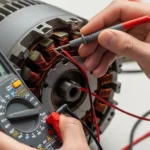
- Use a testing instrument such as a multimeter.
- Measure capacitance or resistance.
- Compare the result with the rated value.
Easy Analogy
Think of a capacitor like a small water tank. The tank fills with water when connected to a pipe and releases water when the pipe is opened. If the tank leaks or cannot hold water, it is faulty. Similarly, a capacitor that cannot hold electrical charge is defective.
4. Types / Classification
Different methods are used when learning how to test capacitor depending on the available tools and required accuracy.
Testing with a Multimeter
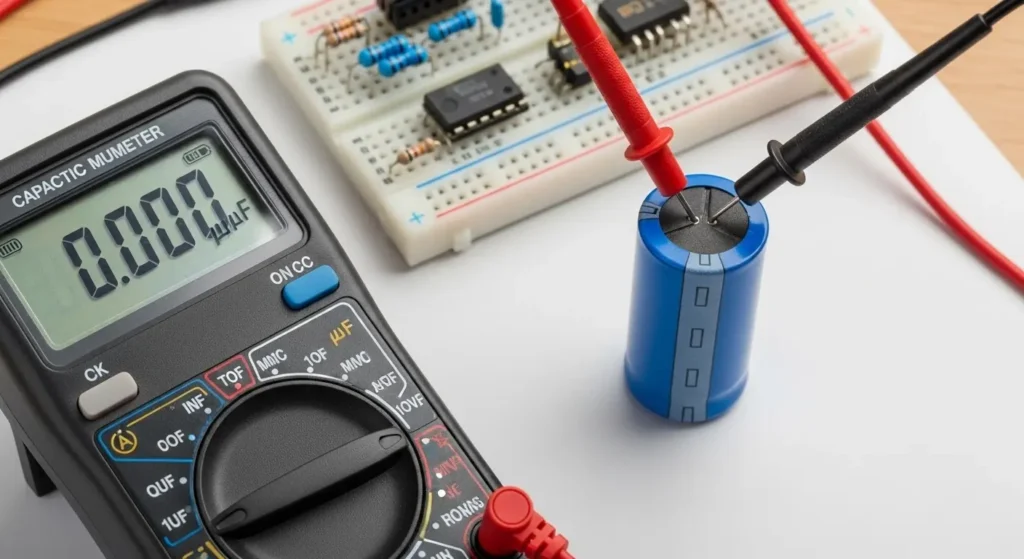
A digital multimeter is one of the most common tools used to test capacitors.
Process
- Set the multimeter to capacitance mode.
- Connect the probes to capacitor terminals.
- Observe the reading on the display.
If the measured value matches the rated capacitance, the capacitor is usually healthy.
Testing with Analog Multimeter
An analog multimeter can also test capacitor condition using resistance measurement.
Process
- Set the meter to resistance mode.
- Connect probes to capacitor terminals.
- Observe the needle movement.
If the needle moves and then slowly returns to infinity, the capacitor is charging and discharging correctly.
Testing with Capacitance Meter
A capacitance meter provides the most accurate measurement.
Features
- Measures exact capacitance value
- Suitable for laboratory testing
- Highly reliable for professional work
5. Main Components
Testing a capacitor requires several tools and components.
1. Multimeter
A multimeter measures voltage, resistance, and capacitance. It is widely used for capacitor testing.
2. Capacitance Meter
This specialized device measures the actual capacitance value.
3. Discharge Resistor
Before testing, the capacitor must be discharged using a resistor to avoid electric shock.
4. Test Leads
Test leads connect the measuring instrument to the capacitor terminals.
Each component ensures safe and accurate testing.
6. Advantages
Understanding how to test capacitor advantages and disadvantages helps technicians choose the right testing method.
Advantages
- Helps detect faulty capacitors quickly
- Prevents unnecessary component replacement
- Improves equipment reliability
- Saves maintenance cost
- Enhances troubleshooting accuracy
Real-World Benefits
In industrial maintenance, testing capacitors regularly helps prevent unexpected equipment failures.
7. Disadvantages / Limitations
Although capacitor testing is useful, it has some limitations.
Disadvantages
- Requires proper testing tools
- Incorrect testing may damage components
- Some faults are difficult to detect without advanced equipment
- Safety precautions are necessary when working with charged capacitors
Proper training reduces these risks.
8. How to Test Capacitor Applications
The how to test capacitor applications are found in many electrical and electronic systems.
Home Appliances
Capacitors in fans, washing machines, and air conditioners often require testing during maintenance.
Industrial Equipment
Motor starting capacitors in pumps and compressors are frequently tested to ensure reliable operation.
Electronics Repair
Capacitors in power supplies, amplifiers, and circuit boards are checked during troubleshooting.
Renewable Energy Systems
Solar inverters and power electronics also use capacitors that require regular testing.
9. Comparison Section
Many beginners ask about the difference between capacitor testing with multimeter and capacitance meter.
| Feature | Multimeter Testing | Capacitance Meter Testing |
|---|---|---|
| Accuracy | Moderate | High |
| Cost | Low | Higher |
| Ease of Use | Simple | Professional |
| Measurement | Approximate | Precise |
Understanding the difference between capacitor testing methods helps choose the correct tool for the job.
10. Selection Guide
Choosing the right testing method depends on the situation.
Factors to Consider
- Type of capacitor
- Required accuracy
- Available tools
- Safety considerations
Tips for Beginners
- Always discharge the capacitor before testing.
- Use a digital multimeter with capacitance mode if available.
- Compare measured values with the rated value printed on the capacitor.
These steps ensure safe and accurate results.
11. Common Problems & Solutions
Problem 1: Capacitor Shows No Reading
Cause: Open circuit inside the capacitor.
Solution: Replace the capacitor.
Problem 2: Capacitor Value Too Low
Cause: Internal degradation of dielectric material.
Solution: Install a new capacitor with the correct rating.
Problem 3: Capacitor Short Circuit
Cause: Internal insulation failure.
Solution: Immediately replace the faulty capacitor to prevent equipment damage.
12. Future Trends
Capacitor testing technology continues to improve.
Smart Diagnostic Tools
Modern digital instruments can automatically detect capacitor health.
Predictive Maintenance
Industries now use sensors and monitoring systems to predict capacitor failure before it occurs.
Advanced Materials
New capacitor designs with improved reliability reduce failure rates.
These advancements help improve system performance and reduce downtime.
13. Conclusion
Learning how to test capacitor is an essential skill for electrical students, engineers, and technicians. Capacitors play an important role in electrical and electronic systems, and their failure can affect equipment performance significantly.
By understanding the how to test capacitor working principle, technicians can diagnose faults accurately using tools such as multimeters and capacitance meters. Testing methods allow professionals to determine whether a capacitor is functioning properly or requires replacement.
Knowledge of how to test capacitor applications, testing methods, and the how to test capacitor advantages and disadvantages helps improve troubleshooting efficiency. With proper tools and safety precautions, capacitor testing becomes a simple and reliable process.
For beginners entering the electrical field, mastering capacitor testing techniques is a valuable step toward becoming a skilled technician or engineer.