
Imagine flipping a switch in your living room, and the light comes on instantly. That power travels from a distant plant at thousands of volts, then steps down to a safe 120 volts at your outlet. If it stayed high voltage all the way, it could arc through the air or cause severe shocks. This real-life balance between high and low voltage keeps our homes safe while efficiently delivering electricity over long distances.
The topic of high voltage vs low voltage is vital in electrical work. High voltage transmits power with less loss, but low voltage is safer for everyday use. Understanding the difference helps prevent accidents, optimize designs, and save costs. It’s key for electrical students, engineers, technicians, and beginners to avoid common pitfalls like mismatched equipment.
In this article, you’ll learn clear definitions, the high voltage vs low voltage working principle, types, components, advantages and disadvantages, and practical applications. We’ll include comparisons, selection tips, troubleshooting, and future trends. By the end, you’ll confidently handle voltage choices in projects, from home wiring to industrial setups.
What is High Voltage vs Low Voltage?
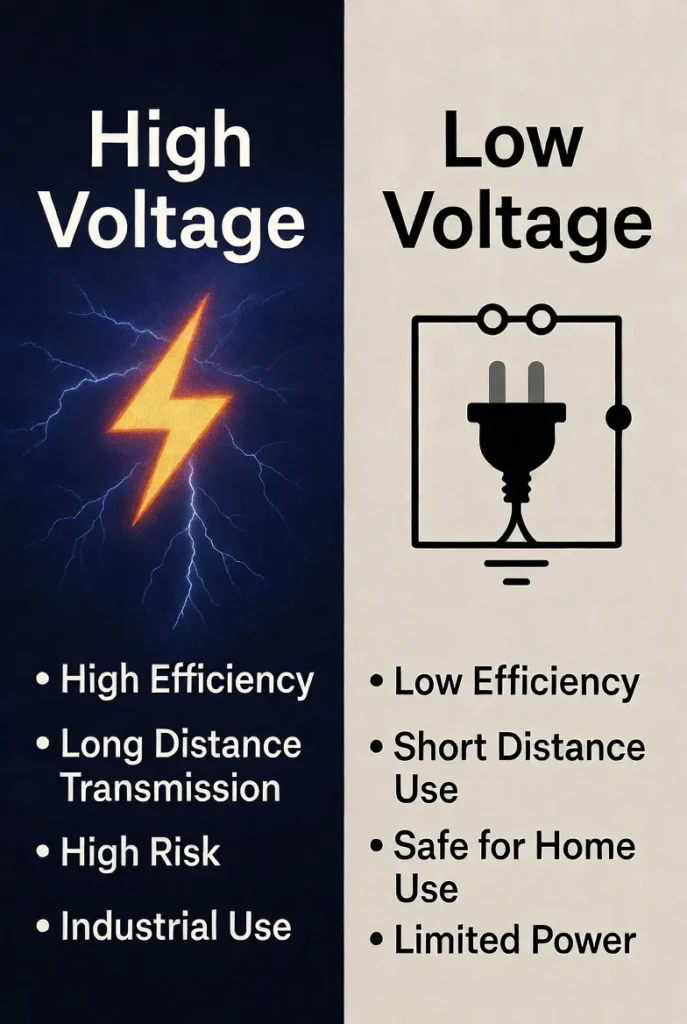
High voltage vs low voltage compares two levels of electrical potential: high (above 1000 volts AC or 1500 volts DC) and low (below those thresholds, often 50-1000 volts AC or 120-1500 volts DC).
Simply put, voltage is like water pressure in pipes – high pressure pushes more over distance with less pipe size, but it’s riskier. Low pressure is safer but needs bigger pipes for the same flow. High voltage carries power far with thin wires; low voltage suits close-range, safe handling.
A practical example: Power lines overhead use high voltage (up to 500,000 volts) to send electricity from plants to cities efficiently. At your home, transformers drop it to low voltage (120/240 volts) for plugs and lights, preventing dangers.
Working Principle
The high voltage vs low voltage working principle centers on how electricity flows and transforms. Both follow Ohm’s law (voltage = current × resistance), but levels affect efficiency, safety, and equipment.
Think of it as a river: High voltage is a fast, narrow stream carrying lots of energy with little loss; low voltage is a wide, slow river safer for swimming but losing more to friction.
Step-by-step:
- Generation: Power starts at generators, often medium voltage, then stepped up to high for transmission.
- Transmission: High voltage reduces current (P = V × I), so less heat loss (I²R) in wires. Like using a hose nozzle for farther spray.
- Transformation: Transformers change levels using electromagnetic induction – coils wrap a core; varying current in one induces in the other.
- Distribution and Use: Step down to low voltage near users for safety and compatibility.
Bullet points for key differences:
- High: Minimizes losses over distance.
- Low: Reduces shock risk, easier insulation.
- Conversion: Always via transformers or converters.
This ensures power reaches us reliably.
Types / Classification
Voltage levels classify by standards like IEC or NEC, based on use and safety.
Low Voltage Types
Includes extra-low (below 50V AC/120V DC) for toys or phones, and standard low (50-1000V AC/120-1500V DC) for homes and offices. Safe for direct touch if protected.
High Voltage Types
Medium high (1-35kV) for local distribution, high (35-230kV) for regional lines, extra-high (230-800kV) for long-distance, ultra-high (above 800kV) for massive grids. Needs heavy insulation.
Direct Current (DC) Variations
Low DC in batteries (1.5-12V), high DC in HVDC transmission (up to 1MV) for efficient long-haul without AC losses.
Alternating Current (AC) Variations
Most common; low AC in appliances, high AC in power lines. The difference between AC and DC voltages is in waveform: AC changes direction, DC steady.
Main Components
Systems handling high vs low voltage share parts but scale differently.
Transformers: Core with primary/secondary coils; steps voltage up/down via turn ratios.
Cables: Thick insulation for high voltage (e.g., XLPE); thinner for low.
Circuit breakers: Interrupt faults; high voltage ones use gas or vacuum for arc quenching.
Insulators: Porcelain or polymer for high voltage lines to prevent leakage.
Switches and relays: Control flow; low voltage simple, high needs remote operation for safety.
Meters: Measure voltage/current; digital for accuracy in both.
These ensure safe, efficient operation.
Advantages
- Efficiency in Transmission: High voltage cuts losses, saving energy and costs over miles.
- Safety for Users: Low voltage minimizes shock risks in homes and devices.
- Cost Savings: High allows thinner wires; low uses cheaper materials.
- Flexibility: Low suits portable tools; high powers big machines.
- Reliability: Proper levels reduce overheating and failures.
- Scalability: Easy to step between for various needs.
These high voltage vs low voltage advantages and disadvantages show balanced use is key.
Disadvantages / Limitations
High voltage poses arc flash and shock hazards, needing expert handling.
Low voltage drops over distance, requiring thicker cables or boosters.
High systems cost more upfront for insulation and equipment.
Low limits power delivery – can’t run heavy industry without step-up.
Both face electromagnetic interference, but high more so.
Conversion between adds efficiency losses (5-10%).
Applications
In homes, low voltage powers lights, appliances, and smart devices safely.
Industry uses high voltage for motors, furnaces, and welding to handle big loads.
Modern tech: Low in EVs batteries (400V), high in charging stations (up to 1000V).
Data centers mix low for servers, high for incoming supply.
Renewables: Wind farms generate medium, step to high for grid.
Telecom: Low for signals, high for long cables.
Comparison Section
High vs low voltage compares to AC vs DC or wired vs wireless power. Table:
| Feature | High Voltage | Low Voltage |
| Efficiency | High (low losses) | Lower (higher losses) |
| Safety | Lower (hazards) | High (safer handling) |
| Cost | High initial | Lower materials |
| Distance Suitability | Long | Short |
| Power Capacity | High | Limited |
| Insulation Needs | Heavy | Light |
The difference between high voltage and low voltage is mainly in application: transmission vs end-use.
Selection Guide
Choose based on distance, power needs, and safety. For home wiring, always low voltage.
Calculate load: Use P = V × I; higher V means lower I, thinner wires.
For beginners: Start with low voltage projects like LED circuits.
Check codes: Follow local standards (e.g., NEC for US).
Budget: High voltage gear pricier but saves long-term.
Environment: Wet areas need better insulation.
Test with multimeter before finalizing.
Common Problems & Solutions
Q: Voltage drop in long low voltage lines?
A: Use thicker wires or add boosters. Shorten runs if possible.
Q: Arcing in high voltage setup?
A: Increase insulation or spacing. Check for moisture.
Q: Overheating cables?
A: Wrong level – switch to high for distance or upsize low.
Q: Shock from low voltage?
A: Still possible if wet; use GFCI protection.
Q: Transformer humming?
A: Loose parts; tighten or replace. Normal in high loads.
These fix everyday issues safely.
Future Trends
High voltage tech advances with HVDC for renewables, reducing losses further.
Low voltage sees DC microgrids in homes for solar efficiency.
Smart sensors monitor levels in real-time.
Superconductors promise zero-loss high voltage lines.
EVs push hybrid systems blending both.
Industry heads to efficient, green voltages.
Conclusion
High voltage vs low voltage balances efficiency and safety in power systems. We’ve explored definitions, working principles, types, components, applications, and more, including advantages and disadvantages.
As a senior electrical engineer, I’ve designed grids where this choice saved millions. Juniors, grasp these basics – they underpin all electrical work. Experiment safely with low voltage first.
Keep learning; voltage tech evolves with energy demands. Master it, and you’ll power the future reliably.