
Imagine you are installing electrical wiring in a concrete wall. A normal drill works well for wood or metal, but when you try to drill into concrete or brick, the drill struggles. The bit stops moving forward, and the process becomes slow and difficult. This is where a Hammer Drill becomes essential.
A hammer drill is a powerful tool designed specifically for drilling into hard materials such as concrete, stone, brick, and masonry. It combines two actions at the same time: rotation and hammering. While the drill bit rotates like a standard drill, it also moves forward and backward rapidly, creating a hammering effect that helps break tough surfaces.
For electricians, engineers, technicians, and construction workers, the hammer drill is one of the most important power tools. It is commonly used for installing electrical boxes, mounting equipment, fixing anchors, and drilling holes in walls and floors.
In this article, you will learn about the Hammer Drill working principle, types, components, Hammer Drill applications, and the Hammer Drill advantages and disadvantages. The goal is to explain the tool clearly so beginners and technical students can understand how it works and how to choose the right one.
What is a Hammer Drill?
A Hammer Drill is a power tool that combines rotational drilling with a rapid hammering motion to drill into hard materials such as concrete, brick, and stone.
Simple Explanation
Unlike a normal drill that only rotates, a hammer drill also creates quick forward and backward impacts. These impacts break the surface material while the rotation removes the debris.
This dual action makes drilling into masonry much faster and easier.
Practical Example
For example, when an electrician needs to install wall plugs or anchor bolts in a concrete wall, a hammer drill is used. The hammering motion cracks the concrete while the rotating drill bit creates the hole.
Without the hammer action, drilling into concrete would take much longer and could damage the drill bit.
Hammer Drill Working Principle
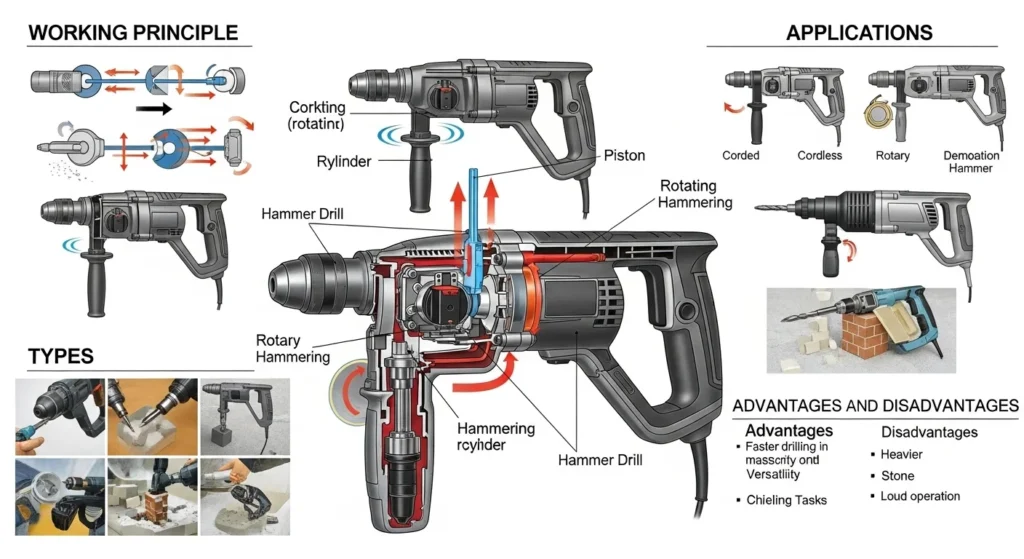
The Hammer Drill working principle is based on a combination of rotational movement and hammering impact.
Inside the drill, mechanical or pneumatic systems create rapid impacts that help the drill bit break through hard surfaces.
Step-by-Step Working Process
- Motor Operation
- The electric motor starts rotating the drill bit.
- Gear Mechanism Activation
- Internal gears create a hammering motion.
- Hammer Action
- The drill bit moves forward and backward rapidly while rotating.
- Material Breaking
- The hammering force cracks hard surfaces like concrete.
- Debris Removal
- The rotating bit removes broken particles from the hole.
Simple Analogy
Think of using a hammer and chisel together. The hammer breaks the surface while the chisel removes the material. A hammer drill performs both actions at the same time.
Types of Hammer Drill
Hammer drills are available in different designs depending on power, usage, and technology.
Corded Hammer Drill
Corded hammer drills operate using direct electrical power from an outlet.
Features:
- Continuous power supply
- Suitable for heavy-duty work
- Common in construction sites
Cordless Hammer Drill
Cordless hammer drills use rechargeable batteries.
Features:
- Portable and lightweight
- Suitable for home repairs
- Convenient for remote locations
Rotary Hammer Drill
A rotary hammer drill uses a pneumatic hammering system for stronger impacts.
Features:
- More powerful hammer action
- Used for heavy-duty drilling
- Ideal for concrete and stone
SDS Hammer Drill
SDS (Slotted Drive System) hammer drills use a special chuck system for quick bit changes and better impact transfer.
Features:
- Strong hammering force
- Faster drilling in concrete
- Common in professional construction work
Main Components of a Hammer Drill
A hammer drill contains several important components that allow it to perform both drilling and hammering.
Electric Motor
The motor provides the rotational power needed to turn the drill bit.
Chuck
The chuck holds the drill bit firmly in place.
Common types include:
- Keyed chuck
- Keyless chuck
- SDS chuck
Hammer Mechanism
The hammer mechanism produces the forward and backward motion that creates the hammering action.
Gear System
The gears transfer motor power to the drill bit and control speed and torque.
Drill Bit
Special drill bits are designed for masonry drilling.
Examples:
- Carbide-tipped bits
- SDS masonry bits
Handle and Trigger
The handle provides grip and control, while the trigger controls the drill speed.
Hammer Drill Advantages
Understanding the Hammer Drill advantages and disadvantages helps users choose the right tool.
Advantages
- Drills easily into concrete and masonry
- Faster drilling compared to normal drills
- Powerful impact action
- Versatile tool for construction work
- Suitable for electrical and plumbing installations
- Reduces drilling time and effort
- Available in both corded and cordless models
Real-World Benefits
Because of these advantages, hammer drills are widely used in construction, electrical installations, and renovation projects.
Hammer Drill Disadvantages / Limitations
Despite its benefits, the hammer drill also has some limitations.
Limitations
- Heavier than normal drills
- More expensive than standard drills
- Creates more vibration
- Can be noisy during operation
- Not ideal for delicate materials like glass or plastic
Users must select the correct tool for the job to avoid damage.
Hammer Drill Applications
There are many Hammer Drill applications in home, construction, and industrial work.
Electrical Installations
Electricians use hammer drills to:
- Install electrical boxes
- Drill holes for wiring
- Mount panels and equipment
Construction Work
Hammer drills are widely used for:
- Drilling concrete walls
- Installing anchors and bolts
- Fixing metal frames
Plumbing Installations
Plumbers use hammer drills to drill holes for pipes and fixtures.
Home Renovation
Homeowners use hammer drills for tasks such as mounting shelves, TV brackets, and cabinets.
Industrial Applications
Factories and industrial plants use hammer drills for equipment installation and structural work.
Comparison: Hammer Drill vs Rotary Hammer
Understanding the difference between hammer drill and rotary hammer helps users choose the correct tool.
| Feature | Hammer Drill | Rotary Hammer |
|---|---|---|
| Hammering Method | Mechanical | Pneumatic |
| Power | Moderate | Very high |
| Best Use | Light to medium masonry drilling | Heavy-duty concrete drilling |
| Weight | Lighter | Heavier |
| Cost | Lower | Higher |
Key Difference
The main difference between hammer drill and rotary hammer is that rotary hammers use a pneumatic mechanism, which produces stronger impacts for heavy construction work.
Selection Guide
Choosing the right hammer drill depends on several factors.
Important Factors
- Power Rating
- Higher wattage provides stronger drilling performance.
- Speed Control
- Adjustable speed allows better control.
- Chuck Type
- SDS chucks allow faster bit changes.
- Corded vs Cordless
- Cordless drills offer mobility while corded drills provide constant power.
Tips for Beginners
- Choose a drill with hammer mode and normal drilling mode.
- Use the correct drill bit for masonry work.
- Always wear safety equipment.
Common Problems and Solutions
Why does the drill bit stop moving?
This may happen when the drill bit becomes dull or overheats.
Solution: Replace or sharpen the drill bit.
Why is the hammer action not working?
The hammer mechanism may be worn or damaged.
Solution: Inspect internal parts and repair if necessary.
Why does the drill overheat?
Overheating occurs due to continuous heavy use.
Solution: Allow the drill to cool down between operations.
Why does the drill vibrate too much?
Excessive vibration may occur due to improper grip or worn parts.
Solution: Check components and use proper handling techniques.
Future Trends in Hammer Drill Technology
Power tool technology continues to evolve with new innovations.
Brushless Motor Technology
Modern hammer drills use brushless motors that provide higher efficiency and longer lifespan.
Smart Power Tools
Some hammer drills now include smart sensors and digital control systems.
Improved Battery Technology
New lithium-ion batteries provide longer runtime for cordless hammer drills.
Reduced Vibration Design
Manufacturers are developing designs that reduce vibration and improve user comfort.
Conclusion
A Hammer Drill is a powerful and versatile tool designed for drilling into hard materials such as concrete, brick, and stone. By combining rotation and hammering action, the tool can break tough surfaces quickly and efficiently.
Understanding the Hammer Drill working principle, components, and Hammer Drill applications is essential for electrical students, technicians, engineers, and construction professionals. This knowledge helps users select the right tool and use it safely in different environments.
Although hammer drills have some limitations such as vibration and noise, their advantages make them indispensable in construction, electrical installations, and home improvement projects. With advancements in motor technology, batteries, and smart features, hammer drills will continue to become more efficient and user-friendly in the future.