
Imagine you are troubleshooting a motor that suddenly stopped working. The power supply looks fine, the breaker is ON, and wiring appears correct. But without proper testing, you cannot identify whether the fault is in voltage supply, continuity, insulation, or internal winding. This is where electrical testing tools become essential.
In real electrical work, guessing is dangerous. Accurate measurement and testing are the foundation of safe and professional electrical practice. Whether you are a beginner learning basic circuits or an experienced engineer working on industrial panels, electrical testing tools help you diagnose problems, verify installations, and ensure system safety.
Understanding electrical testing tools is important because they prevent accidents, reduce downtime, and improve system reliability. In this article, you will learn what electrical testing tools are, their working principle, types, applications, advantages and disadvantages, selection guide, troubleshooting tips, and future trends.
Think of this as practical guidance from a senior engineer to a junior technician entering the field.
2. What is Electrical Testing Tools?
Clear Definition
Electrical testing tools are instruments used to measure, test, and analyze electrical parameters such as voltage, current, resistance, continuity, and insulation.
Simple Explanation
These tools help us answer important questions:
- Is voltage present?
- Is current flowing?
- Is the wire continuous?
- Is insulation safe?
Without proper testing tools, electrical troubleshooting becomes unsafe and inaccurate.
Practical Example
If a circuit breaker trips frequently, you can use a clamp meter to measure current. If current exceeds rating, overload is confirmed. This simple measurement can prevent serious equipment damage.
Electrical testing tools are essential for safe and accurate electrical work.
3. Electrical Testing Tools Working Principle
The electrical testing tools working principle depends on the parameter being measured.
Let us understand step-by-step.
Step 1: Connection to Circuit
- The tool is connected across or in series with the circuit.
- Proper safety procedure must be followed.
Step 2: Detection of Electrical Quantity
- Voltage testers detect potential difference.
- Current meters measure electron flow.
- Resistance meters apply small test current.
Step 3: Internal Conversion
- The tool converts electrical signal into readable value.
- Display shows measurement in volts, amps, or ohms.
Easy Analogy
Think of electrical testing tools like a medical check-up device:
- A thermometer measures temperature.
- A blood pressure monitor checks pressure.
Similarly, electrical tools measure electrical health.
4. Types / Classification of Electrical Testing Tools
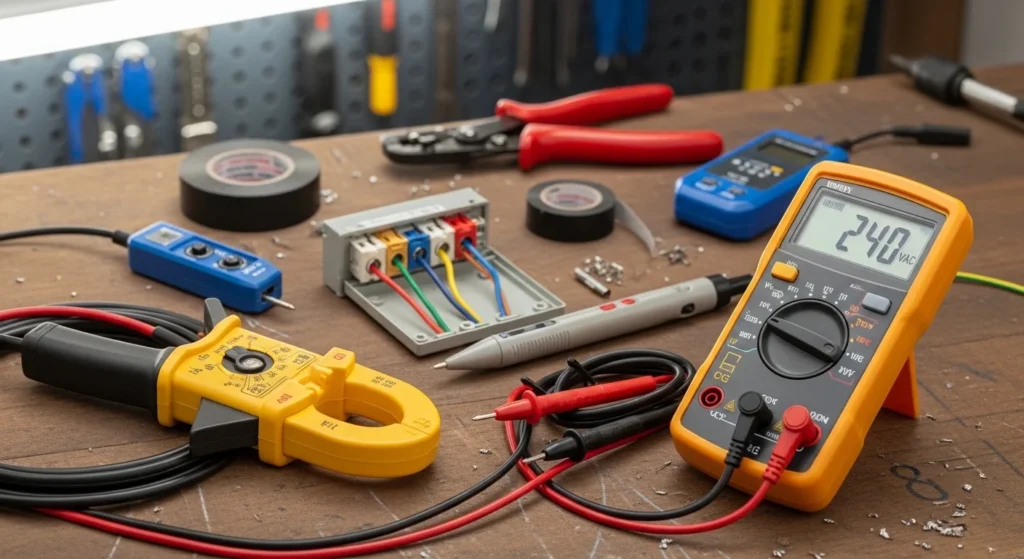
Multimeter
- Measures voltage, current, and resistance.
- Available in analog and digital types.
- Most commonly used tool.
Clamp Meter
- Measures current without breaking circuit.
- Uses magnetic field sensing.
- Safe for high current measurement.
Voltage Tester
- Detects presence of voltage.
- Simple and quick checking tool.
Insulation Resistance Tester (Megger)
- Tests insulation quality.
- Applies high DC voltage.
- Used in motors and cables.
Continuity Tester
- Checks whether circuit path is complete.
- Produces sound or light indication.
Earth Tester
- Measures grounding resistance.
- Ensures proper earthing system.
Understanding difference between multimeter and clamp meter is important for beginners.
5. Main Components of Electrical Testing Tools
Display Unit
- Shows measured values.
- Digital display provides clear reading.
Probes / Test Leads
- Connect tool to circuit.
- Must be insulated and rated properly.
Measurement Circuit
- Internal electronic components.
- Converts electrical signals to display values.
Selector Switch
- Allows selection of measurement type.
- Voltage, current, resistance modes.
Power Source
- Battery powered in most portable tools.
Each component ensures safe and accurate measurement.
6. Advantages
Let us discuss electrical testing tools advantages and disadvantages.
Advantages
- Improves troubleshooting accuracy
- Enhances electrical safety
- Saves time in fault detection
- Prevents equipment damage
- Reduces maintenance cost
- Supports professional installation work
- Helps verify system performance
Real-world benefit: Proper testing prevents electric shock and fire hazards.
7. Disadvantages / Limitations
- Requires training for correct use
- Wrong measurement range may damage tool
- Cheap quality tools give inaccurate readings
- Batteries require replacement
- High-end tools can be expensive
Engineers must choose reliable and certified tools.
8. Electrical Testing Tools Applications
Electrical testing tools applications are very wide.
Home Applications
- Checking household voltage
- Testing faulty switches
- Detecting broken wires
Industrial Applications
- Motor testing
- Panel inspection
- Transformer testing
- Cable insulation testing
Commercial Applications
- Office electrical maintenance
- Generator system testing
- UPS inspection
Modern Technology
- Renewable energy system testing
- Electric vehicle charging station inspection
- Smart building monitoring
Electrical testing tools are essential in every electrical field.
9. Comparison Section
Difference Between Multimeter and Clamp Meter
| Feature | Multimeter | Clamp Meter |
| Measures Current | Yes (Series) | Yes (Without breaking circuit) |
| Measures Voltage | Yes | Yes |
| Measures Resistance | Yes | Limited models |
| Safety for High Current | Medium | High |
| Typical Use | General testing | High current measurement |
This comparison helps understand difference between multimeter and clamp meter clearly.
10. Selection Guide
When choosing electrical testing tools:
- Check voltage and current rating
- Verify safety category (CAT rating)
- Choose digital display for accuracy
- Consider measurement range
- Select trusted brand
Beginner Tips
- Start with a good digital multimeter.
- Do not use low-rated tools on high voltage.
- Always inspect test leads before use.
- Follow lockout and safety procedures.
Proper selection ensures safe operation.
11. Common Problems & Solutions
Why is multimeter showing wrong reading?
Cause:
- Low battery
- Wrong range selection
Solution:
- Replace battery
- Select correct measurement mode
Why does clamp meter not measure small current?
Cause:
- Minimum current threshold
Solution:
- Use multimeter in series for small current
Why does insulation tester show low value?
Cause:
- Moisture in cable
- Insulation damage
Solution:
- Dry cable
- Replace damaged insulation
12. Future Trends
Electrical testing technology is improving rapidly.
Smart Testing Tools
- Bluetooth connectivity
- Mobile app integration
- Data logging features
Non-Contact Measurement
- Infrared temperature sensors
- Wireless voltage detection
AI-Based Diagnostics
- Predictive maintenance
- Fault pattern recognition
Future electrical testing tools will become smarter and more automated.
13. Conclusion
Electrical testing tools are essential instruments for safe and professional electrical work. They help measure voltage, current, resistance, and insulation, ensuring system safety and reliability. Understanding electrical testing tools working principle, types, applications, and advantages and disadvantages is fundamental for every electrical student and engineer.
We discussed different tools such as multimeter, clamp meter, insulation tester, and voltage tester. We also explained comparison, selection guide, and troubleshooting tips.
As a junior engineer, always prioritize safety, proper rating selection, and correct usage techniques. Accurate measurement is the backbone of electrical engineering practice.
Keep learning and practicing safe testing procedures to build strong technical skills.