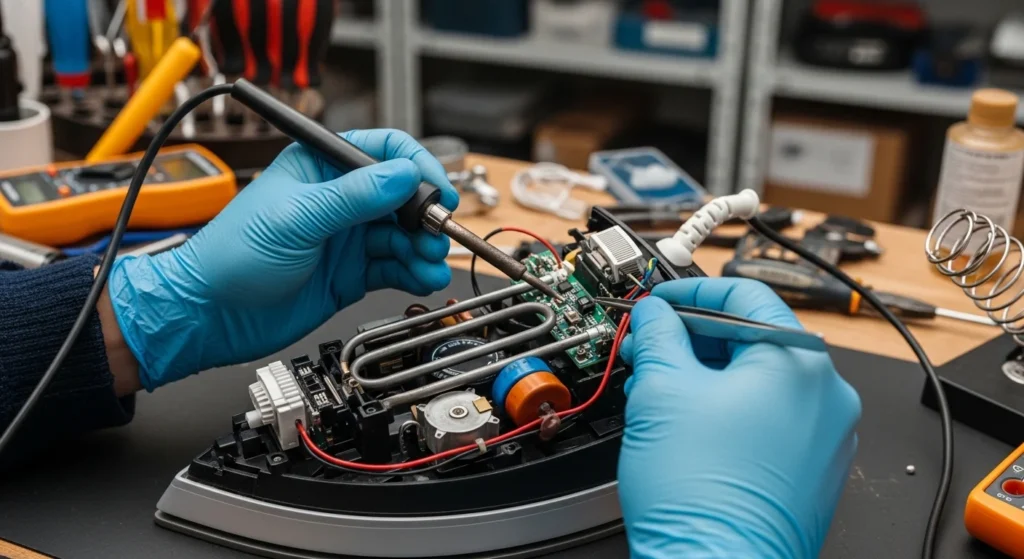

Imagine preparing clothes for an important meeting or school event, but when you plug in your electric iron, nothing happens. The iron does not heat up, the indicator light stays off, and your clothes remain wrinkled. Situations like this are common in homes and workshops, and they often require electric iron repair.
Electric irons are simple yet essential household appliances. They use electrical energy to produce heat that removes wrinkles from clothes. Because they operate frequently and handle high temperatures, faults such as heating problems, thermostat failure, or damaged cords can occur.
For electrical students, technicians, and beginners, learning how to repair an electric iron is a practical skill. Understanding the internal components and the electric iron working principle makes troubleshooting easier and safer.
In this guide, you will learn the fundamentals of electric iron repair, including how an iron works, common types of irons, major components, typical faults, and practical troubleshooting steps. By the end of this article, you will have a clear understanding of how to diagnose problems, repair common issues, and maintain electric irons efficiently.
What is Electric Iron Repair?
Electric iron repair is the process of diagnosing, troubleshooting, and fixing faults in an electric iron to restore its normal heating and ironing function.
Electric irons may stop working due to several reasons such as a broken heating element, faulty thermostat, damaged power cord, or loose electrical connections. Repair involves identifying the faulty part and replacing or fixing it.
Simple Explanation
Electric iron repair usually includes:
- Checking electrical connections
- Testing heating elements
- Replacing damaged parts
- Cleaning internal components
- Ensuring safe operation
Practical Example
Suppose an iron is plugged into a power socket but does not heat up. A technician may check the following:
- Power cord continuity
- Thermostat operation
- Heating element condition
After identifying the faulty component, the technician replaces or repairs it, restoring the iron to working condition.
Electric Iron Working Principle
Understanding the electric iron working principle is essential before attempting any repair.
An electric iron converts electrical energy into heat energy through a heating element.
Step-by-Step Working Process
- Electric Power SupplyThe iron is connected to an electrical outlet.
- Current FlowElectric current flows through the heating element.
- Heat GenerationThe heating element produces heat due to electrical resistance.
- Temperature ControlA thermostat regulates the temperature by turning the heating element on and off.
- Heat TransferThe metal soleplate transfers heat to clothes, removing wrinkles.
Simple Analogy
The heating element in an iron works like an electric heater. When electricity passes through a resistance wire, it produces heat that warms the soleplate.
Types / Classification of Electric Irons
Electric irons come in different types depending on design and technology.
Dry Iron
Dry irons are the most basic type.
Characteristics:
- No steam function
- Simple temperature control
- Lightweight and affordable
These irons are commonly used for everyday ironing.
Steam Iron
Steam irons release steam while ironing.
Features include:
- Water tank
- Steam vents
- Adjustable steam control
Steam helps remove wrinkles more easily.
Cordless Iron
Cordless irons operate without a permanent power cord.
They use a base station to heat the iron periodically.
Benefits include improved mobility and convenience.
Travel Iron
Travel irons are compact and lightweight.
They are designed for portability and can operate at multiple voltage levels.
Main Components of an Electric Iron
Understanding the components helps in performing effective electric iron repair.
Heating Element
The heating element is responsible for generating heat.
It is usually made from resistance wire embedded in insulating material.
Thermostat
The thermostat regulates temperature.
It automatically switches the heating element on and off to maintain the selected heat level.
Soleplate
The soleplate is the flat metal surface that touches the clothes.
It distributes heat evenly during ironing.
Power Cord
The power cord supplies electricity from the outlet to the iron.
Damaged cords are a common cause of iron failure.
Indicator Light
The indicator light shows whether the iron is heating or ready for use.
Water Tank (Steam Irons)
Steam irons contain a water tank that produces steam during operation.
Electric Iron Advantages and Disadvantages
Understanding electric iron advantages and disadvantages helps users maintain and repair them effectively.
Advantages
- Simple and reliable appliance
- Easy to operate
- Affordable household tool
- Fast heating capability
- Widely available spare parts
Disadvantages / Limitations
- Heating element may burn out over time
- Power cord damage is common
- Scale buildup in steam irons
- Risk of overheating if thermostat fails
Regular maintenance helps reduce these issues.
Electric Iron Applications
Electric irons are used in many environments beyond homes.
Household Use
The primary electric iron applications include ironing clothes at home.
Laundry Services
Commercial laundries use heavy-duty electric irons for large volumes of clothes.
Textile Industry
Factories use industrial irons for garment finishing.
Hotels and Hospitality
Hotels maintain professional ironing services for guest clothing.
Comparison Section
Difference Between Dry Iron and Steam Iron
| Feature | Dry Iron | Steam Iron |
|---|---|---|
| Steam Function | No | Yes |
| Water Tank | Not required | Required |
| Wrinkle Removal | Moderate | More effective |
| Maintenance | Simple | Requires cleaning |
| Cost | Lower | Higher |
Understanding the difference between dry iron and steam iron helps users choose the right appliance.
Selection Guide
Choosing the right iron depends on several factors.
Type of Use
For simple ironing, dry irons are sufficient.
For heavy wrinkles, steam irons are better.
Power Rating
Higher wattage irons heat faster and work more efficiently.
Safety Features
Choose irons with automatic shut-off and temperature control.
Build Quality
Durable soleplates and strong cords increase lifespan.
Beginners should select simple models that are easy to repair.
Common Problems & Solutions
Why is the iron not heating?
Possible causes:
- Broken heating element
- Faulty thermostat
- Loose internal wiring
Solution: Test components and replace defective parts.
Why does the iron overheat?
Possible causes:
- Thermostat malfunction
- Temperature control failure
Solution: Replace the thermostat.
Why is the indicator light not turning on?
Possible causes:
- Burned-out bulb
- Power cord damage
Solution: Check power supply and replace the bulb.
Why is steam not coming out?
Possible causes:
- Blocked steam vents
- Mineral deposits
Solution: Clean the water tank and steam holes.
Future Trends
Electric irons are evolving with new technology.
Smart Irons
Modern irons include sensors that adjust temperature automatically.
Energy-Efficient Heating
New heating elements reduce electricity consumption.
Advanced Steam Technology
Improved steam systems remove wrinkles more effectively.
Automatic Safety Systems
Modern irons include auto shut-off features to prevent overheating.
Conclusion
Electric iron repair is an important skill for electrical students, technicians, and beginners who want practical knowledge of household appliances. Electric irons operate using a simple heating system where electrical energy is converted into heat energy.
In this article, we discussed the electric iron working principle, types of irons, main components, advantages, disadvantages, and common electric iron applications. We also examined typical problems such as heating failure, thermostat faults, and power cord damage, along with practical solutions.
Understanding how electric irons function helps technicians diagnose problems quickly and perform effective repairs. With proper maintenance and correct troubleshooting techniques, most electric iron problems can be solved easily.
Learning appliance repair not only saves money but also develops valuable technical skills for anyone working in electrical maintenance and repair.