
Imagine you buy a new electric motor for a water pump. The motor consumes electrical power from the supply, but not all of that power becomes useful mechanical output. Some energy is lost as heat, friction, sound, or electrical losses inside the motor. The important question for engineers is: how much of the input energy actually becomes useful output?
This is where the Efficiency Formula becomes very important. Efficiency helps engineers measure how effectively a system converts input energy into useful output energy. Whether it is an electric motor, generator, transformer, or even a power plant, efficiency tells us how well the system performs.
High efficiency means less energy waste, lower operating costs, and better performance. Low efficiency means more energy loss and higher electricity bills.
Electrical engineers, technicians, and students use the efficiency formula to analyze machines, improve system performance, and design better equipment.
In this article, you will learn the Efficiency Formula working principle, different types of efficiency, Efficiency Formula applications, and the Efficiency Formula advantages and disadvantages. The explanation is written in simple and practical language so beginners can easily understand the concept.
2. What is Efficiency Formula?
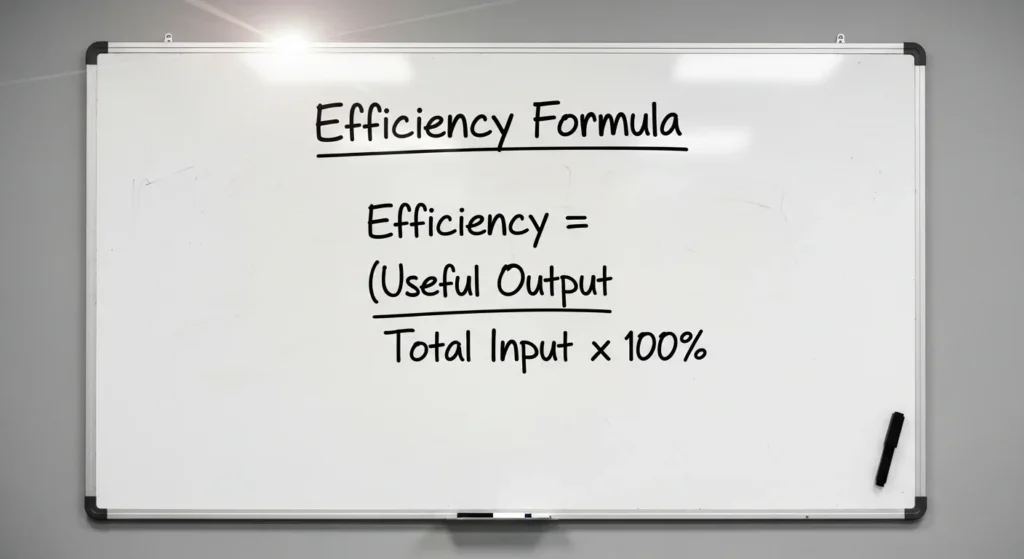
The Efficiency Formula is a mathematical expression used to calculate how effectively a system converts input energy or power into useful output.
In electrical engineering, efficiency is usually expressed as a percentage.
The basic Efficiency Formula is shown below.
Where:
- η (eta) = Efficiency
- Output Power = Useful power delivered by the system
- Input Power = Total power supplied to the system
Simple Explanation
Efficiency tells us how much useful work we get from the energy we supply.
For example:
- Input power to a motor = 1000 watts
- Output mechanical power = 900 watts
Efficiency = 90%
This means 10% of energy is lost inside the machine.
Practical Example
Consider an electric heater.
- Input electrical energy: 1000 W
- Output heat energy: 950 W
Efficiency = 95%
The remaining 50 W may be lost through wires or internal resistance.
This simple calculation helps engineers evaluate machine performance.
3. Efficiency Formula Working Principle
The Efficiency Formula working principle is based on the conservation of energy.
Energy cannot be created or destroyed; it can only change form. However, during energy conversion, some energy is always lost due to physical limitations.
Step-by-Step Explanation
- Energy enters a system as input energy.
- The system converts energy into another useful form.
- Some energy is lost due to friction, heat, resistance, or vibration.
- The remaining energy becomes useful output energy.
- The efficiency formula compares output energy with input energy.
Simple Analogy
Think of efficiency like carrying water in a bucket with small holes.
- Water poured into bucket = input energy
- Water reaching destination = useful output
- Water leaking = energy losses
Efficiency tells us how much water successfully reaches the destination.
Key Factors Affecting Efficiency
- Electrical resistance
- Mechanical friction
- Heat losses
- Magnetic losses
- Environmental conditions
Understanding these factors helps engineers improve system efficiency.
4. Types / Classification of Efficiency
Efficiency can be classified into several types depending on the system being analyzed.
Mechanical Efficiency
Mechanical efficiency applies to machines such as engines, turbines, and motors.
Formula concept:
Mechanical efficiency compares mechanical output power with mechanical input power.
Example:
- Turbines
- Gear systems
- Engines
Electrical Efficiency
Electrical efficiency is used in electrical machines and circuits.
It compares electrical output power with electrical input power.
Examples include:
- Transformers
- Electric motors
- Generators
Thermal Efficiency
Thermal efficiency is used in heat engines and power plants.
It measures how efficiently heat energy is converted into useful mechanical or electrical energy.
Examples:
- Steam turbines
- Internal combustion engines
- Thermal power plants
Overall Efficiency
Overall efficiency considers multiple stages of energy conversion.
Example:
Fuel → heat → mechanical energy → electrical energy
Each stage has losses, so the overall efficiency is lower.
This concept is important in large power generation systems.
5. Main Components of Efficiency Calculation
When calculating efficiency using the Efficiency Formula, several important elements are involved.
Input Power
Input power is the total energy supplied to the system.
Examples:
- Electrical power supplied to motor
- Fuel energy supplied to engine
- Heat energy supplied to turbine
Output Power
Output power is the useful energy produced by the system.
Examples:
- Mechanical rotation of motor shaft
- Electrical power from generator
- Useful heat from heater
Energy Losses
Energy losses reduce efficiency.
Common types of losses include:
- Heat losses
- Friction losses
- Copper losses
- Magnetic losses
Reducing these losses increases system efficiency.
Measurement Instruments
Engineers use instruments to measure input and output power.
Common tools include:
- Wattmeters
- Power analyzers
- Torque meters
- Energy meters
These instruments help calculate accurate efficiency values.
6. Advantages of Efficiency Formula
Understanding the Efficiency Formula advantages and disadvantages helps engineers design better systems.
Advantages
- Helps evaluate machine performance
- Identifies energy losses in systems
- Improves energy management
- Reduces electricity consumption
- Supports better engineering design
- Helps compare different machines
In modern industries, efficiency measurement is essential for energy optimization.
7. Disadvantages / Limitations
Despite its usefulness, the efficiency formula has some limitations.
- Requires accurate measurement of input and output power
- Difficult to measure losses precisely in complex systems
- Environmental conditions may affect results
- Efficiency varies with load conditions
Therefore, engineers often perform efficiency tests under controlled conditions.
8. Efficiency Formula Applications
There are many Efficiency Formula applications in electrical engineering and technology.
Electric Motors
Efficiency helps determine how well a motor converts electrical power into mechanical rotation.
High-efficiency motors reduce electricity consumption in industries.
Generators
Generators convert mechanical energy into electrical energy.
Efficiency calculations help evaluate generator performance.
Transformers
Transformer efficiency determines how effectively electrical power is transferred between circuits.
High efficiency reduces transmission losses.
Power Plants
Efficiency analysis is critical in:
- Thermal power plants
- Hydro power plants
- Nuclear power plants
Improving efficiency reduces fuel consumption.
Household Appliances
Many home appliances are rated based on efficiency.
Examples include:
- Air conditioners
- Refrigerators
- Washing machines
Higher efficiency appliances save electricity.
9. Comparison: Efficiency vs Effectiveness
Understanding the difference between efficiency and effectiveness is important.
| Feature | Efficiency | Effectiveness |
|---|---|---|
| Definition | Measures energy conversion performance | Measures goal achievement |
| Focus | Resource utilization | Final results |
| Measurement | Input vs output energy | Task completion |
| Example | Motor energy efficiency | Machine performing required task |
Both concepts are important in engineering management.
10. Selection Guide
When evaluating equipment using the efficiency formula, engineers consider several factors.
Rated Efficiency
Always check the rated efficiency provided by the manufacturer.
Load Conditions
Machines usually have maximum efficiency near rated load.
Operating far from rated load reduces efficiency.
Energy Losses
Select equipment designed with low energy losses.
Examples include:
- High-quality materials
- Improved cooling systems
Energy Standards
Many countries have efficiency standards for electrical equipment.
Selecting certified equipment improves long-term reliability.
11. Common Problems & Solutions
Why is system efficiency low?
Possible reasons:
- Excessive heat losses
- Mechanical friction
- Poor maintenance
Solution: Improve cooling, lubrication, and system design.
Why does efficiency decrease with time?
Machines wear out over time.
Causes include:
- Bearing wear
- Insulation degradation
- Dust accumulation
Regular maintenance improves efficiency.
Why is efficiency different at various loads?
Most machines have maximum efficiency at rated load.
Operating at very low or very high loads reduces efficiency.
12. Future Trends
Efficiency improvement is a major focus in modern engineering.
Smart Energy Monitoring
Advanced sensors monitor energy usage and efficiency in real time.
High-Efficiency Electrical Machines
Modern motors use improved materials and advanced designs.
Artificial Intelligence Optimization
AI systems can analyze energy systems and optimize efficiency automatically.
Renewable Energy Integration
Solar and wind power systems require efficient energy conversion technologies.
These trends will help reduce global energy consumption.
13. Conclusion
The Efficiency Formula is one of the most important concepts in electrical engineering and energy systems. It helps engineers measure how effectively a machine or system converts input energy into useful output energy.
By using the efficiency formula, engineers can identify energy losses, improve machine design, and optimize system performance. Whether analyzing electric motors, generators, transformers, or power plants, efficiency plays a critical role in determining system performance.
Understanding the Efficiency Formula working principle, types, and Efficiency Formula applications allows students and engineers to evaluate machines more accurately. Although no system can achieve 100% efficiency due to unavoidable losses, modern engineering continues to improve efficiency through better materials, smarter designs, and advanced technology.
For anyone studying electrical engineering or working in the energy sector, mastering the efficiency formula is essential for building reliable and energy-efficient systems.