
Think about a small toy car. When you insert a battery and switch it ON, the wheels start rotating. Inside that toy car, a small motor converts electrical energy into mechanical motion. That motor is usually a DC motor.
From electric vehicles and cranes to robotics and conveyor belts, DC motors are used everywhere. As an electrical student or technician, understanding DC motor explained simply is not just theory—it is practical knowledge you will use in real projects, maintenance work, and industrial systems.
Many beginners find motors confusing because of terms like armature, commutator, and field winding. But once you understand the basic DC motor working principle, everything becomes clear and logical.
In this complete guide, you will learn:
- What a DC motor is
- DC motor working principle step by step
- Types of DC motors
- Components and their functions
- DC motor applications
- DC motor advantages and disadvantages
- Difference between DC motor and AC motor
- Selection tips and troubleshooting
Let’s start from the basics.
2. What Is DC Motor Explained Simply?
A DC motor is an electrical machine that converts direct current (DC) electrical energy into mechanical energy (rotation).
In simple words:
When DC voltage is applied to the motor, it starts rotating.
Practical Example
Imagine you connect a 12V battery to a small motor. The motor shaft begins to spin. That spinning motion can:
- Rotate a fan
- Move a conveyor belt
- Drive a pump
So, DC motor explained simply means:
DC electricity goes in → Rotation comes out.
It is one of the most important machines in electrical engineering.
3. DC Motor Working Principle
To understand DC motor working principle, remember one important rule:
A current-carrying conductor placed in a magnetic field experiences a force.
This force causes rotation.
Step-by-Step Working
- DC Supply Applied
- Voltage is given to motor terminals.
- Voltage is given to motor terminals.
- Current Flows in Armature
- Current flows through conductors.
- Current flows through conductors.
- Magnetic Field Present
- Field winding or permanent magnet creates magnetic field.
- Field winding or permanent magnet creates magnetic field.
- Force is Produced
- Interaction between magnetic field and current produces force.
- Interaction between magnetic field and current produces force.
- Rotor Starts Rotating
- Continuous force creates continuous rotation.
- Continuous force creates continuous rotation.
- Commutator Changes Current Direction
- Keeps torque in same direction.
- Ensures smooth rotation.
- Keeps torque in same direction.
Simple Analogy
Think of a water wheel:
- Water hits the wheel.
- Wheel rotates continuously.
In DC motor:
- Current is like water.
- Magnetic field is like gravity.
- Rotor rotates due to force.
That is the core DC motor working principle.
4. Types / Classification of DC Motor
DC motors are classified based on how the field winding is connected.
Separately Excited DC Motor
- Field winding powered separately.
- Armature powered separately.
Used in:
- Precise speed control systems.
Shunt DC Motor
- Field winding connected in parallel (shunt) with armature.
- Speed remains almost constant.
Best for:
- Lathes
- Fans
- Conveyors
Series DC Motor
- Field winding connected in series with armature.
- High starting torque.
Used in:
- Cranes
- Electric trains
- Starter motors
Compound DC Motor
- Combination of series and shunt.
- Balanced performance.
Understanding these types helps in choosing correct DC motor applications.
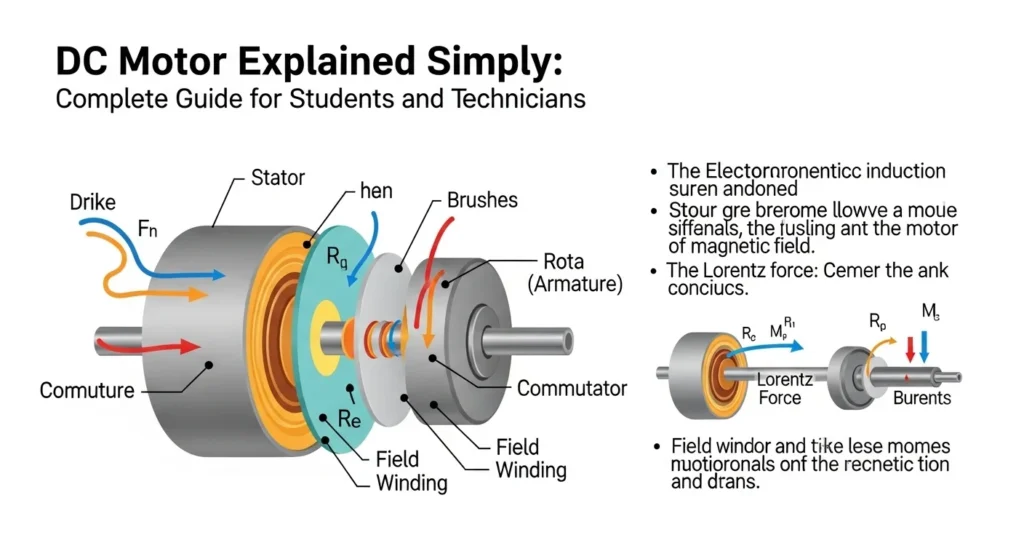
5. Main Components of DC Motor
Every DC motor has important parts.
1. Armature
- Rotating part.
- Carries current.
- Produces torque.
2. Field Winding
- Produces magnetic field.
- Mounted on stator.
3. Commutator
- Mechanical rectifier.
- Reverses current direction.
4. Brushes
- Made of carbon.
- Transfer current from supply to rotating armature.
5. Shaft
- Transfers mechanical output to load.
6. Stator
- Stationary outer frame.
- Supports field system.
Each part plays an essential role in DC motor working principle.
6. DC Motor Advantages and Disadvantages
Advantages
- Simple speed control
- High starting torque
- Quick response
- Easy installation
- Good for battery systems
These DC motor advantages and disadvantages must be evaluated before selection.
7. Disadvantages / Limitations
- Brushes wear out
- Requires maintenance
- Not suitable for very high-speed applications
- Sparking may occur
- Higher cost compared to some AC motors
Regular maintenance reduces these issues.
8. DC Motor Applications
DC motor applications are very wide.
Home Applications
- Toys
- Small pumps
- Portable tools
Industrial Applications
- Cranes
- Elevators
- Rolling mills
- Conveyors
Automotive Applications
- Car wipers
- Power windows
- Starter motors
Modern Technology
- Robotics
- Electric vehicles
- Solar-powered systems
Because of good speed control, DC motors are widely used in automation.
9. Difference Between DC Motor and AC Motor
Understanding the difference between DC motor and AC motor is very important.
| Feature | DC Motor | AC Motor |
| Supply | Direct Current | Alternating Current |
| Speed Control | Easy | More complex |
| Maintenance | Higher (brushes) | Lower |
| Cost | Higher | Generally lower |
| Applications | Precise control | Heavy industrial loads |
Both motors have their own importance depending on application.
10. Selection Guide
Choosing the right DC motor depends on:
1. Load Requirement
- High torque → Series motor
- Constant speed → Shunt motor
2. Power Rating
- Calculate load in watts or horsepower.
3. Voltage Rating
- Match motor voltage with supply voltage.
4. Speed Requirement
- Check RPM rating.
Tips for Beginners
- Never overload motor
- Check insulation resistance
- Use proper fuse protection
- Ensure proper cooling
Correct selection improves efficiency and life.
11. Common Problems & Solutions
Q1: Motor not starting?
Possible Causes:
- No supply
- Loose connection
- Burnt brushes
Solution:
- Check voltage
- Tighten wiring
- Replace brushes
Q2: Excessive Sparking?
Cause:
- Worn commutator
- Loose brushes
Solution:
- Clean commutator
- Adjust brush pressure
Q3: Motor overheating?
Cause:
- Overload
- Poor ventilation
Solution:
- Reduce load
- Improve cooling
Q4: Speed fluctuation?
Cause:
- Voltage variation
- Field winding issue
Solution:
- Check supply
- Inspect field circuit
Proper maintenance ensures longer service life.
12. Future Trends
Modern DC motor technology is improving.
New Developments
- Brushless DC motors (BLDC)
- Smart motor controllers
- IoT-based monitoring
- Energy-efficient designs
- Electric vehicle motors
Brushless DC motors reduce maintenance because they do not use brushes.
In future, DC motors will play a major role in renewable energy and electric transportation systems.
13. Conclusion
DC motor explained simply means converting DC electrical energy into mechanical rotation using magnetic force. Understanding DC motor working principle makes it easy to analyze performance, types, and applications.
We discussed DC motor applications, DC motor advantages and disadvantages, and the difference between DC motor and AC motor. Each type of DC motor has its own importance depending on load and speed requirements.
As an electrical student or technician, mastering DC motor basics will strengthen your foundation in machines and drive systems. Focus on practical understanding, safety, and correct selection.
Strong fundamentals today will build strong engineering skills tomorrow.