
Imagine you are inspecting an electrical distribution panel in a factory. The machines are running, and you need to measure the current flowing through a cable. If you disconnect the wire to measure current with a traditional meter, the entire system must be shut down. This can stop production and cause serious inconvenience. In such situations, electricians use a clamp meter to measure current safely without disconnecting the circuit.
A clamp meter is one of the most practical tools for electrical troubleshooting and maintenance. It allows technicians to measure current by simply clamping the meter around a conductor. This method saves time, improves safety, and avoids interrupting electrical systems.
For electrical students, engineers, technicians, and beginners, understanding how to use a clamp meter is an essential skill. It is widely used in power systems, motor testing, industrial maintenance, and electrical inspections.
In this guide, you will learn the clamp meter working principle, types of clamp meters, key components, advantages and disadvantages, and real-world clamp meter applications. By the end of this article, you will understand how clamp meters operate and why they are a critical tool for modern electrical work.
What is a Clamp Meter?
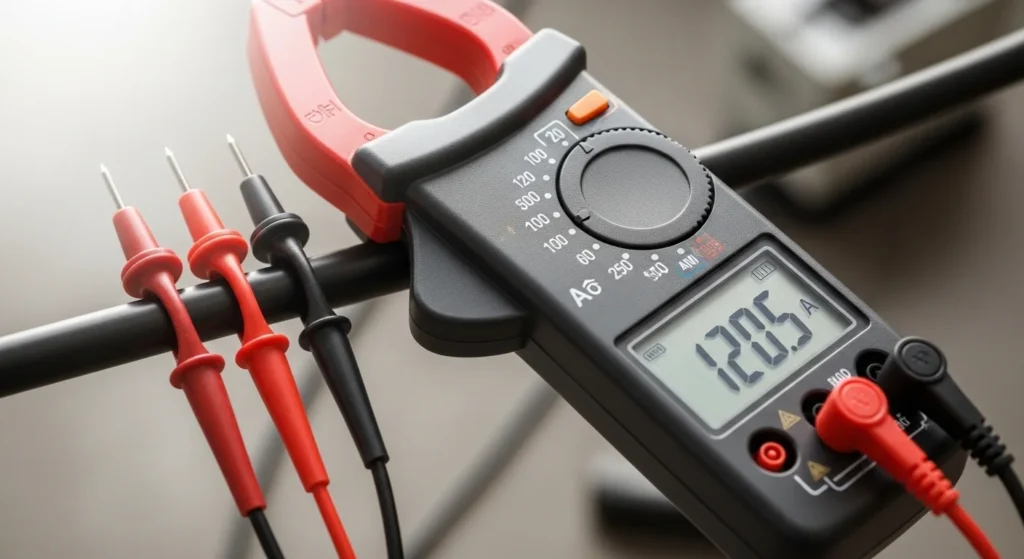
A clamp meter is an electrical measuring instrument used to measure current in a conductor without physically disconnecting the circuit.
The meter has a clamp-shaped sensor that surrounds a wire. When current flows through the conductor, the clamp detects the magnetic field produced by that current and converts it into a measurable value.
Simple Explanation
A clamp meter measures electrical current by detecting the magnetic field around a wire. The wire does not need to be cut or disconnected.
Many modern clamp meters can also measure:
- Voltage
- Resistance
- Continuity
- Frequency
Practical Example
Suppose an electrician needs to check the current drawn by an air conditioner. Instead of disconnecting the cable, the technician places the clamp around the live wire. The meter immediately displays the current reading.
This quick and safe measurement shows why clamp meters are widely used in electrical maintenance.
Clamp Meter Working Principle
Understanding the clamp meter working principle helps technicians use the instrument correctly.
Clamp meters measure current based on electromagnetic principles.
Step-by-Step Working Process
- Current Flow in ConductorWhen electric current flows through a wire, it creates a magnetic field around the conductor.
- Clamp Sensor DetectionThe clamp jaws surround the conductor and detect the magnetic field.
- Magnetic Field ConversionThe internal sensor converts the magnetic field into an electrical signal.
- Signal ProcessingElectronic circuits process the signal and calculate the current value.
- Display OutputThe measured current is displayed on the meter screen.
Simple Analogy
Think of the clamp meter like a sensor that “feels” the magnetic energy around a wire. Instead of touching the current directly, it detects the field created by it.
Important Measurement Tip
For accurate measurement:
- Clamp only one conductor at a time
- Do not clamp both live and neutral wires together
Otherwise, the magnetic fields cancel each other and the reading becomes zero.
Types / Classification of Clamp Meters
Clamp meters are available in different designs depending on their technology and applications.
Analog Clamp Meter
Analog clamp meters use a needle pointer and scale.
Characteristics:
- Mechanical display
- Simple design
- Requires manual reading
They are less common today but still useful for observing changing current values.
Digital Clamp Meter
Digital clamp meters display readings on an LCD screen.
Features include:
- High measurement accuracy
- Easy-to-read display
- Multiple measurement functions
These meters are the most widely used in modern electrical work.
AC Clamp Meter
AC clamp meters measure alternating current only.
Key features:
- Uses transformer-based sensing
- Commonly used in industrial electrical systems
AC/DC Clamp Meter
These meters can measure both alternating current and direct current.
Features include:
- Hall-effect sensors
- Used in automotive and battery systems
Main Components of a Clamp Meter
A clamp meter consists of several important components that allow accurate measurement.
Clamp Jaws
The clamp jaws are the most important part of the meter.
They open and close around a conductor to detect magnetic fields produced by current.
Display Screen
The display shows the measured value.
Digital clamp meters use LCD displays that provide clear and precise readings.
Function Selector Switch
This switch allows users to select different measurement modes such as:
- Current
- Voltage
- Resistance
Test Leads
Clamp meters usually include test leads for measuring voltage, resistance, and continuity.
Internal Sensor
The internal sensor converts magnetic fields into electrical signals.
Hall-effect sensors are commonly used in modern clamp meters.
Battery
The battery powers the electronic circuits of the clamp meter.
Clamp Meter Advantages and Disadvantages
Understanding clamp meter advantages and disadvantages helps technicians choose the right measuring tool.
Advantages
- Measures current without disconnecting the circuit
- Improves safety during electrical testing
- Fast and convenient measurements
- Ideal for high-current applications
- Portable and easy to use
- Reduces system downtime
Disadvantages / Limitations
- Slightly less accurate than direct current measurement methods
- Cannot measure current if both wires are clamped together
- Some models measure AC only
- Higher cost compared to basic multimeters
Despite these limitations, clamp meters remain essential for electrical troubleshooting.
Clamp Meter Applications
Clamp meters are used in many industries and technical environments.
Industrial Electrical Maintenance
Common clamp meter applications include measuring motor current, power distribution loads, and equipment performance.
Household Electrical Inspection
Electricians use clamp meters to test current in appliances, air conditioners, and lighting circuits.
HVAC Systems
Clamp meters help technicians check compressor current and diagnose electrical faults.
Automotive Systems
AC/DC clamp meters are used to measure battery charging current and electrical load.
Renewable Energy Systems
Technicians use clamp meters to monitor solar panel and inverter current.
Comparison Section
Difference Between Clamp Meter and Multimeter
| Feature | Clamp Meter | Multimeter |
|---|---|---|
| Current Measurement | Without disconnecting circuit | Requires circuit connection |
| Safety | Safer for high current | Less safe for high current |
| Accuracy | Moderate | High for direct measurement |
| Usage | Industrial and maintenance | General electrical testing |
| Convenience | Very convenient | Requires probe connection |
Understanding the difference between clamp meter and multimeter helps technicians choose the appropriate instrument for different tasks.
Selection Guide
Choosing the right clamp meter depends on several factors.
Measurement Type
Select an AC clamp meter for standard electrical work.
Choose an AC/DC clamp meter for automotive or battery systems.
Measurement Range
Ensure the meter supports the required current range for your application.
Safety Rating
Choose meters with proper safety standards for industrial environments.
Additional Features
Modern clamp meters may include:
- Temperature measurement
- Frequency testing
- Data logging
Beginners should start with a reliable digital clamp meter with basic functions.
Common Problems & Solutions
Why is the clamp meter showing zero current?
Possible causes:
- Clamping both live and neutral wires
- No current flow in the circuit
Solution: Clamp only one conductor.
Why are readings unstable?
Possible causes:
- Weak battery
- External magnetic interference
Solution: Replace battery and measure away from strong magnetic sources.
Why is the display not turning on?
Possible causes:
- Dead battery
- Internal electronic failure
Solution: Replace battery or service the meter.
Why are measurements inaccurate?
Possible causes:
- Incorrect measurement mode
- Damaged clamp sensor
Solution: Verify settings and inspect the clamp jaws.
Future Trends
Measurement technology continues to improve with advanced innovations.
Smart Clamp Meters
Modern clamp meters can connect to smartphones for data recording and analysis.
Wireless Data Monitoring
Future meters will support remote monitoring through wireless communication.
Advanced Safety Features
New designs will include improved insulation and protection against high voltage.
Integration with Digital Systems
Clamp meters may integrate with smart electrical systems for automated monitoring and diagnostics.
Conclusion
A clamp meter is an essential tool for electricians, technicians, and engineers working with electrical systems. It allows safe and convenient current measurement without disconnecting wires, making it ideal for industrial maintenance and troubleshooting.
In this article, we explored the clamp meter working principle, types of clamp meters, major components, advantages and disadvantages, and important clamp meter applications. We also discussed the difference between clamp meter and multimeter and provided guidance on selecting the right instrument.
Understanding how to use a clamp meter properly improves efficiency and safety when working with electrical circuits. For electrical students and beginners, mastering this tool is a valuable step toward building strong technical skills in electrical measurement and diagnostics.