
Imagine entering a modern office building during a hot summer day. The environment feels cool and comfortable, but you cannot see any air conditioner on the walls. Instead, the cooling seems to come evenly from the ceiling. This is usually the result of a cassette air conditioner installed inside the ceiling.
Cassette air conditioners are widely used in commercial buildings such as offices, restaurants, hotels, and shopping malls. They provide uniform cooling while maintaining a clean and modern interior design. Unlike traditional wall-mounted air conditioners, cassette AC systems are installed inside a false ceiling and distribute air in multiple directions.
For electrical students, engineers, technicians, and beginners, understanding cassette air conditioners is very important. These systems are common in modern HVAC installations, and knowing how they work helps in installation, maintenance, and troubleshooting.
In this article, you will learn about the cassette air conditioner working principle, types, components, advantages and disadvantages, and real-world applications. By the end, you will clearly understand how cassette air conditioners work and how to select the right system for different environments.
What is a Cassette Air Conditioner?
A cassette air conditioner is a type of split air conditioning system where the indoor unit is mounted in the ceiling while the outdoor unit is installed outside the building.
Only the decorative panel of the indoor unit is visible from inside the room. The rest of the system is hidden in the ceiling space. This design allows the system to distribute cool air evenly across the room.
In simple words, a cassette air conditioner works like a regular split AC but is installed in the ceiling rather than on the wall.
Practical Example
Consider a large meeting room in an office. If a wall-mounted AC is used, it may cool only one side of the room effectively. However, a cassette air conditioner placed in the center of the ceiling can distribute air in four directions, ensuring uniform cooling across the entire space.
Because of this design, cassette air conditioners are commonly used in:
- Offices
- Shopping malls
- Hotels
- Restaurants
- Conference halls
Cassette Air Conditioner Working Principle
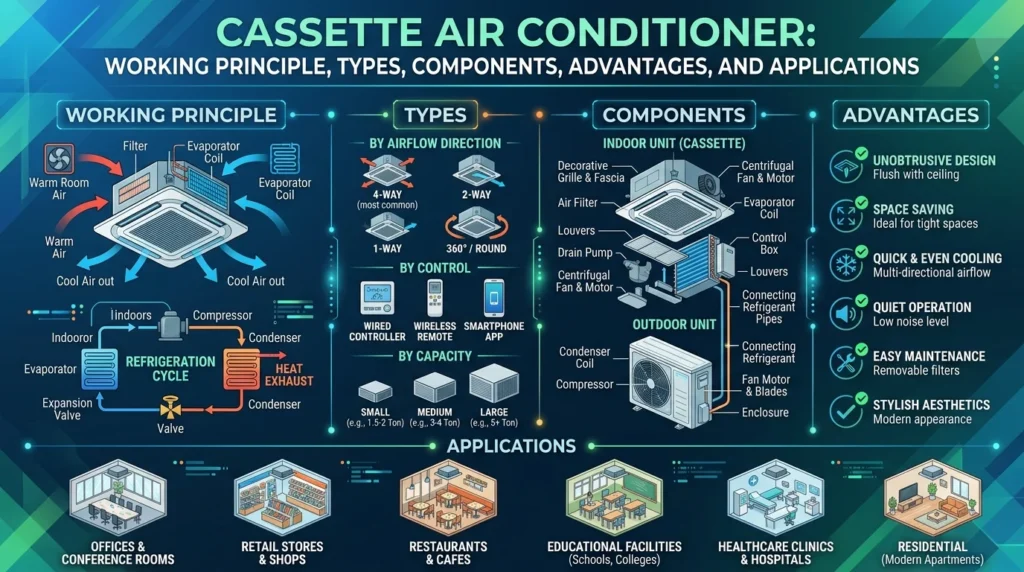
The cassette air conditioner working principle is based on the standard refrigeration cycle used in most air conditioning systems. The system removes heat from indoor air and releases it outside the building.
This process happens through four main stages: compression, condensation, expansion, and evaporation.
Step-by-Step Working Process
- Warm Air Intake
The indoor unit draws warm air from the room through the intake grille. - Cooling in the Evaporator Coil
The air passes over the evaporator coil, which contains cold refrigerant.
The refrigerant absorbs heat from the air, cooling it. - Air Distribution
The fan inside the cassette unit blows the cooled air back into the room.
Most cassette AC systems distribute air in four directions for uniform cooling. - Compression of Refrigerant
The refrigerant gas moves to the compressor located in the outdoor unit.
The compressor increases the pressure and temperature of the refrigerant. - Heat Release in Condenser
The hot refrigerant flows through the condenser coil and releases heat to the outside environment. - Expansion Process
The refrigerant passes through an expansion valve which reduces its pressure and temperature. - Cycle Repeats
The cooled refrigerant returns to the evaporator coil, and the cooling cycle continues.
Simple Analogy
Think of the system like a heat transfer pump. It removes heat from the room and moves it outside, leaving the indoor space cool and comfortable.
Types / Classification of Cassette Air Conditioners
Cassette air conditioners are classified based on airflow direction and design.
4-Way Cassette Air Conditioner
This is the most common type used in commercial buildings.
Air is distributed in four directions, which ensures uniform cooling across the room.
Key Features
- Wide air distribution
- Ideal for large spaces
- Most commonly used in offices and malls
2-Way Cassette Air Conditioner
This type distributes air in two directions.
It is usually installed in long or rectangular rooms such as corridors or hallways.
Key Features
- Suitable for narrow areas
- Controlled airflow direction
- Energy efficient for specific layouts
1-Way Cassette Air Conditioner
A one-way cassette AC blows air in only one direction.
This type is suitable for smaller rooms or areas where cooling needs to be focused in a specific direction.
Compact Cassette Air Conditioner
Compact cassette units are designed for smaller ceiling spaces.
They are commonly used in hotel rooms, small offices, or residential applications where ceiling space is limited.
Main Components
A cassette air conditioner consists of several key components that work together to produce cooling.
Compressor
The compressor is the most important part of the air conditioning system.
It compresses refrigerant gas and increases its pressure and temperature.
Evaporator Coil
The evaporator coil absorbs heat from the indoor air.
As warm air passes over the coil, the refrigerant absorbs heat and cools the air.
Condenser Coil
The condenser coil is located in the outdoor unit.
Its function is to release the heat absorbed from the room into the outdoor environment.
Expansion Valve
The expansion valve regulates the flow of refrigerant into the evaporator coil.
It reduces refrigerant pressure and temperature before entering the evaporator.
Indoor Fan (Blower)
The indoor fan circulates air across the evaporator coil and distributes cooled air into the room.
Air Filters
Air filters remove dust, dirt, and small particles from the air.
They help maintain indoor air quality and protect internal components.
Decorative Panel
The decorative panel is the visible part of the cassette unit installed on the ceiling.
It helps distribute air evenly and improves the appearance of the room.
Advantages
Understanding the cassette air conditioner advantages and disadvantages is important before selecting this system.
Advantages
- Provides uniform cooling due to multi-direction airflow
- Space-saving design because the unit is hidden in the ceiling
- Improves room aesthetics with minimal visible equipment
- Operates quietly, making it suitable for offices and hotels
- Ideal for large rooms and commercial spaces
- Better air distribution compared to wall AC units
Disadvantages / Limitations
Although cassette air conditioners have many benefits, they also have some limitations.
- Higher installation cost compared to wall-mounted AC systems
- Requires a false ceiling for installation
- Maintenance access may be more difficult
- Not suitable for very small rooms
- Installation requires professional technicians
Understanding these points helps technicians select the correct cooling system.
Cassette Air Conditioner Applications
There are many cassette air conditioner applications in modern buildings.
Commercial Buildings
- Offices
- Shopping malls
- Restaurants
- Hotels
- Conference rooms
Residential Uses
- Large living rooms
- Luxury apartments
- Villas with false ceilings
Industrial and Institutional Uses
- Hospitals
- Schools and universities
- Laboratories
- Training centers
Because of their design and performance, cassette AC systems are widely used in modern HVAC systems.
Comparison: Cassette Air Conditioner vs Split Air Conditioner
One common question is the difference between cassette air conditioner and split air conditioner.
| Feature | Cassette Air Conditioner | Wall-Mounted Split AC |
|---|---|---|
| Installation | Installed in ceiling | Installed on wall |
| Airflow | Four-direction airflow | One-direction airflow |
| Appearance | Hidden inside ceiling | Visible indoor unit |
| Cooling Coverage | Large rooms | Small to medium rooms |
| Installation Cost | Higher | Lower |
| Best Use | Commercial spaces | Homes and small offices |
This comparison helps engineers and technicians select the appropriate system.
Selection Guide
Choosing the right cassette air conditioner requires careful evaluation.
Room Size
Large rooms require higher cooling capacity measured in BTU or tons.
Ceiling Design
Cassette AC systems require a false ceiling for installation.
Air Distribution
If uniform cooling is required, a 4-way cassette AC is the best option.
Energy Efficiency
Choose systems with high energy efficiency ratings to reduce electricity consumption.
Maintenance Accessibility
Ensure there is enough ceiling access for cleaning filters and servicing components.
These simple guidelines help beginners choose the correct system.
Common Problems & Solutions
Why is the cassette air conditioner not cooling properly?
Possible causes:
- Dirty air filters
- Low refrigerant level
- Blocked airflow
- Compressor problems
Solution: Clean filters and check refrigerant levels.
Why is water leaking from the cassette AC?
Possible causes:
- Blocked drainage pipe
- Dirty evaporator coil
- Improper installation
Solution: Clean the drain system and ensure proper installation.
Why is the AC making unusual noise?
Possible reasons:
- Loose internal components
- Fan motor issues
- Dirt inside the blower
Solution: Inspect and tighten components.
Why is airflow weak?
Possible causes:
- Dirty filters
- Faulty fan motor
- Obstructed air outlets
Solution: Clean filters and inspect the fan system.
Future Trends
Air conditioning technology is evolving rapidly.
Future cassette air conditioners are expected to include:
- Smart control through mobile apps
- AI-based temperature management
- Energy-efficient inverter compressors
- Eco-friendly refrigerants
- Advanced air purification technologies
These innovations will improve performance, efficiency, and environmental sustainability.
Conclusion
Cassette air conditioners are a modern and efficient cooling solution, especially for large indoor spaces. Unlike traditional wall-mounted air conditioners, cassette units are installed in the ceiling and distribute air evenly in multiple directions. This design ensures uniform cooling and maintains the aesthetics of the room.
Understanding the cassette air conditioner working principle, components, and system operation is essential for electrical students, engineers, and technicians. These systems operate using the same refrigeration cycle as other air conditioners but provide better air distribution.
Although cassette air conditioners require higher installation cost and ceiling space, their performance, comfort, and design advantages make them ideal for commercial environments such as offices, hotels, and shopping centers.
Learning about the cassette air conditioner advantages and disadvantages, types, and applications will help beginners confidently install, maintain, and select these systems in real-world HVAC projects.