
Imagine an electrical technician installing a cable tray in an industrial building. During installation, metal brackets and pipes often need to be cut or shaped to fit properly. Using manual tools for this task can be slow and physically demanding. This is where a powerful tool called an angle grinder becomes extremely useful.
An angle grinder is one of the most commonly used power tools in electrical work, construction, metal fabrication, and mechanical workshops. It helps technicians cut, grind, polish, and smooth different materials quickly and accurately.
For electrical engineers and technicians, an angle grinder is especially useful when working with metal conduits, cable trays, brackets, bolts, and steel frames. With the right disc attachment, the same tool can perform many different tasks.
Understanding the angle grinder working principle, types, components, and angle grinder applications is very important for beginners and professionals. It allows technicians to work safely and efficiently.
In this article, you will learn everything about the angle grinder, including its definition, working principle, types, main components, angle grinder advantages and disadvantages, comparison with similar tools, and practical tips for choosing the right one.
What is an Angle Grinder?
An angle grinder is a handheld power tool used for cutting, grinding, polishing, and smoothing different materials such as metal, stone, concrete, and tiles.
The tool uses a high-speed rotating disc that performs the cutting or grinding action. The disc is mounted at a right angle to the motor shaft, which is why the tool is called an angle grinder.
In simple terms, an angle grinder is a multi-purpose tool that helps technicians shape, cut, and clean materials efficiently.
Practical Example
Suppose an electrician is installing a metal conduit system. Some metal pipes need to be cut to specific lengths. Instead of using a manual hacksaw, the technician can use an angle grinder with a cutting disc to complete the job quickly and accurately.
Angle Grinder Working Principle
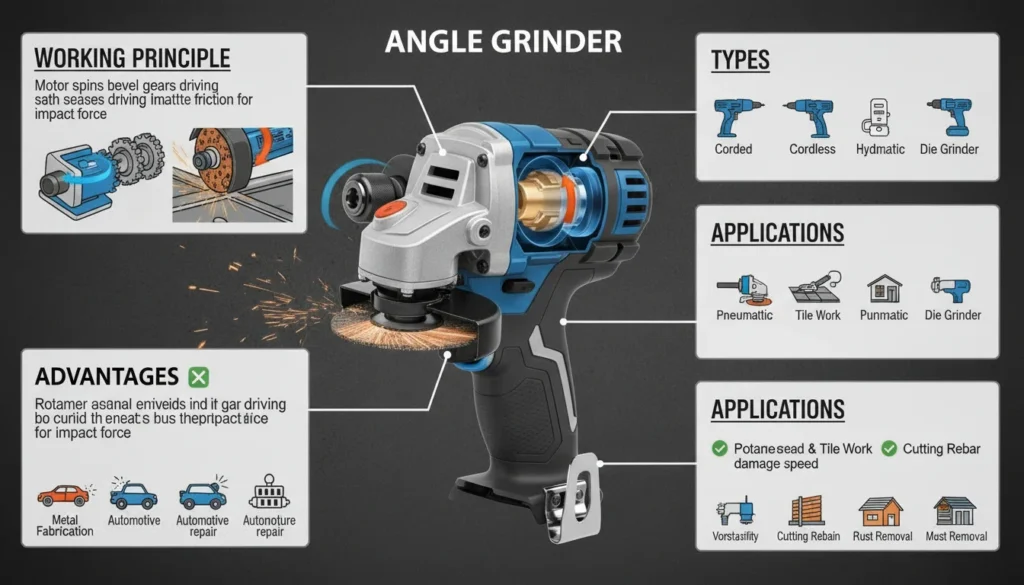
The angle grinder working principle is based on converting electrical energy into high-speed rotational motion. This rotation drives a grinding or cutting disc attached to the tool.
The disc spins at very high speed and removes material when it comes into contact with the surface.
Step-by-Step Working Process
- Power supplyElectricity from a power source or battery powers the motor.
- Motor rotationThe electric motor rotates at very high speed.
- Gear mechanismA gear system changes the direction of rotation to a right angle.
- Disc movementThe grinding or cutting disc rotates rapidly.
- Material removalWhen the rotating disc touches the material, friction removes material from the surface.
Simple Analogy
Think of rubbing sandpaper on a wooden surface to smooth it. The difference is that an angle grinder performs this process much faster using a rotating disc.
Types of Angle Grinders
Different types of angle grinders are available depending on their power source and application.
Corded Angle Grinder
Corded angle grinders operate using electricity from a power outlet.
They provide continuous power and are commonly used in workshops and industrial environments.
Cordless Angle Grinder
Cordless angle grinders operate using rechargeable batteries.
They are portable and ideal for field work where electrical outlets are not available.
Pneumatic Angle Grinder
Pneumatic angle grinders use compressed air to operate.
They are commonly used in industrial environments and automotive workshops.
Small Angle Grinder
Small angle grinders usually have disc sizes between 4 to 5 inches.
They are lightweight and suitable for light-duty tasks.
Large Angle Grinder
Large angle grinders have disc sizes of 7 to 9 inches.
They are used for heavy-duty cutting and grinding tasks.
Main Components of an Angle Grinder
An angle grinder consists of several important mechanical and electrical components.
Electric Motor
The motor is the main component that generates rotational power.
Gearbox
The gearbox changes the direction of rotation and increases torque.
Spindle
The spindle holds the grinding or cutting disc in place.
Grinding Disc or Wheel
This is the main working part that performs cutting or grinding.
Protective Guard
The guard protects the user from sparks and debris during operation.
Handle
The handle provides stability and control while using the tool.
Power Switch
The switch controls the operation of the grinder.
Angle Grinder Advantages and Disadvantages
Understanding angle grinder advantages and disadvantages helps technicians use the tool effectively.
Advantages
- Multi-purpose tool for cutting, grinding, and polishing
- High-speed operation saves time
- Suitable for different materials such as metal and concrete
- Portable and easy to handle
- Available in many sizes and power levels
- Improves efficiency in electrical installation work
These advantages make angle grinders essential tools in construction and electrical industries.
Disadvantages / Limitations
Although angle grinders are powerful tools, they also have some limitations.
- Produces sparks and dust during operation
- Requires safety equipment such as gloves and goggles
- Can be dangerous if used incorrectly
- High noise level
- Discs wear out and require replacement
Proper training and safety precautions are necessary when using an angle grinder.
Angle Grinder Applications
The angle grinder applications are found in many industries and technical fields.
Electrical Installation
Electricians use angle grinders to cut metal conduits, cable trays, and brackets.
Construction Industry
Builders use them for cutting tiles, concrete blocks, and steel bars.
Metal Fabrication
Metal workers use angle grinders to shape, smooth, and polish metal surfaces.
Automotive Workshops
Mechanics use them for cutting bolts, removing rust, and polishing metal parts.
Home Maintenance
Homeowners use angle grinders for DIY repairs and renovation projects.
Difference Between Angle Grinder and Bench Grinder
Understanding the difference between bench grinder and angle grinder helps beginners choose the correct tool.
| Feature | Angle Grinder | Bench Grinder |
|---|---|---|
| Portability | Portable handheld tool | Fixed machine |
| Main Use | Cutting and grinding | Sharpening tools |
| Mobility | Can be used anywhere | Installed on a workbench |
| Power | Moderate to high | Usually constant power |
| Flexibility | Very versatile | Limited functions |
An angle grinder is more flexible, while a bench grinder is mainly used for sharpening tools.
Selection Guide: How to Choose the Right Angle Grinder
Choosing the right angle grinder depends on several important factors.
Disc Size
Common disc sizes include 4-inch, 5-inch, 7-inch, and 9-inch grinders.
Small discs are suitable for light work, while large discs are used for heavy-duty tasks.
Motor Power
Higher motor power allows the grinder to handle tougher materials.
Speed Rating
Higher RPM provides faster cutting and grinding performance.
Corded vs Cordless
Corded grinders provide continuous power, while cordless grinders offer portability.
Safety Features
Choose grinders with safety guards, anti-vibration handles, and overload protection.
Common Problems and Solutions
Why is the angle grinder not starting?
The power supply may be disconnected or the switch may be faulty.
Solution: Check the power cable and switch.
Why is the grinder overheating?
Continuous heavy use can cause overheating.
Solution: Allow the tool to cool before continuing work.
Why is the cutting disc breaking?
Using the wrong disc for the material can cause damage.
Solution: Always use the correct disc type.
Why are there excessive sparks?
Worn grinding discs may produce more sparks.
Solution: Replace the disc with a new one.
Future Trends in Angle Grinder Technology
Power tool technology is continuously improving.
Brushless Motors
Modern grinders use brushless motors for higher efficiency and longer lifespan.
Smart Safety Systems
New models include automatic shut-off systems to improve safety.
Lightweight Design
Manufacturers are developing lighter tools to reduce operator fatigue.
Advanced Battery Technology
Cordless grinders are becoming more powerful with improved battery performance.
These innovations will make angle grinders safer and more efficient in the future.
Conclusion
An angle grinder is one of the most versatile and powerful tools used in electrical, construction, and mechanical industries. It allows technicians to perform cutting, grinding, polishing, and surface preparation tasks quickly and efficiently.
Understanding the angle grinder working principle, types, components, and angle grinder applications helps professionals use the tool safely and effectively. Although angle grinders have some limitations, their flexibility and high-speed operation make them essential in many technical fields.
By choosing the right grinder and using proper safety precautions, electrical technicians and engineers can greatly improve productivity and work quality. Learning how to properly use an angle grinder is an important skill for anyone involved in modern technical and industrial work.