
Imagine sitting in a small workshop or home during a very hot summer afternoon. The temperature is high, and the air feels dry and uncomfortable. Turning on an air conditioner may not always be affordable because it consumes a large amount of electricity. Instead, many people switch on an air cooler, which quickly provides a refreshing breeze and reduces the room temperature.
Air coolers have become a popular cooling solution in homes, small offices, workshops, and outdoor environments. They are simple devices that use water evaporation to cool the air. Compared to air conditioners, air coolers consume less electricity and are easier to maintain.
For electrical students, engineers, technicians, and beginners, understanding how an air cooler works is important. Air coolers demonstrate basic engineering concepts such as evaporative cooling, airflow systems, electric motors, water circulation, and heat transfer.
In this article, we will explain the air cooler working principle, types, main components, advantages, disadvantages, and applications. We will also discuss the difference between air cooler and air conditioner, which helps beginners understand when each system should be used. By the end of this guide, you will have a clear understanding of how air coolers operate and why they are widely used.
What is an Air Cooler?
An air cooler, also called an evaporative cooler, is a cooling device that reduces air temperature using the natural process of water evaporation.
Unlike air conditioners that use refrigerants and compressors, air coolers use water, air, and a fan to produce cooling.
Simple Explanation
An air cooler pulls warm air through water-soaked cooling pads. As the air passes through these pads, the water evaporates and absorbs heat from the air. This process produces cooler and more comfortable air.
Practical Example
For example, in a small room or outdoor sitting area, an air cooler can blow cool air by drawing hot air through wet cooling pads. This reduces the temperature and increases humidity slightly, making the environment more comfortable.
Because air coolers require only electricity for the fan and water pump, they are energy-efficient and cost-effective cooling devices.
Air Cooler Working Principle
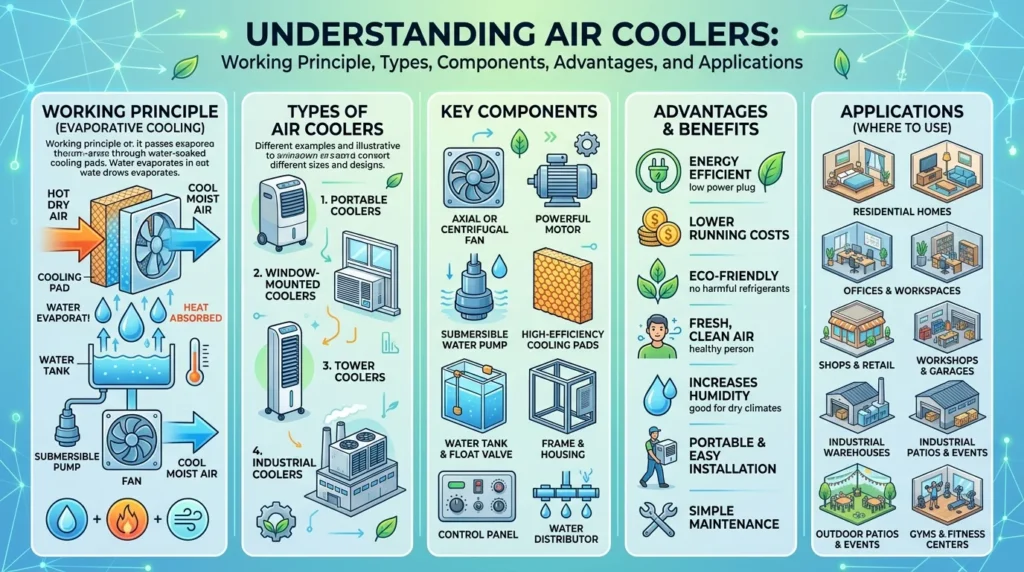
The air cooler working principle is based on evaporative cooling. When water evaporates, it absorbs heat from the surrounding air. This reduces the air temperature.
Step-by-Step Working Process
- Warm air enters the cooler
A fan or blower draws warm air from the environment into the air cooler.
- Air passes through cooling pads
The air flows through specially designed cooling pads that are kept wet by water.
- Water evaporation occurs
As warm air passes through the wet pads, water evaporates and absorbs heat from the air.
- Temperature decreases
The evaporation process cools the air.
- Cool air enters the room
The fan pushes the cooled air into the room.
- Continuous water circulation
A small water pump continuously circulates water from the tank to keep the cooling pads wet.
Simple Analogy
Think of the cooling effect you feel when water evaporates from your skin after swimming. The evaporation removes heat from your body and creates a cooling sensation. Air coolers work using the same principle.
Types of Air Coolers
Air coolers are available in several types depending on size, airflow, and application.
Personal Air Cooler
Personal air coolers are small and designed for cooling small rooms or individual spaces.
Features include:
- Compact size
- Low power consumption
- Portable design
They are commonly used in bedrooms or study rooms.
Desert Air Cooler
Desert air coolers are larger and designed for hot and dry climates.
Key features:
- Large water tank
- High airflow capacity
- Large cooling pads
These coolers are suitable for living rooms, halls, and outdoor areas.
Tower Air Cooler
Tower air coolers are tall and slim units designed for modern homes.
Advantages include:
- Stylish design
- Space-saving structure
- Good airflow direction control
They are commonly used in apartments and offices.
Window Air Cooler
Window air coolers are installed in windows similar to window air conditioners.
Benefits include:
- Better air circulation
- Suitable for large rooms
- Efficient cooling performance
Main Components of an Air Cooler
Understanding the components of an air cooler helps technicians perform maintenance and troubleshooting.
Fan or Blower
The fan draws warm air into the cooler and pushes cool air into the room.
It is usually powered by an electric motor.
Cooling Pads
Cooling pads are made from materials that absorb water effectively.
Functions:
- Hold water
- Allow air to pass through
- Enable evaporation cooling
Water Pump
The water pump circulates water from the water tank to the cooling pads.
This ensures the pads remain wet during operation.
Water Tank
The water tank stores water used in the cooling process.
Larger tanks allow longer operating time without refilling.
Electric Motor
The electric motor drives the fan or blower to move air through the system.
Air Louvers
Air louvers control the direction of airflow inside the room.
They help distribute cool air evenly.
Control Panel
The control panel allows the user to adjust:
- Fan speed
- Cooling mode
- Swing direction
Modern coolers may include remote control options.
Air Cooler Advantages
Understanding air cooler advantages and disadvantages helps engineers evaluate when to use these systems.
Key Advantages
- Low electricity consumption
- Affordable cost compared to air conditioners
- Simple installation
- Eco-friendly cooling method
- Portable design in many models
- Easy maintenance
- No refrigerant required
Real-World Benefits
Air coolers are particularly useful in regions with dry climates, where evaporative cooling works most effectively.
Disadvantages / Limitations
Despite their benefits, air coolers also have some limitations.
Common Disadvantages
- Cooling efficiency depends on humidity
- Less effective in humid environments
- Requires regular water refilling
- Cooling is weaker than air conditioners
- Large units may produce noise
- Cooling pads require periodic replacement
These limitations mean air coolers are best suited for dry and ventilated environments.
Air Cooler Applications
The air cooler applications cover residential, commercial, and industrial environments.
Residential Applications
Air coolers are commonly used in:
- Bedrooms
- Living rooms
- Small apartments
- Outdoor patios
Commercial Applications
Businesses often use air coolers in:
- Shops
- Restaurants
- Warehouses
- Workshops
Industrial Applications
Large air coolers may also be used in:
- Factories
- Assembly areas
- Industrial halls
They help improve worker comfort in large open spaces.
Difference Between Air Cooler and Air Conditioner
Understanding the difference between air cooler and air conditioner is important for selecting the right cooling system.
| Feature | Air Cooler | Air Conditioner |
|---|---|---|
| Cooling Method | Evaporative cooling | Refrigeration cycle |
| Power Consumption | Low | High |
| Installation | Simple | Complex |
| Cost | Affordable | Expensive |
| Cooling Performance | Moderate | Strong |
| Best Climate | Dry areas | Any climate |
Air coolers are ideal for energy-efficient cooling in dry climates, while air conditioners provide stronger cooling.
Selection Guide
Choosing the right air cooler depends on several factors.
Room Size
Select a cooler with airflow capacity suitable for the room area.
Water Tank Capacity
Larger tanks allow longer operation without refilling.
Cooling Pad Quality
High-quality cooling pads improve cooling performance.
Airflow Capacity
Airflow is measured in CFM (Cubic Feet per Minute).
Higher airflow provides better cooling for larger spaces.
Portability
If mobility is important, choose a cooler with wheels.
Common Problems and Solutions
Air coolers may experience some common operational problems.
Why is the air cooler not cooling properly?
Possible causes:
- Dry cooling pads
- Low water level
- Blocked air vents
Solution: Ensure sufficient water supply and clean the pads.
Why is the air cooler producing bad smell?
Cause:
Dirty water or contaminated cooling pads.
Solution:
Clean the water tank and replace or wash cooling pads.
Why is the fan not working?
Possible cause:
Faulty electric motor or power supply issue.
Solution:
Check electrical connections and motor operation.
Why is water leaking from the cooler?
Cause:
Damaged water tank or pump hose.
Solution:
Inspect and repair the water system.
Future Trends
Cooling technology is evolving, and air coolers are also improving.
Smart Air Coolers
Modern air coolers now include:
- Remote control
- Mobile app connectivity
- Automatic water level indicators
Improved Cooling Pads
New cooling pad materials improve evaporation efficiency and durability.
Energy-Efficient Motors
Advanced motors reduce electricity consumption while improving airflow.
Hybrid Cooling Systems
Future systems may combine evaporative cooling with other cooling technologies for better performance.
These developments will make air coolers more efficient and convenient.
Conclusion
Air coolers remain one of the most affordable and energy-efficient cooling solutions available today. Their simple design, low power consumption, and eco-friendly operation make them ideal for homes, offices, and industrial spaces in dry climates.
In this article, we discussed the air cooler working principle, types, components, advantages, disadvantages, and applications. Understanding these systems helps electrical students and technicians learn about evaporative cooling, electric motors, airflow systems, and basic HVAC technology.
We also explained the difference between air cooler and air conditioner, which helps determine the best cooling solution for different environments.
For beginners in electrical and HVAC fields, studying air coolers provides a strong foundation in cooling technology. With proper maintenance and correct usage, air coolers can provide reliable and comfortable cooling for many years.