
Imagine coming home on a very hot summer day. The room feels warm and uncomfortable. You switch on a small air conditioner installed in the window, and within minutes the room becomes cool and comfortable. This simple but effective cooling system is known as a window air conditioner.
Window air conditioners have been used for many decades and remain one of the most common cooling solutions for small rooms, apartments, offices, and dormitories. They are popular because they are compact, affordable, and relatively easy to install.
For electrical students, engineers, and technicians, understanding how a window air conditioner works is important. These systems combine electrical motors, refrigeration cycles, control circuits, and heat transfer principles in a single compact unit. Studying them helps beginners understand the fundamentals of HVAC systems.
In this article, we will explain the window air conditioner working principle, types, main components, advantages, disadvantages, and applications. We will also discuss the difference between window air conditioner and split air conditioner, which is a common question among beginners. By the end of this guide, you will clearly understand how window air conditioners operate and where they are most useful.
What is a Window Air Conditioner?
A window air conditioner is a self-contained cooling system designed to cool a single room or a small area. All the important components—compressor, condenser, evaporator, expansion device, and fan—are installed inside a single unit.
This unit is usually mounted in a window opening or a wall slot, with one part facing inside the room and the other facing outside.
Simple Explanation
A window air conditioner works like a compact cooling machine that removes heat from indoor air and releases it outside through the back of the unit.
Practical Example
For example, a small bedroom in an apartment may not require a large central cooling system. Installing a window air conditioner allows the room to be cooled quickly without complicated installation.
Because everything is contained in one unit, window air conditioners are widely used in residential buildings around the world.
Window Air Conditioner Working Principle
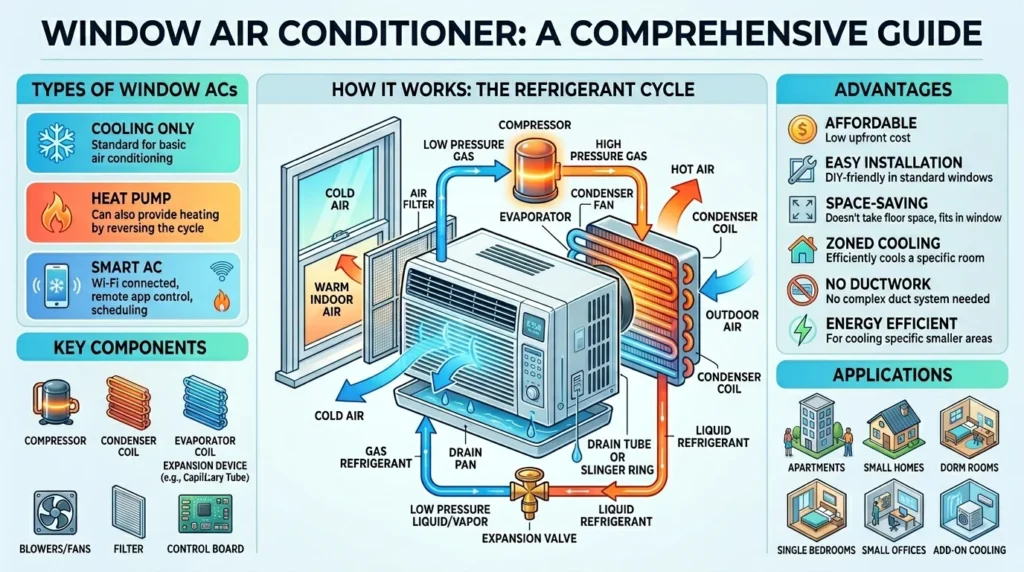
The window air conditioner working principle is based on the vapor compression refrigeration cycle. The system transfers heat from inside the room to the outside environment.
It works through a continuous cycle of refrigerant flow.
Step-by-Step Working Process
- Warm air enters the air conditioner
A fan pulls warm room air into the front section of the unit.
- Evaporator absorbs heat
The air passes over the evaporator coil containing cold refrigerant.
The refrigerant absorbs heat from the air.
- Refrigerant changes state
As heat is absorbed, the refrigerant changes from liquid to low-pressure gas.
- Compressor increases pressure
The compressor compresses the gas, raising its temperature and pressure.
- Condenser releases heat
The hot refrigerant flows through the condenser coil located at the back of the unit.
Outdoor air removes the heat.
- Refrigerant condenses
After losing heat, the refrigerant becomes liquid again.
- Expansion device lowers pressure
The expansion valve reduces refrigerant pressure and temperature.
- Cooling cycle repeats
The refrigerant returns to the evaporator and continues the cooling process.
Simple Analogy
Think of the system like a heat pump that moves heat from the room to the outside air.
It does not produce cold air directly; it removes heat from the indoor environment.
Types of Window Air Conditioners
Although window air conditioners are generally simple systems, they can still be classified into different types.
Manual Control Window Air Conditioner
This is the traditional type of window air conditioner.
Features include:
- Mechanical thermostat
- Manual fan speed control
- Simple operation
These systems are durable and easy to repair.
Electronic Control Window Air Conditioner
Modern window air conditioners use electronic control systems.
Features include:
- Digital thermostat
- Remote control operation
- Timer functions
- Improved energy efficiency
Inverter Window Air Conditioner
Inverter technology allows the compressor to adjust its speed based on cooling demand.
Benefits include:
- Lower electricity consumption
- Quieter operation
- Stable room temperature
These models are becoming more common in modern homes.
Main Components of a Window Air Conditioner
Understanding the main components helps technicians maintain and troubleshoot the system effectively.
Compressor
The compressor is the heart of the air conditioner.
Functions include:
- Compressing refrigerant gas
- Increasing refrigerant pressure
- Circulating refrigerant through the system
Condenser Coil
The condenser coil releases heat from the refrigerant to the outdoor air.
A fan helps improve heat transfer efficiency.
Evaporator Coil
The evaporator coil is located in the indoor section.
Functions include:
- Absorbing heat from room air
- Cooling the air before it returns to the room
Expansion Device
The expansion device reduces refrigerant pressure before it enters the evaporator coil.
Lower pressure results in lower temperature.
Fans or Blowers
Window air conditioners typically use two fans:
- Indoor fan to circulate cool air inside the room
- Outdoor fan to remove heat from the condenser
Air Filter
The air filter removes dust and particles from the air before it enters the evaporator.
Regular cleaning improves performance.
Control System
The control system regulates:
- Compressor operation
- Fan speed
- Temperature settings
Modern units include digital control boards.
Window Air Conditioner Advantages
Understanding window air conditioner advantages and disadvantages helps engineers choose the correct cooling solution.
Key Advantages
- Compact and space-saving design
- Easy installation
- Lower cost compared to split systems
- Suitable for small rooms
- Simple maintenance
- All components contained in one unit
- No need for duct systems
Real-World Benefits
Window air conditioners are ideal for small apartments, rented homes, and temporary cooling needs.
Disadvantages / Limitations
Despite their benefits, window air conditioners also have some limitations.
Common Disadvantages
- Noisy compared to split systems
- Limited cooling capacity
- Blocks part of the window
- Less attractive appearance
- Not suitable for large spaces
- Limited energy efficiency in older models
These limitations explain why many buildings now prefer split or central air conditioning systems.
Window Air Conditioner Applications
The window air conditioner applications are mainly focused on small or individual spaces.
Residential Applications
Window air conditioners are commonly used in:
- Bedrooms
- Small apartments
- Dormitories
- Rental houses
Commercial Applications
They can also be found in:
- Small offices
- Shops
- Guard rooms
- Temporary cabins
Technical Applications
Window air conditioners may also be used in:
- Small server rooms
- Control rooms
- Security booths
These environments require simple and affordable cooling solutions.
Difference Between Window Air Conditioner and Split Air Conditioner
Understanding the difference between window air conditioner and split air conditioner is important for HVAC system selection.
| Feature | Window Air Conditioner | Split Air Conditioner |
|---|---|---|
| Design | Single unit | Two separate units |
| Installation | Simple | More complex |
| Noise Level | Higher | Lower |
| Cost | Lower | Higher |
| Cooling Area | Small rooms | Medium to large rooms |
| Appearance | Visible unit | More aesthetic |
Split systems provide better comfort, but window units remain popular due to their simplicity and affordability.
Selection Guide
Choosing the right window air conditioner requires considering several technical factors.
Cooling Capacity
Cooling capacity is measured in BTU (British Thermal Units).
Select a unit suitable for the room size.
Energy Efficiency Ratio (EER)
Higher EER ratings mean better energy efficiency and lower electricity consumption.
Room Size
Make sure the cooling capacity matches the room area.
Example:
- Small room: 5000–8000 BTU
- Medium room: 8000–12000 BTU
Noise Level
Some models are quieter than others. Consider noise if the unit will be used in bedrooms.
Power Supply
Check that the electrical supply meets the unit’s voltage and current requirements.
Common Problems and Solutions
Technicians frequently encounter similar issues with window air conditioners.
Why is the window air conditioner not cooling properly?
Possible causes include:
- Dirty air filters
- Low refrigerant level
- Blocked condenser coil
Solution: Clean filters and inspect refrigerant charge.
Why is water leaking from the unit?
Cause:
Blocked drainage system.
Solution:
Clean the drain channel and ensure proper installation angle.
Why is the unit making unusual noise?
Possible causes:
- Loose mounting
- Fan obstruction
Solution:
Check mounting brackets and inspect fan blades.
Why does the air conditioner start and stop frequently?
Cause:
Faulty thermostat or electrical control problem.
Solution:
Inspect thermostat settings and control circuits.
Future Trends
Although window air conditioners are traditional systems, new technology is improving their performance.
Smart Window Air Conditioners
Modern models can connect to mobile apps and smart home systems.
Inverter Technology
Inverter compressors reduce energy consumption and improve temperature control.
Eco-Friendly Refrigerants
New refrigerants are being developed to reduce environmental impact.
Improved Energy Efficiency
Manufacturers are designing units with higher efficiency ratings to meet modern energy standards.
These improvements will make window air conditioners more efficient and environmentally friendly.
Conclusion
Window air conditioners remain one of the most widely used cooling systems for small spaces. Their compact design, simple installation, and affordable cost make them ideal for bedrooms, apartments, offices, and temporary spaces.
In this article, we explored the window air conditioner working principle, types, main components, advantages, disadvantages, and applications. Understanding these concepts helps electrical students and technicians gain practical knowledge about HVAC systems.
We also discussed the difference between window air conditioner and split air conditioner, which helps engineers choose the most suitable system for specific environments.
For beginners in electrical and HVAC fields, studying window air conditioners provides valuable insight into refrigeration cycles, electrical motors, and heat transfer systems. With proper maintenance and correct installation, these systems can provide reliable cooling for many years.