
Picture a massive cooling tower rising against the sky, steam gently drifting up—not from burning fuel, but from the quiet hum of atoms splitting inside a reactor. This is the scene at plants like Palo Verde in Arizona, where nuclear power generates electricity for millions without a single puff of smoke from coal or gas.
Nuclear power is vital today because it supplies clean, reliable energy in a world racing to cut carbon emissions. As of 2024, it provides about 9% of global electricity, second only to hydropower among low-emission sources. For electrical students, engineers, and technicians, understanding nuclear power builds your skills in advanced generation, safety systems, and grid integration—key for future jobs in energy.
In this guide, you’ll get a clear breakdown: what nuclear power is, its working principle, types of reactors, main parts, advantages and disadvantages, applications, comparisons with other tech, how to select systems, troubleshooting tips, and upcoming trends. Explained simply, like I’m your senior engineer mentor, sketching it out during a site visit.
By reading on, you’ll grasp how nuclear fits into renewables, why it’s debated, and how to discuss it confidently in interviews or projects. Let’s explore this powerhouse of energy.
What is Nuclear Power?
Nuclear power is electricity generated from the energy released when atoms split or fuse, typically through controlled splitting in reactors.
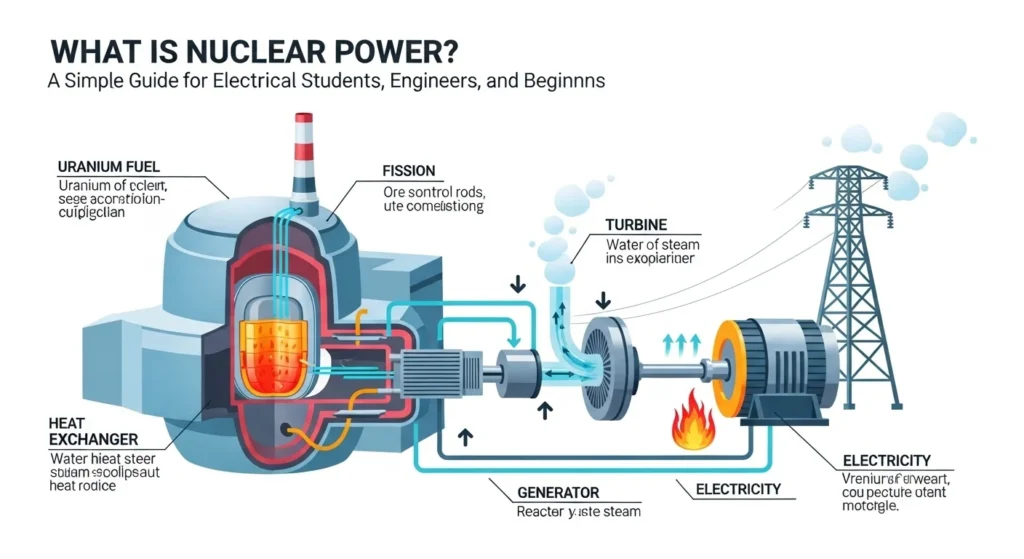
Simply put: Heavy atoms like uranium are bombarded with particles, causing them to break apart and release huge amounts of heat. This heat boils water into steam, which spins turbines to make electricity—just like a coal plant, but without burning anything.
A real-world example is France’s nuclear fleet. With 57 reactors, it produces over 60% of the country’s electricity, keeping lights on affordably and with low emissions. No fuel trucks needed daily; a small amount of uranium powers a city for years.
This makes nuclear a baseload source—steady power 24/7, unlike sun-dependent solar.
Nuclear Power Working Principle
The nuclear power working principle centers on fission: splitting atoms to release energy.
Step by step:
- Fuel preparation: Uranium pellets, enriched to have more splittable atoms, are loaded into fuel rods.
- Fission starts: Neutrons hit uranium atoms in the reactor core, splitting them into smaller atoms and releasing more neutrons plus heat.
- Chain reaction: Released neutrons hit other atoms, creating a controlled chain—like dominoes falling but managed with control rods to absorb extras.
- Heat transfer: Heat warms water (or another fluid) around the core, turning it to steam without direct contact to keep radiation contained.
- Steam drives turbine: High-pressure steam spins a turbine connected to a generator.
- Electricity generation: Spinning creates electricity via electromagnetic induction.
- Cooling and recycle: Steam condenses back to water, cooled by towers or rivers, and loops back.
Analogy: Imagine a popcorn kernel. Heat (from fission) makes it pop, releasing energy. In nuclear, one pop triggers others in a chain, but safety systems prevent a runaway explosion.
Key factors:
- Criticality: Balanced neutron production.
- Moderator: Slows neutrons (water or graphite).
- Efficiency: Around 33-37%, but fuel lasts years.
Types / Classification of Nuclear Power
Nuclear reactors vary by coolant, fuel, and design. Main types explained below.
Pressurized Water Reactor (PWR)
Most common worldwide. Water under high pressure cools the core and transfers heat without boiling inside. Steam is made in a separate loop. Safe and reliable; used in over 60% of plants. Example: U.S. Navy submarines.
Boiling Water Reactor (BWR)
Water boils directly in the core, producing steam for turbines. Simpler design with fewer parts, but needs more radiation shielding. Popular in Japan and the U.S. Efficient for large-scale power.
Fast Breeder Reactor (FBR)
Uses fast neutrons and liquid sodium coolant. “Breeds” more fuel than it uses by converting non-fissile uranium. Higher efficiency, reduces waste. Experimental but promising; Russia has operational ones.
Advanced Gas-Cooled Reactor (AGR)
Uses carbon dioxide gas as coolant and graphite moderator. Runs hotter for better efficiency. Mainly in the UK. Good for high-temperature applications.
Other classes: By size—large gigawatt plants vs. small modular (under 300 MW). Or generation: Gen II (current), Gen III+ (safer, like AP1000), Gen IV (future, recycle fuel).
Main Components of a Nuclear Power Plant
Key parts work together safely.
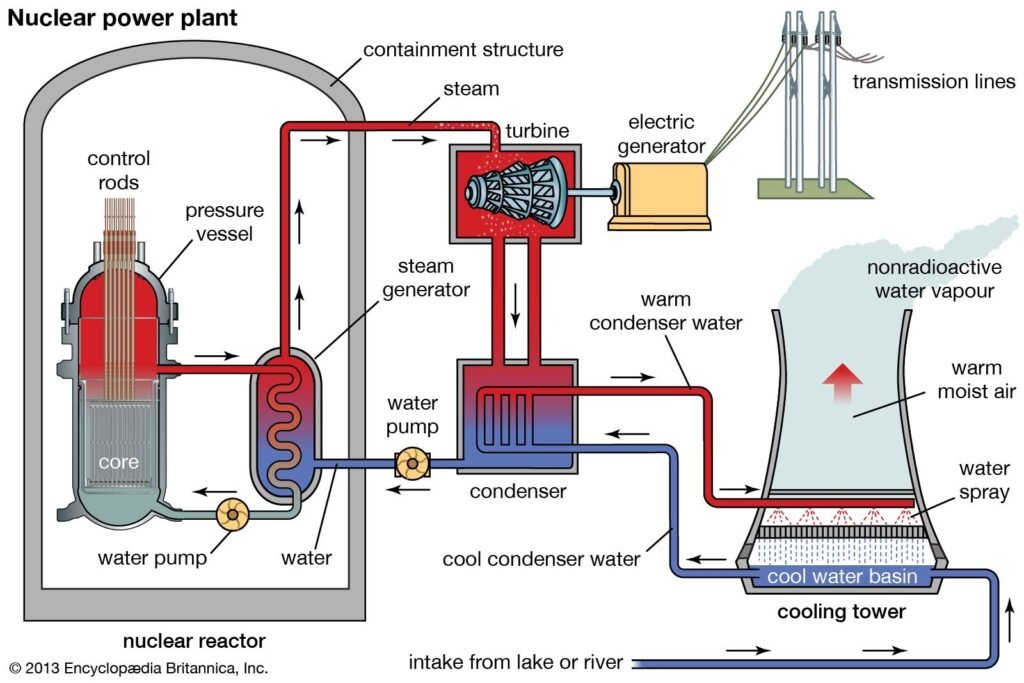
- Reactor Core: Heart where fission happens. Contains fuel rods, control rods (absorb neutrons to control reaction), and moderator.
- Containment Structure: Thick concrete and steel dome around the reactor. Traps radiation if anything goes wrong.
- Coolant System: Pumps and pipes circulate water or gas to remove heat. Prevents overheating.
- Steam Generator: In PWRs, transfers heat from reactor water to make clean steam.
- Turbine and Generator: Steam spins the turbine shaft, driving the generator to produce electricity.
- Condenser and Cooling Tower: Cools steam back to water; towers release harmless vapor.
- Control Room and Safety Systems: Computers monitor everything; emergency coolant injection and shutdown rods for quick stops.
- Fuel Handling: Cranes and pools for safe fuel loading/unloading.
These ensure 24/7 operation with multiple backups.
Nuclear energy | Definition, Sources, Uses, & Facts | Britannica
Nuclear Power Advantages
Nuclear power advantages shine in reliability and environmental impact:
- Massive energy from small fuel: One uranium pellet equals a ton of coal.
- Low emissions: Near-zero CO2 during operation, fighting climate change.
- Steady baseload: Runs 90%+ capacity factor, unlike weather-dependent renewables.
- Fuel independence: Uranium from stable sources reduces oil/gas reliance.
- Long plant life: 40-60 years, extendable to 80.
- Job creator: Plants employ thousands in high-tech roles.
- Efficient land use: Produces more power per acre than solar farms.
Real benefits: Countries like France have cheap, stable electricity; U.S. avoids millions of tons of emissions yearly.
Disadvantages / Limitations
Nuclear has real challenges we must address honestly.
- High upfront costs: Building takes billions and 5-10 years.
- Waste management: Spent fuel is radioactive, needs secure storage for centuries.
- Safety concerns: Rare accidents like Chernobyl or Fukushima cause fear, though modern designs prevent meltdowns.
- Proliferation risk: Technology could be misused for weapons if not regulated.
- Water use: Needs lots for cooling, stressing rivers in dry areas.
- Decommissioning: Shutting down plants is expensive and time-consuming.
- Public opposition: Delays projects due to “not in my backyard” views.
Still, with strict rules, risks are lower than many think—fewer deaths per energy unit than coal.
Nuclear Power Applications
Nuclear power applications focus on large-scale but extend further.
- Grid electricity: Powers cities and nations. One plant like China’s Hualong One supplies millions of homes.
- Industry: Heavy users like aluminum smelters or chemical plants get steady, cheap power.
- Military and transport: Submarines and aircraft carriers use compact reactors for unlimited range.
- Modern tech: Space missions—rovers like Perseverance use radioisotope generators. Data centers for AI are eyeing nuclear for reliable, green energy.
- Remote areas: Small reactors could power isolated mines or islands without fuel shipments.
No true home use yet, but micro-reactors might change that for communities.
Comparison Section
To see the difference between nuclear power and other sources, compare with coal (fossil) and solar (renewable).
| Feature | Nuclear Power | Coal Power | Solar Power |
| Fuel Source | Uranium (abundant) | Coal (finite) | Sunlight (free) |
| Emissions | Very low CO2 | High CO2 and pollutants | Zero during operation |
| Reliability | High (baseload) | High but dirty | Intermittent (day only) |
| Initial Cost | Very high | Medium | Medium-low |
| Operating Cost | Low (fuel cheap) | Medium (fuel + cleanup) | Very low |
| Lifespan | 40-80 years | 30-50 years | 25-30 years |
| Waste/Impact | Radioactive waste | Ash and air pollution | Panel disposal |
| Best For | Constant large supply | Cheap but phasing out | Rooftop/ sunny areas |
Nuclear excels in steady output but lags in build time vs. solar’s quick setup.
Selection Guide
Choosing the right nuclear system? As beginners, focus on project needs.
- Assess site: Need water for cooling? Stable geology to avoid quakes.
- Pick type: PWR for proven safety; BWR for simplicity; SMR for smaller scales.
- Check regulations: IAEA standards mandatory; local laws on waste.
- Budget and timeline: Large plants for grids; modular for faster build.
- Fuel supply: Ensure uranium access; consider thorium for alternatives.
- Safety first: Opt for Gen III+ with passive cooling—no power needed for shutdown.
- Get experts: Join teams or consult firms like Westinghouse.
Tip: Start with simulations in software like MATLAB for reactor modeling before real projects.
Common Problems & Solutions
Q: What if the reactor overheats?
A: Multiple backups like emergency coolant pumps activate. Solution: Regular drills and sensor checks prevent issues.
Q: Handling radioactive waste?
A: Stored in pools then dry casks onsite. Solution: Recycle in advanced reactors; deep geological storage long-term.
Q: Radiation leaks?
A: Containment domes hold it. Solution: Monitor with Geiger counters; evacuate drills.
Q: High costs overruns?
A: Poor planning. Solution: Use standardized designs like AP1000 to cut surprises.
Q: Public fear after accidents?
A: Education helps. Solution: Transparent reports and community tours build trust.
Q: Fuel rod damage?
A: From corrosion. Solution: Inspect ultrasonically; replace every 18-24 months.
These fix most issues with basic engineering smarts.
Future Trends
Nuclear is evolving rapidly. Small modular reactors (SMRs) are game-changers—factory-built, scalable, safer. By 2030, expect deployments for data centers and military bases.
Gen IV reactors recycle waste, use thorium for less proliferation risk. Molten salt designs run hotter, more efficient.
Fusion power edges closer with milestones in tokamaks—unlimited fuel from seawater.
Global capacity may double by 2050, driven by AI energy needs and net-zero goals. China leads builds; U.S. pushes pilots.
Hyperscalers like Meta invest billions for GW-scale nuclear. Watch for hybrids with renewables.
Conclusion
Nuclear power harnesses atom-splitting for vast, clean electricity, covering basics from fission principles to reactor types, components, nuclear power advantages and disadvantages, applications, and comparisons. You’ve seen its steady output trumps intermittents, but waste and costs demand care.
As your mentor, I urge diving deeper—study IAEA resources, model circuits, visit plants. Nuclear engineers shape a low-carbon future; your skills in safety and efficiency will power tomorrow’s grids responsibly. Embrace it thoughtfully.