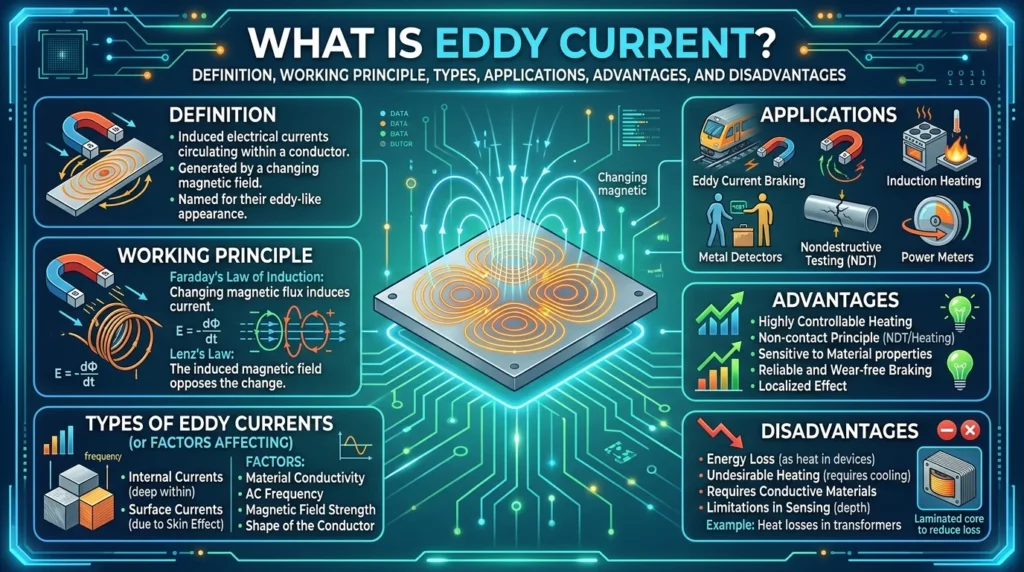

Have you ever noticed that a metal object can become warm when it moves through a changing magnetic field? This effect is not always caused by a direct electrical connection. In many cases, it happens because of eddy currents.
Eddy currents are small circulating electric currents produced inside electrically conductive materials when they experience a changing magnetic field. They are an important part of electrical engineering because they can be either useful or unwanted.
Engineers use eddy currents in induction heating, braking systems, metal detection, non-destructive testing, speed sensing, and electrical machines. At the same time, unwanted eddy currents can cause energy losses and heating in transformer cores, motors, generators, and other magnetic equipment.
Understanding eddy current helps electrical students and technicians understand why laminated transformer cores are used, how induction brakes work, and why some metal objects heat up near strong alternating magnetic fields.
In this guide, you will learn what eddy current is, how it works, its types, main components, advantages and disadvantages, applications, troubleshooting methods, and future trends.
What Is Eddy Current?
An eddy current is a circulating electric current induced inside an electrically conductive material when the material is exposed to a changing magnetic field.
In simple terms, when a changing magnetic field passes through a conductor, it creates small loops of current inside that conductor.
These circulating currents are called eddy currents.
Simple Example
Imagine placing an aluminum plate near a strong AC electromagnet.
The changing magnetic field passes through the aluminum. Because aluminum is electrically conductive, currents are induced inside the plate.
These currents flow in circular paths.
The circulating current can produce:
- Heat
- Magnetic forces
- Energy loss
- Braking force
Why Is It Called an Eddy Current?
The word eddy describes a circular movement, similar to a small circular flow of water in a river.
Eddy currents behave in a similar way. Instead of water circulating in a stream, electric current circulates inside a conductive material.
Basic Eddy Current Formula
The exact eddy-current behavior depends on several factors, including material properties, magnetic-field strength, frequency, and geometry.
The induced voltage is related to Faraday’s law:
EMF = -dΦ/dt
Where:
- EMF = induced electromotive force
- Φ = magnetic flux
- t = time
The negative sign represents Lenz’s law, which means the induced effect opposes the change that produces it.
Eddy Current Working Principle
The eddy current working principle is based mainly on Faraday’s law of electromagnetic induction and Lenz’s law.
The process can be understood in a few simple steps.
Step 1: A Conductive Material Is Exposed to a Magnetic Field
A material such as:
- Copper
- Aluminum
- Steel
- Brass
is placed in or near a magnetic field.
The material must have electrical conductivity for significant eddy currents to develop.
Step 2: The Magnetic Field Changes
The magnetic field can change because:
- An AC current flows through a coil.
- A magnet moves near the conductor.
- A conductor moves through a magnetic field.
- The magnetic flux changes with time.
Step 3: Voltage Is Induced
The changing magnetic flux produces an induced EMF inside the conductor.
This is explained by Faraday’s law.
Step 4: Current Circulates
Because the material is conductive, the induced EMF causes current to flow.
Unlike current in a normal wire circuit, eddy currents form closed loops within the material.
Step 5: The Current Produces Its Own Magnetic Field
The circulating current creates a magnetic field.
According to Lenz’s law, this magnetic field opposes the change in the original magnetic field.
Step 6: Heat or Force May Be Produced
The electrical resistance of the material causes power to be converted into heat.
In moving systems, the opposing magnetic effect can also produce a braking force.
Easy Analogy
Think of a spinning wheel moving through thick water.
The water resists the wheel’s movement.
Similarly, eddy currents create magnetic resistance when a conductor moves through a changing magnetic field.
This principle is used in eddy-current brakes.
Types and Classification of Eddy Currents
Eddy currents can be classified according to where they occur and how they are produced.
Surface Eddy Currents
Surface eddy currents mainly develop near the surface of a conductive material.
They are particularly important in high-frequency applications.
Their penetration depth becomes smaller as frequency increases.
Bulk Eddy Currents
Bulk eddy currents circulate through larger regions of a conductive component.
They can create unwanted heating and power losses in electrical machines and magnetic cores.
Eddy Currents in Transformer Cores
Alternating magnetic flux in a transformer core can induce circulating currents within the core material.
These currents produce heat and reduce efficiency.
This is one reason transformer cores are made from thin insulated laminations.
Eddy Currents in Motors and Generators
Changing magnetic fields can produce eddy currents in:
- Rotor components
- Stator components
- Metal frames
- Magnetic cores
Engineers design electrical machines to control these losses.
Useful Eddy Currents
Not all eddy currents are unwanted.
Engineers intentionally use them in:
- Induction heating
- Magnetic braking
- Metal detection
- Non-destructive testing
- Position sensing
Main Components Involved in Eddy Current Systems
Eddy current itself does not require a fixed set of components. However, practical eddy-current systems usually contain several important parts.
Conductive Material
The conductor is where the eddy currents develop.
Common materials include:
- Aluminum
- Copper
- Steel
- Brass
Electrical conductivity strongly affects current flow.
Magnetic Field Source
A magnetic field can be created using:
- Permanent magnets
- Electromagnets
- AC coils
- Induction coils
The field must change relative to the conductor to produce significant eddy currents.
Excitation Source
In many systems, an AC power supply drives a coil.
The alternating current creates a changing magnetic field.
Detection Coil
Some eddy-current testing systems use a coil to detect changes caused by defects or changes in material properties.
Control System
Modern equipment may use electronic controllers to regulate:
- Frequency
- Current
- Magnetic-field strength
- Heating power
- Detection sensitivity
Cooling System
High-power systems can generate substantial heat.
Cooling may be provided by:
- Air
- Fans
- Water
- Heat exchangers
Advantages of Eddy Current
Eddy currents provide many useful engineering benefits.
- No physical contact is required: Many eddy-current systems can operate without touching the test object.
- Fast operation: Eddy-current inspection and sensing can be performed quickly.
- Useful for metal detection: Conductive materials can be detected through changes in electromagnetic behavior.
- Provides braking without friction: Eddy-current brakes can slow moving systems without mechanical contact.
- Useful for heating: Induction heating can generate heat directly inside conductive materials.
- Supports non-destructive testing: Engineers can inspect components without cutting or damaging them.
- Reliable sensing: Eddy-current sensors can detect position, speed, and material changes.
- Low mechanical wear: Contactless systems have fewer mechanical wear problems.
Disadvantages and Limitations of Eddy Current
Eddy currents also have disadvantages.
Energy Loss
Unwanted eddy currents convert electrical energy into heat.
This reduces the efficiency of transformers, motors, and generators.
Heating
Excessive eddy currents can cause unwanted temperature increases.
High temperatures can damage insulation and other components.
Skin Effect
At higher frequencies, eddy currents tend to concentrate near the surface of a conductor.
This can affect electrical performance.
Material Limitations
Eddy-current techniques work best with electrically conductive materials.
They are not suitable for inspecting ordinary nonconductive materials in the same way.
Complex Testing
Interpreting eddy-current test results can require trained technicians and suitable instruments.
Frequency Dependence
The depth and behavior of eddy currents change with frequency.
Selecting an unsuitable frequency can produce poor results.
Eddy Current Applications
The eddy current applications are broad and important in electrical and mechanical engineering.
Transformer Cores
Eddy-current losses are an important source of transformer core losses.
Thin insulated laminations reduce the paths available for circulating currents.
Electric Motors
Motor cores are commonly laminated to reduce unwanted eddy-current losses.
Reducing these losses improves efficiency and helps control operating temperature.
Generators
Generators also experience changing magnetic fields.
Laminated magnetic cores help limit circulating currents.
Eddy Current Brakes
Eddy-current brakes use magnetic fields to create resistance against moving conductive components.
They are used in some:
- Industrial machines
- Testing equipment
- Transportation systems
- Exercise equipment
Because there is no direct friction between braking surfaces, mechanical wear can be reduced.
Induction Heating
Induction heating intentionally produces eddy currents inside conductive materials.
The resulting electrical losses generate heat.
Applications include:
- Metal hardening
- Metal melting
- Welding
- Brazing
- Heat treatment
- Industrial manufacturing
Non-Destructive Testing
Eddy-current testing is widely used to find surface and near-surface defects in conductive materials.
Technicians can detect:
- Cracks
- Corrosion
- Material changes
- Thickness variations
- Manufacturing defects
Metal Detectors
Metal detectors use electromagnetic fields to detect conductive objects.
When a metal object enters the field, induced currents change the electromagnetic response.
The detector senses this change.
Speed Measurement
Eddy-current sensors can measure the speed of rotating components without direct mechanical contact.
Position Measurement
They can also detect the position or movement of conductive targets.
This is useful in industrial automation.
Eddy Current vs Similar Electrical Phenomena
Understanding the difference between eddy current and hysteresis loss is important when studying transformer and motor losses.
| Feature | Eddy Current | Hysteresis Loss |
|---|---|---|
| Main cause | Induced circulating currents | Repeated magnetization |
| Occurs in | Conductive magnetic materials and conductors | Magnetic materials |
| Main effect | Heat generation | Heat generation |
| Reduced by | Laminations and suitable materials | Low-hysteresis core materials |
| Depends on frequency | Yes | Yes |
| Related to magnetic flux | Yes | Yes |
| Example | Transformer core current loops | Repeated core magnetization |
Eddy Current vs Normal Current
Normal current usually flows through a designed electrical circuit.
Eddy current circulates naturally inside a conductive body because of changing magnetic flux.
Eddy Current vs Skin Effect
These phenomena are related but not identical.
Eddy currents are circulating currents induced by changing magnetic fields.
Skin effect describes the tendency of AC current to concentrate toward the outer surface of a conductor as frequency increases.
How to Reduce Unwanted Eddy Current Losses
Engineers use several methods to control unwanted eddy currents.
Use Laminated Cores
Instead of using one solid piece of magnetic material, engineers use thin sheets separated by electrical insulation.
This breaks large current paths into smaller paths.
As a result, eddy-current losses are reduced.
Use High-Resistivity Core Materials
Materials with higher electrical resistance reduce the magnitude of circulating currents.
Electrical steel and other specialized magnetic materials are commonly used for this purpose.
Reduce Lamination Thickness
Thinner laminations generally provide better control of eddy-current losses, especially at higher frequencies.
Use Ferrite Materials at High Frequencies
Ferrites have high electrical resistivity and are widely used in many high-frequency magnetic components.
Selection Guide for Eddy Current Systems
When selecting an eddy-current system, engineers should consider several factors.
1. Identify the Material
Determine whether the target material is electrically conductive.
Material conductivity affects the strength and depth of induced currents.
2. Consider Frequency
Frequency strongly affects eddy-current behavior.
Higher frequencies generally produce shallower penetration.
3. Check Magnetic Properties
For magnetic materials, permeability can affect the response.
4. Consider Required Detection Depth
For inspection work, select a frequency suitable for the depth of the expected defect.
5. Check Temperature Requirements
If the system is designed for induction heating, determine the required heating temperature and power.
6. Consider Measurement Accuracy
For sensing applications, select equipment with suitable:
- Resolution
- Frequency range
- Sensor size
- Detection distance
- Signal processing
Beginner Tip
Do not choose an eddy-current testing frequency randomly. Start by identifying the material, thickness, expected defect depth, and application requirements.
Common Problems and Solutions
Why Do Eddy Currents Cause Heating?
Eddy currents flow through a material that has electrical resistance.
The resulting power loss is converted into heat.
This is useful in induction heating but unwanted in transformer and motor cores.
Why Are Transformer Cores Laminated?
Transformer cores are laminated to reduce the size of circulating current paths.
The insulation between laminations increases resistance between the layers and reduces eddy-current losses.
Why Are Eddy Currents Unwanted in Motors?
They consume energy and produce heat.
Excessive losses can reduce motor efficiency and increase operating temperature.
Why Are Eddy Currents Useful in Brakes?
The induced currents create a magnetic field that opposes the motion causing them.
This produces a braking effect without requiring direct friction between braking surfaces.
Can Eddy Currents Flow in Copper?
Yes.
Copper is highly electrically conductive, so changing magnetic fields can induce eddy currents in it.
Can Eddy Currents Flow in Plastic?
Ordinary plastic is not electrically conductive, so it does not support eddy currents in the same way as metals.
How Can a Technician Detect Eddy-Current Problems?
Depending on the equipment, technicians can monitor:
- Temperature
- Efficiency
- Power losses
- Current
- Vibration
- Magnetic behavior
Thermal imaging and electrical testing can also help identify abnormal heating.
Future Trends in Eddy Current Technology
Eddy-current technology continues to develop as industries demand better efficiency, faster inspection, and smarter automation.
Advanced Non-Destructive Testing
Modern eddy-current systems use digital signal processing and improved sensors to detect smaller defects.
Automated inspection systems can scan components faster and produce detailed inspection data.
Artificial Intelligence
Advanced software can help classify inspection signals and identify unusual patterns.
This can support technicians by reducing the time required to interpret complex measurements.
Electric Vehicles
Electric vehicles contain motors, power electronics, charging systems, and other components where electromagnetic losses must be carefully controlled.
Eddy-current analysis helps engineers improve efficiency and thermal performance.
High-Frequency Electronics
As switching frequencies increase, controlling electromagnetic losses becomes more important.
Engineers are developing better magnetic materials and component designs to reduce unwanted eddy currents.
Smart Sensors
Modern eddy-current sensors can provide accurate contactless measurement of:
- Position
- Speed
- Vibration
- Shaft movement
- Material properties
These sensors are increasingly useful in industrial automation and condition monitoring.
Conclusion
Eddy current is a circulating electric current induced inside a conductive material by a changing magnetic field. It is based mainly on Faraday’s law of electromagnetic induction and Lenz’s law.
Eddy currents can be harmful when they occur unintentionally. In transformers, motors, and generators, they cause unwanted heating and energy loss. Engineers reduce these losses using laminated cores, high-resistivity materials, suitable magnetic materials, and careful electrical design.
At the same time, eddy currents have many valuable uses. They are intentionally created in induction heating, eddy-current brakes, metal detectors, non-destructive testing, speed sensors, and position sensors.
The key point is simple: a changing magnetic field can induce circulating currents inside a conductor. Understanding this principle helps electrical students and technicians understand both power losses and useful electromagnetic technologies.