
Imagine you are listening to music on your mobile phone. The sound is loud and clear, even though the signal from the microphone or antenna is very small. Inside that small device, tiny electronic components are increasing weak signals and controlling large currents. One of the most important of these components is the transistor.
Without transistors, modern electronics would not exist. Computers, mobile phones, televisions, industrial control systems, and even satellites depend on them. In fact, millions or even billions of transistors are used inside a single microprocessor.
Understanding what is a transistor is essential for electrical students, engineers, technicians, and beginners. It is the foundation of electronics and digital systems. In this detailed guide, you will learn the transistor working principle, types, components, transistor applications, transistor advantages and disadvantages, comparisons, troubleshooting tips, and future trends — all explained in simple and clear English.
What is a Transistor?
A transistor is a three-terminal semiconductor device used to amplify or switch electronic signals and electrical power.
Simple Explanation
A transistor works like a small electronic switch or amplifier:
- It can turn current ON or OFF.
- It can increase (amplify) a weak signal.
It controls a large current using a small input signal.
Practical Example
When you speak into a microphone, the signal is very weak. A transistor amplifies this signal so that it can drive a speaker and produce loud sound.
So, when we ask what is a transistor, the simple answer is:
It is a device that controls and amplifies electrical signals.
Transistor Working Principle
The transistor working principle depends on semiconductor behavior. Let us understand it step-by-step.
There are two main types of transistors:
- Bipolar Junction Transistor (BJT)
- Field Effect Transistor (FET)
First, let’s understand the basic idea using a simple analogy.
Simple Analogy
Think of a water tap:
- A small movement of the tap handle
- Controls a large flow of water
Similarly:
- A small input signal
- Controls a large output current
Working Principle of BJT (Basic Idea)
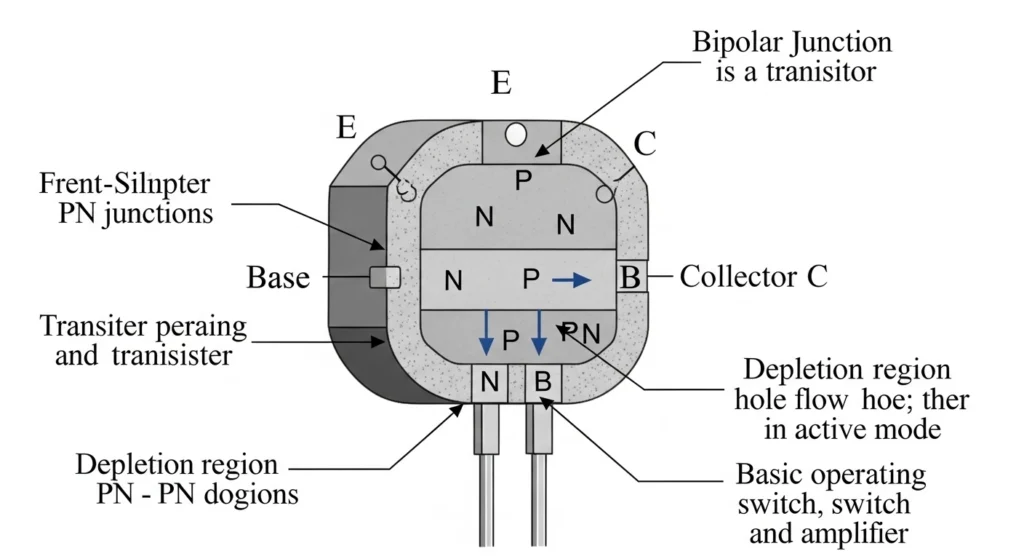
A BJT has three terminals:
- Emitter
- Base
- Collector
Step-by-step operation:
- Small current flows into base.
- This small base current controls a larger collector current.
- Output is taken from collector.
Small input → Large output
That is amplification.
Working Principle of FET (Basic Idea)
A FET also has three terminals:
- Source
- Gate
- Drain
Step-by-step operation:
- Voltage applied to gate.
- Electric field controls current flow.
- Drain current changes according to gate voltage.
This is voltage-controlled operation.
Key Points
- Transistor has three terminals.
- It controls large current using small signal.
- Used as amplifier or switch.
This is the transistor working principle in simple words.
Types / Classification of Transistors
Transistors are classified based on structure and operation.
Bipolar Junction Transistor (BJT)
BJT is current-controlled device.
Types of BJT
- NPN Transistor
- PNP Transistor
In NPN:
- Current flows from collector to emitter.
In PNP:
- Current direction is opposite.
Understanding the difference between NPN and PNP transistor is important for circuit design.
Field Effect Transistor (FET)
FET is voltage-controlled device.
Types of FET
- JFET (Junction FET)
- MOSFET (Metal Oxide Semiconductor FET)
MOSFET is widely used in power electronics and digital circuits.
Power Transistor
- Handles high current
- Used in motor drives
- Used in inverters
Small Signal Transistor
- Used in amplification circuits
- Low current handling
Darlington Transistor
- Two transistors combined
- Very high gain
- Used in control circuits
Main Components of a Transistor
Let’s understand important internal parts.
Emitter
- Supplies charge carriers
- Heavily doped
Base
- Very thin region
- Controls current flow
Collector
- Collects charge carriers
- Larger area
In FET:
Gate
- Controls channel conductivity
Source
- Entry point of current
Drain
- Exit point of current
Each part plays a critical role in amplification and switching.
Advantages of Transistor
Here are the main transistor advantages and disadvantages. First, advantages:
- Small size
- Low power consumption
- High efficiency
- Fast switching speed
- Long life
- Reliable operation
Real-world benefit: Transistors allow compact devices like smartphones and laptops.
Disadvantages / Limitations
- Sensitive to heat
- Can be damaged by static electricity
- Limited voltage and current rating (small types)
- Requires proper biasing
- Complex circuits compared to diodes
Engineers must carefully design circuits to protect transistors.
Transistor Applications
Transistor applications are extremely wide.
Home Applications
- Audio amplifiers
- LED drivers
- TV circuits
- Mobile phones
Industrial Applications
- Motor control systems
- Inverters
- UPS systems
- Automation panels
Digital Electronics
- Logic gates
- Microprocessors
- Memory chips
Communication Systems
- RF amplifiers
- Signal modulation
Without transistors, modern electronics and computing would not exist.
Comparison Section
Difference Between Diode and Transistor
| Feature | Diode | Transistor |
| Terminals | 2 | 3 |
| Function | One-way current | Amplify or switch |
| Control | No control terminal | Has control terminal |
| Use | Rectifier | Amplifier & switch |
| Complexity | Simple | More complex |
Understanding the difference between diode and transistor is important for beginners.
Selection Guide
Choosing the right transistor depends on:
- Maximum voltage rating
- Current rating
- Power dissipation
- Gain (hFE)
- Switching speed
- Application type
Tips for Beginners
- Always check datasheet values.
- Use heat sink for power transistors.
- Choose MOSFET for high-speed switching.
- Add protection circuits.
Never select a transistor only based on price.
Common Problems & Solutions (FAQs Style)
Q1: Why does transistor overheat?
Due to excess current or poor heat dissipation.
Solution:
Use proper heat sink and check biasing.
Q2: Why is amplifier output distorted?
Incorrect biasing.
Solution:
Adjust base voltage and check resistors.
Q3: Why is transistor not switching properly?
Insufficient base current or gate voltage.
Solution:
Check input signal level.
Q4: How to test a transistor?
Use multimeter in diode mode to check junctions.
Future Trends
Transistor technology continues to evolve.
Silicon Carbide (SiC) Transistors
- Higher efficiency
- Used in electric vehicles
Gallium Nitride (GaN) Transistors
- Faster switching
- Smaller size
Nano-Scale Transistors
- Used in advanced microprocessors
- Billions on single chip
Future electronics will rely on faster and more efficient transistors.
Conclusion
So, what is a transistor? It is a three-terminal semiconductor device that can amplify signals and act as an electronic switch. The transistor working principle allows a small input signal to control a larger output current.
We discussed transistor types, transistor applications, and transistor advantages and disadvantages. We also explained the difference between diode and transistor and provided selection guidelines.
As a junior engineer, mastering transistors is essential for understanding analog and digital electronics. Strong knowledge of this component builds the foundation for advanced circuit design and power electronics.
Keep practicing circuit building and testing to gain practical confidence.