
Picture this: You’re fixing a broken radio at home, and it won’t turn on. After checking, you find a small striped component that’s overheated and failed. Replacing it with a new one brings the radio back to life. That tiny part is a resistor, a basic building block in electronics that controls current flow.
Understanding what a resistor is matters because it’s found in almost every electrical device, from simple toys to complex computers. For electrical students, engineers, technicians, and beginners, knowing resistors helps in designing safe circuits, troubleshooting issues, and innovating new tech. Without them, devices could overload and fail quickly.
In this article, you’ll learn the clear definition of a resistor, its working principle, types, main parts, advantages and disadvantages, applications, and practical tips. We’ll also cover selection guides, common problems with solutions, and future trends. By the end, you’ll have the knowledge to use resistors confidently in your projects, like a junior engineer gaining insights from a senior.
What is a Resistor?
A resistor is a passive electrical component that limits or controls the flow of electric current in a circuit. It resists the movement of electrons, turning electrical energy into heat.
In simple terms, think of a resistor as a narrow pipe in a water system. Just as the pipe slows down water flow, a resistor reduces current to protect other parts from too much power.
For a practical example, in a LED light circuit, a resistor prevents the LED from burning out by limiting current. Without it, the bright light would flash and fail in seconds, but with the resistor, it glows steadily for hours.
Resistor Working Principle
The resistor working principle is based on Ohm’s Law, which links voltage, current, and resistance. Let’s explain it step by step with easy analogies.
First, when voltage applies across a resistor, it creates an electric field that pushes electrons through the material. The resistor’s material opposes this flow, like friction in a slide slowing you down.
Next, this opposition generates heat, as electrons collide with atoms. It’s similar to rubbing your hands together to warm them up—the resistance creates energy loss as heat.
Finally, the current output is lower than input, keeping the circuit balanced. Resistance is measured in ohms, where higher ohms mean more restriction.
- Step 1: Voltage Application – Power source sends electrons, like starting a river flow.
- Step 2: Material Opposition – Electrons bump into atoms, slowing down like rocks in a stream.
- Step 3: Heat Generation – Collisions produce warmth, safely dissipating extra energy.
- Step 4: Controlled Output – Steady current reaches other components, preventing damage.
This principle ensures resistors maintain safe levels in everyday electronics.
Types / Classification
Resistors come in various types, each designed for specific uses. We’ll cover the main ones, explaining their features separately.
Fixed Resistors
These have a set resistance value that doesn’t change. Made from carbon or metal film, they’re common in basic circuits.
Fixed resistors are reliable for tasks like voltage division. They’re cheap and come in color-coded bands to show their value easily.
Variable Resistors
Also called potentiometers, these allow you to adjust resistance manually. They have a knob or slider to change the value.
Useful in volume controls for radios, variable resistors let users tweak settings. Rheostats are a type for high-power adjustments.
Thermistors
These change resistance with temperature. NTC types decrease resistance as heat rises, while PTC increase it.
Thermistors are great for sensors in thermostats. They help monitor and control heat in devices like ovens.
Photoresistors
Known as LDRs (Light Dependent Resistors), they alter resistance based on light exposure. More light means less resistance.
They’re used in automatic lights that turn on at dusk. Simple and effective for light-sensitive applications.
Wirewound Resistors
Made by winding wire around a core, these handle high power and precise values.
Ideal for heavy-duty uses like amplifiers, but they’re bulkier than others.
Main Components
A resistor might seem simple, but it has key parts that define its function. Let’s describe them and their roles.
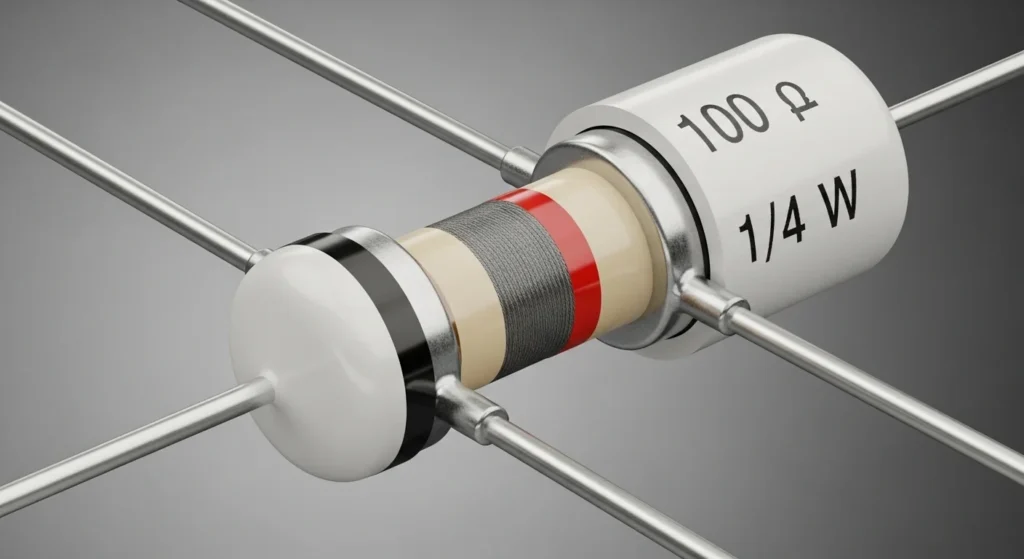
The resistive element is the core, often carbon, metal, or wire. It provides the opposition to current, determining the ohm value.
Terminals or leads are metal ends for connecting to circuits. They ensure secure attachment, like plugs in a socket.
The body or casing protects the inner material from damage. It’s usually ceramic or plastic, insulating against heat and moisture.
Color bands or markings indicate the resistance value and tolerance. This helps quick identification without tools.
For some, a heat sink attaches to dissipate excess warmth, preventing overheating in high-power setups.
These parts work together to make resistors durable and effective in circuits.
Advantages
Resistors offer several benefits that make them essential in electrical work.
- Current Control: They protect components by limiting flow, extending device life.
- Voltage Division: Help create different voltages in a circuit, useful for sensors.
- Low Cost: Affordable and widely available, perfect for beginners’ projects.
- Simplicity: Easy to use and replace, with no moving parts.
- Precision: Available in accurate values for fine-tuned applications.
- Heat Generation: Useful in heaters, providing warmth where needed.
- Stability: Maintain performance over time, ensuring reliable circuits.
In real-world scenarios, these advantages save money and prevent failures in everyday gadgets.
Disadvantages / Limitations
Resistors aren’t perfect, and knowing their limits helps in better design.
They waste energy as heat, which can reduce efficiency in battery-powered devices.
In high-precision needs, tolerance variations might cause slight inaccuracies.
Fixed types can’t adjust, limiting flexibility in changing conditions.
Overheating can lead to failure if power ratings are exceeded.
They’re sensitive to temperature changes, altering resistance unintentionally.
In compact designs, their size can be a drawback compared to integrated options.
Recycling involves separating materials, adding to electronic waste challenges.
Applications
Resistors have wide uses in homes, industries, and modern tech.
At home, they’re in appliances like toasters for heating elements and in dimmer switches for light control.
In industry, resistors manage power in motors and control systems, ensuring safe operations in factories.
Modern tech includes smartphones, where they stabilize signals, and computers for circuit protection.
In automotive, resistors help in dashboard lights and engine controls.
Medical devices use them in monitors for accurate readings.
Renewable energy systems employ resistors in inverters for smooth power conversion.
Comparison Section
Resistors differ from similar components like capacitors and inductors. Here’s a table comparing them.
| Aspect | Resistor | Capacitor | Inductor |
| Function | Limits current | Stores charge | Stores magnetic energy |
| Energy Handling | Dissipates as heat | Stores and releases | Stores in field |
| Frequency Response | Constant resistance | Blocks DC, passes AC | Blocks AC, passes DC |
| Applications | Current control | Filtering, timing | Filtering, energy storage |
| Advantages | Simple, cheap | Quick energy burst | Handles high currents |
| Disadvantages | Energy loss | Leaks over time | Bulky, electromagnetic noise |
This shows the difference between resistor and capacitor, highlighting unique roles in circuits.
Selection Guide
Choosing the right resistor starts with knowing your circuit needs. Calculate required resistance using Ohm’s Law: resistance equals voltage divided by current.
For beginners, check power rating—ensure it’s higher than expected to avoid burnout.
Consider tolerance; 1% is precise for sensitive work, while 5% suits general use.
Type matters: Use fixed for stable needs, variable for adjustments.
Material affects performance—carbon for low cost, metal film for accuracy.
Size and mounting: Through-hole for easy soldering, surface-mount for compact boards.
Tips: Buy assortments to experiment, use multimeters to verify values, and start with simple projects to build confidence.
Common Problems & Solutions
Here are FAQs with practical fixes for resistor issues.
Why is my resistor getting too hot?
It might exceed its power rating. Replace with a higher-wattage one or add a heat sink.
How do I read resistor color codes?
Bands show values—use online charts. Practice with known resistors to learn quickly.
Resistor value changed—why?
Temperature or age. Use stable types like metal film and keep circuits cool.
Circuit not working after adding resistor?
Wrong value or poor connection. Double-check calculations and solder joints.
Noise in audio circuit?
Carbon resistors can be noisy. Switch to metal film for cleaner sound.
These solutions come from years of hands-on troubleshooting.
Future Trends
Resistor tech is advancing with new materials and designs for better performance.
Nanomaterials like graphene promise ultra-precise, tiny resistors for wearables.
Smart resistors with sensors could self-adjust in IoT devices.
3D-printed resistors allow custom shapes for complex circuits.
Eco-friendly options using biodegradable materials reduce waste.
Integration in flexible electronics for bendable gadgets is growing.
Industry moves toward higher efficiency, with resistors in AI hardware for faster computing.
Expect more in quantum tech, where resistors handle extreme conditions.
Conclusion
What is a resistor? It’s a vital component that controls current, protects circuits, and enables countless devices. We’ve explored its definition, resistor working principle with analogies, types like fixed and variable, main parts, advantages like low cost, and disadvantages such as energy loss. Resistor applications range from homes to high-tech, with comparisons showing differences between related components.
As a senior electrical engineer, I’ve used resistors in everything from basic fixes to advanced systems— they’re foundational. Juniors, experiment safely, build simple circuits, and keep learning. This knowledge empowers you to innovate and solve real problems in our electrified world.