
Imagine you are running a large water pump in an industrial plant. You press a small push button, and suddenly the motor starts running. You are not directly handling the high current motor circuit. Instead, a small control signal is activating a device that safely switches the power supply. That device is called a contactor.
A contactor is one of the most important components in electrical control and industrial automation systems. It is widely used for switching motors, heaters, lighting systems, and heavy electrical loads.
Understanding what is a contactor is essential for electrical students, engineers, technicians, and beginners. Contactors provide safe and reliable control of high-power circuits using low-power signals.
In this article, you will learn contactor working principle, types of contactors, contactor applications, advantages and disadvantages, and selection tips — explained in simple and practical language.
What is a Contactor?
A contactor is an electrically controlled switching device used to make or break an electrical power circuit.
Simple Explanation
- A contactor works like a relay but is designed for high-power loads.
- It is mainly used in motor control circuits.
- It operates using an electromagnetic coil.
Practical Example
In an industrial conveyor system, a push button sends a signal to the control circuit. That signal energizes the contactor coil, and the contactor switches ON the motor supply.
So, when we ask what is a contactor, remember this simple idea:
Contactor is a heavy-duty electrically controlled switch.
Contactor Working Principle
The contactor working principle is based on electromagnetic force.
Let us explain step-by-step.
Step 1: Control Signal Activation
- When control voltage is applied, current flows through contactor coil.
Step 2: Magnetic Field Formation
- Coil current produces magnetic field.
Step 3: Armature Movement
- Magnetic field pulls the movable contact assembly.
Step 4: Contact Closing
- Main contacts close and power circuit is connected.
Step 5: Load Operation
- Motor or load starts running.
Simple Analogy
Think of contactor like a remote-controlled switch:
- Push button = Remote signal
- Coil = Receiver
- Contacts = Switch mechanism
This is contactor working principle in simple terms.
Types / Classification of Contactors
Contactors are classified based on application and design.
AC Contactors
- Used in AC power systems.
- Common in motor starters.
- Designed for AC load switching.
DC Contactors
- Used in DC circuits.
- Found in battery systems and electric vehicles.
Vacuum Contactors
- Contacts operate inside vacuum chamber.
- High reliability.
- Minimal arc formation.
Magnetic Contactors
- Most common industrial type.
- Uses electromagnetic coil operation.
Understanding difference between AC contactor and DC contactor is important for beginners.
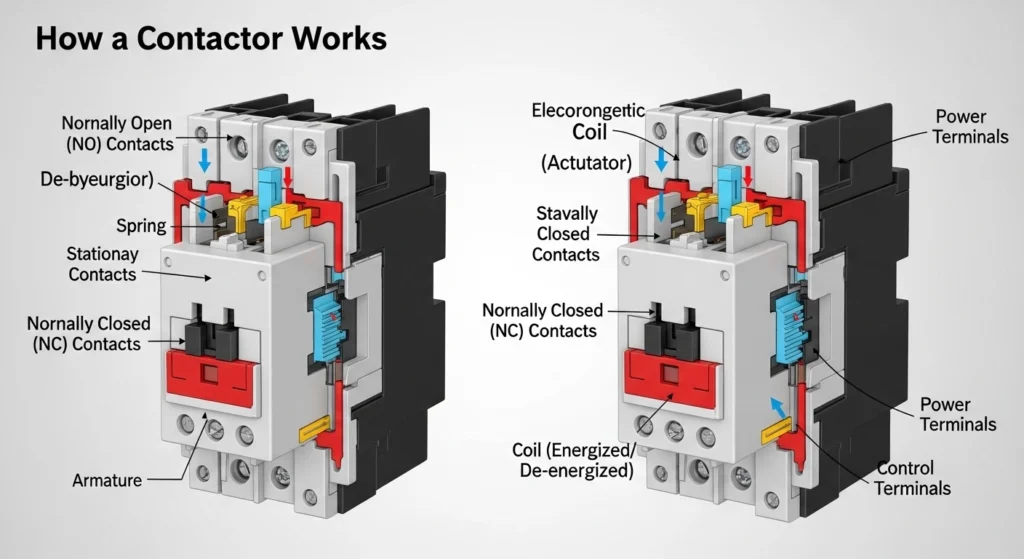
Main Components of a Contactor
Coil
- Produces magnetic field.
- Acts as control element.
Main Contacts
- Carry load current.
- Usually made of silver alloy material.
Auxiliary Contacts
Two types:
- Normally Open (NO)
- Normally Closed (NC)
Used for control circuit feedback.
Armature
- Mechanical moving part.
- Connects and disconnects contacts.
Spring Mechanism
- Returns armature to initial position.
Each component ensures safe switching operation.
Advantages of Contactor
Let us discuss contactor advantages and disadvantages.
Advantages
- Safe control of high-power circuits
- Remote operation capability
- Suitable for automation systems
- High switching reliability
- Long operational life
- Easy integration with PLC systems
Real-world benefit: Contactors allow operators to control heavy motors safely.
Disadvantages / Limitations
- Mechanical wear over time
- Contact arcing may occur
- Noise during switching
- Requires maintenance
- Higher cost than simple switches
Engineers must consider these limitations during design.
Contactor Applications
Contactor applications are very wide.
Home Applications
- Air conditioner compressors
- Water pump motors
- Heating systems
Industrial Applications
- Motor starter panels
- Conveyor systems
- Industrial automation
- Elevator control
Modern Technology
- Electric vehicle motor control
- Renewable energy systems
- Smart industrial plants
Contactors are essential in heavy electrical switching.
Comparison Section
Difference Between Contactor and Relay
| Feature | Contactor | Relay |
| Load Capacity | High | Low |
| Contact Size | Large | Small |
| Main Use | Motor switching | Signal switching |
| Arc Suppression | Better | Limited |
| Current Rating | High | Low |
This table helps beginners understand the difference between contactor and relay.
Selection Guide
When selecting a contactor:
- Check load current rating
- Check coil voltage rating
- Consider switching frequency
- Check environmental conditions
- Verify contact material quality
Beginner Tips
- Always install overload protection.
- Use proper wiring insulation.
- Follow manufacturer datasheet.
- Provide proper ventilation.
Never oversize or undersize contactor rating.
Common Problems & Solutions
Why does contactor not pull in?
Cause:
- Low control voltage
- Coil damage
Solution:
- Measure coil supply voltage
- Replace coil if faulty
Why do contacts burn?
Cause:
- Excess load current
- Arc formation
Solution:
- Use arc suppressor
- Select proper rating
How to test contactor?
- Check coil resistance
- Test contact continuity
- Inspect mechanical movement
Future Trends
Contactor technology is evolving.
Solid State Switching
- No mechanical movement
- High-speed switching
- Longer life
Smart Automation Systems
- IoT-based motor control
- Remote monitoring
- Predictive maintenance
Renewable Energy Integration
Contactors are widely used in:
- Solar inverter systems
- Wind power plants
Future contactors will be more intelligent and efficient.
Conclusion
A contactor is a very important switching device used in electrical and industrial automation systems. It allows safe remote control of high-power circuits using low-power signals.
We discussed what is a contactor, contactor working principle, types of contactors, contactor applications, and contactor advantages and disadvantages. We also compared contactor and relay and explained selection guidelines.
For electrical students and junior engineers, understanding contactors is essential for learning motor control and industrial automation.
Focus on practical circuit testing and safety practices. Strong knowledge of contactors helps build a solid foundation in power system and control engineering.
Keep learning and practicing real-world electrical systems.