
Imagine starting your washing machine at home. You load clothes, add detergent, press the start button, and within seconds the drum begins to rotate. Clothes move, water circulates, and the washing process starts automatically. The main component responsible for this movement is the Washing Machine Motor.
A washing machine motor converts electrical energy into mechanical energy that rotates the drum. Without this motor, the washing machine cannot wash, rinse, or spin clothes. This motor is designed to handle different speeds and loads while maintaining reliable performance.
For electrical students, engineers, and technicians, understanding how a washing machine motor works is very important. Many household appliances depend on electric motors, and the washing machine motor is one of the most common examples.
In this article, you will learn the Washing Machine Motor working principle, its types, main components, and Washing Machine Motor applications. We will also discuss the Washing Machine Motor advantages and disadvantages, comparison with other motors, and practical troubleshooting tips.
What is a Washing Machine Motor?
A Washing Machine Motor is an electric motor used to rotate the drum or agitator in a washing machine to wash and spin clothes.
Clear Definition
A washing machine motor is an electrical device that converts electrical energy into mechanical rotation to move the washing drum during washing, rinsing, and spinning cycles.
Simple Explanation
When electricity flows through the motor windings, it creates a magnetic field. This magnetic field causes the motor shaft to rotate. The rotating shaft turns the drum of the washing machine.
Practical Example
For example, during the washing cycle, the motor rotates the drum slowly to move clothes through water and detergent. During the spin cycle, the motor rotates at high speed to remove water from the clothes.
Washing Machine Motor Working Principle
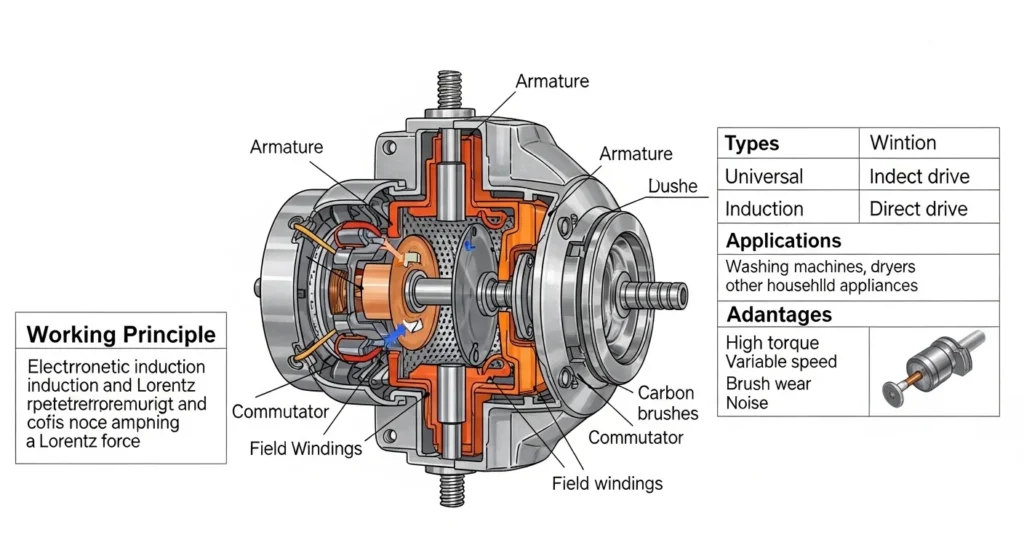
The Washing Machine Motor working principle is based on electromagnetic induction, where electric current produces a magnetic field that causes the motor to rotate.
When electricity flows through the motor coils, it creates a rotating magnetic field. This magnetic field interacts with the rotor and produces mechanical motion.
Step-by-Step Working Process
- Power Supply Activation
- Electricity from the power supply enters the washing machine motor.
- Magnetic Field Creation
- Current flows through the stator windings and creates a magnetic field.
- Rotor Interaction
- The magnetic field interacts with the rotor inside the motor.
- Motor Rotation
- The rotor begins to rotate due to electromagnetic forces.
- Drum Movement
- The motor shaft transfers rotation to the washing drum through a belt or direct drive.
Simple Analogy
Think of the washing machine motor like a fan motor. When electricity flows into the fan motor, the blades start spinning. Similarly, the washing machine motor spins the drum.
Types of Washing Machine Motor
Different types of motors are used in washing machines depending on design, efficiency, and cost.
Universal Motor
Universal motors are commonly used in older washing machines.
Features:
- Can operate on AC and DC power
- High starting torque
- Compact design
However, they may produce more noise compared to modern motors.
Induction Motor
Induction motors are widely used in many appliances.
Features:
- Simple construction
- Reliable performance
- Low maintenance
These motors are often used in semi-automatic washing machines.
Brushless DC Motor (BLDC)
BLDC motors are used in modern washing machines.
Features:
- High efficiency
- Quiet operation
- Longer lifespan
These motors are controlled electronically for better speed control.
Direct Drive Motor
Direct drive motors are used in advanced washing machines.
Features:
- Connected directly to the drum
- No belt required
- Reduced vibration and noise
They are common in modern high-efficiency washing machines.
Main Components of a Washing Machine Motor
A washing machine motor contains several important parts that work together to produce rotation.
Stator
The stator is the stationary part of the motor.
Function:
- Produces the magnetic field that drives the rotor.
Rotor
The rotor is the rotating part inside the motor.
Function:
- Rotates when magnetic forces act on it.
Motor Shaft
The shaft is connected to the rotor.
Function:
- Transfers rotational motion to the drum.
Bearings
Bearings support the rotating shaft.
Function:
- Reduce friction and allow smooth rotation.
Cooling Fan
Some motors include cooling fans.
Function:
- Prevent overheating during operation.
Washing Machine Motor Advantages
Understanding the Washing Machine Motor advantages and disadvantages helps technicians understand its performance.
Advantages
- Efficient conversion of electrical energy to mechanical motion
- Reliable operation for long periods
- Compact design suitable for household appliances
- High torque for drum rotation
- Suitable for multiple speed operations
Real-World Benefits
These advantages allow washing machines to operate efficiently while handling different load sizes and washing cycles.
Washing Machine Motor Disadvantages / Limitations
Despite its benefits, washing machine motors also have some limitations.
Limitations
- Motors may overheat if overloaded
- Brush motors require maintenance
- Some motors produce noise and vibration
- Electrical faults can stop machine operation
Proper maintenance helps extend the motor lifespan.
Washing Machine Motor Applications
There are many Washing Machine Motor applications in appliances and equipment.
Household Washing Machines
The primary application is rotating the washing drum for cleaning clothes.
Industrial Laundry Machines
Large laundry machines in hotels and hospitals use powerful washing machine motors.
Textile Processing Equipment
Some textile cleaning machines use similar motor systems.
Automatic Cleaning Systems
Industrial cleaning equipment also uses motors similar to washing machine motors.
Comparison: Washing Machine Motor vs Induction Motor
Understanding the difference between washing machine motor and induction motor helps technicians choose the right motor.
| Feature | Washing Machine Motor | Induction Motor |
|---|---|---|
| Application | Washing machines | Many industrial machines |
| Speed Control | Multiple speeds | Fixed or limited speeds |
| Efficiency | Moderate to high | High |
| Noise Level | Depends on type | Usually low |
| Maintenance | May require service | Low maintenance |
Key Difference
The main difference between washing machine motor and induction motor is that washing machine motors are specially designed for variable speeds and drum rotation.
Selection Guide
Choosing the right washing machine motor depends on several factors.
Important Factors
Motor Type
Select between universal, induction, or BLDC motors depending on efficiency needs.
Power Rating
Higher power motors handle heavier loads.
Speed Control
Modern machines require motors with variable speed control.
Durability
High-quality motors provide longer service life.
Tips for Beginners
- Choose energy-efficient motors.
- Ensure proper compatibility with the washing machine model.
- Check motor insulation and safety ratings.
Common Problems and Solutions
Why does the washing machine motor not start?
Possible reasons:
- Power supply failure
- Faulty wiring
- Motor damage
Solution: Check electrical connections and power supply.
Why is the motor making unusual noise?
Possible causes:
- Worn bearings
- Loose mounting
- Overload
Solution: Inspect bearings and mechanical parts.
Why does the motor overheat?
Possible reasons:
- Excess load
- Poor ventilation
- Electrical fault
Solution: Reduce load and ensure proper cooling.
Why is the drum not rotating?
Possible causes:
- Broken belt
- Motor fault
- Control system failure
Solution: Inspect belt and motor connections.
Future Trends in Washing Machine Motor Technology
Modern washing machines are evolving with advanced motor technologies.
Energy-Efficient Motors
Manufacturers are focusing on energy-saving motors.
Smart Motor Control
Modern motors include electronic control systems for precise speed adjustment.
Noise Reduction Technology
New designs reduce vibration and operating noise.
IoT-Enabled Appliances
Future washing machines may use smart motors connected to digital monitoring systems.
Conclusion
A Washing Machine Motor is the core component that drives the washing and spinning functions of a washing machine. By converting electrical energy into mechanical rotation, it enables the drum to move clothes effectively during washing cycles.
Understanding the Washing Machine Motor working principle, types, and Washing Machine Motor applications helps electrical students, technicians, and engineers diagnose problems and improve appliance performance.
Although washing machine motors have some limitations such as possible overheating and maintenance requirements, their advantages like reliable operation, efficient performance, and compact design make them ideal for household appliances.
As technology continues to evolve with brushless motors and smart control systems, washing machine motors will become even more efficient, quieter, and more durable.