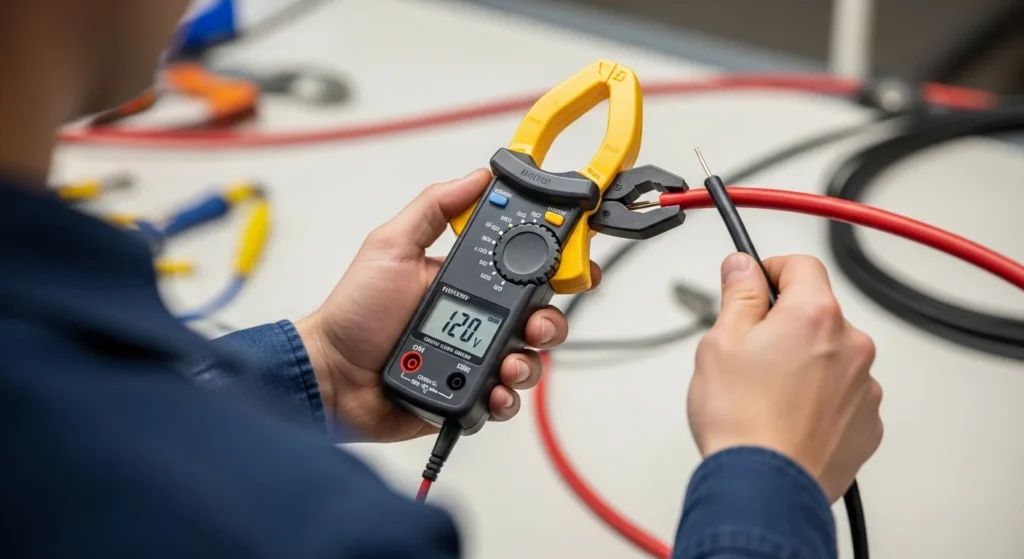

Imagine an electrician troubleshooting a motor in a factory. The motor suddenly stops working, and the technician needs to quickly check the current flowing through the cable. Traditionally, measuring current required cutting the wire and connecting a meter in series, which is time-consuming and risky. However, with a clamp meter, the electrician can simply place the meter around the wire and instantly measure the current without disconnecting the circuit.
This simple but powerful tool has become essential for electricians, technicians, and engineers working with electrical systems. Learning how to use a clamp meter correctly is very important for safe electrical testing and accurate measurements.
Clamp meters are widely used for measuring electrical current, voltage, resistance, and sometimes even temperature. They help diagnose electrical problems in homes, factories, HVAC systems, and industrial equipment.
In this guide, you will learn how to use a clamp meter, understand the clamp meter working principle, explore different types of clamp meters, and discover their components, advantages, limitations, and applications. This article is written in simple and practical language to help beginners and professionals improve their electrical measurement skills.
2. What is How to Use a Clamp Meter?
A clamp meter is a specialized electrical measuring instrument used to measure current flowing through a conductor without physically touching or disconnecting the wire.
Learning how to use a clamp meter allows technicians to measure current safely and quickly.
Simple Explanation
A clamp meter has a jaw-shaped clamp that opens and closes around a wire. When the clamp surrounds the wire, the meter detects the magnetic field created by the flowing current and converts it into a measurable value.
Practical Example
If an air conditioner is not working properly, a technician may use a clamp meter to measure the current drawn by the compressor motor. This helps determine whether the motor is overloaded or functioning normally.
Understanding how to use a clamp meter in electrical testing is a fundamental skill for anyone working with electrical systems.
3. Working Principle
The clamp meter working principle is based on electromagnetic induction.
Whenever electrical current flows through a wire, it creates a magnetic field around the conductor. The clamp meter detects this magnetic field and converts it into a current reading.
Step-by-Step Working Process
- Electrical current flows through a conductor.
- This current creates a magnetic field around the wire.
- The clamp meter jaw surrounds the wire.
- The sensor inside the clamp detects the magnetic field.
- The meter converts the magnetic field into a current measurement.
Simple Analogy
Think of the clamp meter as a sensor that “listens” to the magnetic field created by electricity.
Instead of touching the electricity directly, it detects the invisible magnetic energy around the wire.
This is why clamp meters can measure current without breaking the circuit.
4. Types / Classification
There are several types of clamp meters, each designed for specific electrical measurements.
AC Clamp Meter
AC clamp meters measure alternating current only.
Features
- Simple design
- Affordable price
- Common in basic electrical work
They are mainly used for household and commercial electrical systems.
AC/DC Clamp Meter
AC/DC clamp meters measure both alternating and direct current.
Features
- More advanced measurement capability
- Used in automotive and solar systems
- Higher accuracy
These meters are widely used in modern electrical maintenance.
Digital Clamp Meter
Digital clamp meters display readings on an electronic screen.
Features
- Easy to read measurements
- High accuracy
- Multiple functions
Most electricians today use digital clamp meters.
True RMS Clamp Meter
True RMS clamp meters provide accurate measurements even when the waveform is distorted.
Features
- High precision
- Suitable for industrial equipment
- Reliable for variable frequency drives
They are commonly used in industrial environments.
5. Main Components
Understanding the main parts of a clamp meter helps users operate the tool properly.
Clamp Jaws
The clamp jaws open and close around the wire.
They detect the magnetic field produced by current.
Trigger
The trigger opens the clamp jaws.
It allows the user to place the meter around the conductor.
Display Screen
The display shows measurement values such as current, voltage, and resistance.
Function Selector Dial
The dial allows the user to select different measurement modes.
Test Leads
Test leads are used to measure voltage, resistance, and continuity.
Internal Sensor
The internal sensor converts magnetic field signals into electrical readings.
6. Advantages
Understanding clamp meter advantages and disadvantages helps technicians choose the right tool.
Advantages
- Measures current without disconnecting wires
- Safer than traditional current measurement methods
- Fast and convenient testing
- Suitable for high current measurement
- Portable and easy to use
- Multi-function measurement capability
These benefits make clamp meters essential tools for electricians.
7. Disadvantages / Limitations
Despite their usefulness, clamp meters have some limitations.
Disadvantages
- Less accurate for very small currents
- Higher cost compared to basic multimeters
- Limited measurement range in some models
- Requires proper positioning for accurate readings
Understanding these limitations helps users avoid measurement errors.
8. Applications
The clamp meter applications are widespread in electrical testing and troubleshooting.
Residential Electrical Work
- Checking household circuit current
- Diagnosing overloaded circuits
- Testing appliances
Industrial Maintenance
- Monitoring motor current
- Testing electrical panels
- Troubleshooting industrial machines
HVAC Systems
Clamp meters are commonly used to test compressors, fans, and electrical components in heating and cooling systems.
Renewable Energy Systems
Technicians use clamp meters in solar and battery systems to measure DC current.
9. Comparison Section
Many beginners ask about the difference between clamp meter and multimeter.
| Feature | Clamp Meter | Multimeter |
|---|---|---|
| Current Measurement | Without breaking circuit | Requires series connection |
| Safety | Safer for high current | Less safe for high current |
| Convenience | Very quick measurement | Slower process |
| Accuracy | Good for high current | Better for low current |
| Typical Use | Electrical maintenance | Electronic testing |
Both tools are important but serve slightly different purposes.
10. Selection Guide
Choosing the right clamp meter requires careful consideration.
Important Factors
- Current measurement range
- AC or AC/DC measurement capability
- Display quality
- Safety rating
- Measurement accuracy
Tips for Beginners
- Choose a digital clamp meter with multiple functions.
- Ensure the meter has proper safety certification.
- Select models with backlit displays for easy reading.
- Consider True RMS meters for advanced work.
Selecting the right tool improves measurement accuracy and safety.
11. Common Problems & Solutions
Q1: Why does the clamp meter show incorrect readings?
This may happen if the clamp surrounds multiple wires.
Solution: Clamp only one conductor at a time.
Q2: Why is the display showing zero current?
This may occur if the meter is set to the wrong mode.
Solution: Select the correct measurement setting.
Q3: Why does the clamp meter give unstable readings?
Unstable readings may occur due to electromagnetic interference.
Solution: Keep the meter away from strong magnetic sources.
Q4: Why does the clamp meter not turn on?
This may be caused by a weak battery.
Solution: Replace the battery.
12. Future Trends
Electrical measurement tools are evolving rapidly.
Smart Clamp Meters
Modern clamp meters now include Bluetooth connectivity for data recording and mobile monitoring.
Advanced Sensors
New sensor technologies improve accuracy and measurement range.
Integration with Smart Systems
Future clamp meters may connect directly to smart maintenance systems for automated diagnostics.
These advancements will improve electrical troubleshooting and safety.
13. Conclusion
Learning how to use a clamp meter is an essential skill for electrical students, technicians, and engineers. This versatile tool allows users to measure current safely and efficiently without disconnecting wires. By understanding the clamp meter working principle, users can accurately measure electrical parameters and diagnose system problems.
Clamp meters come in several types, including AC clamp meters, AC/DC clamp meters, digital clamp meters, and True RMS models. Each type serves different electrical applications, from residential troubleshooting to industrial maintenance.
Although clamp meters have some limitations, their advantages in safety, convenience, and speed make them one of the most valuable tools in electrical work. As electrical systems become more advanced, clamp meters will continue evolving with smarter features and improved measurement capabilities.
Mastering this tool will greatly improve your ability to diagnose and maintain electrical systems safely and effectively.