
Imagine electricity generated at a power plant at 11 kV. It cannot be transmitted directly over long distances at this voltage because losses will be high. So, engineers use a transformer to increase the voltage to 132 kV or even higher. Near your home, another transformer reduces that high voltage to 230V so you can safely use fans, lights, and appliances.
This simple example shows how important transformers are in our daily life. Without them, modern power systems would not work efficiently or safely.
Understanding the types of transformers is essential for electrical students, engineers, technicians, and beginners. Different applications require different transformer designs. In this detailed guide, you will learn the types of transformers, transformer working principle, classification, components, applications, advantages and disadvantages, and practical selection tips — explained in simple and clear English.
What is Types of Transformers?
A transformer is an electrical device that transfers electrical energy from one circuit to another using electromagnetic induction. It can increase or decrease voltage without changing frequency.
When we talk about types of transformers, we mean different transformer designs based on function, construction, voltage level, cooling method, and application.
Simple Explanation
A transformer changes voltage level:
- High voltage to low voltage (step-down)
- Low voltage to high voltage (step-up)
It works only with alternating current (AC).
Practical Example
In a mobile charger, a small transformer reduces 230V AC to a lower voltage before rectification. In a power station, a large transformer increases generator voltage for transmission.
Transformer Working Principle
The transformer working principle is based on electromagnetic induction.
Let’s understand step-by-step with a simple analogy.
Think of two coils placed near each other. When electricity flows in the first coil, it creates a magnetic field. That magnetic field links to the second coil and produces voltage.
Step-by-Step Process
- AC supply applied to primary winding
- Current flows in primary coil
- Magnetic field is produced in core
- Magnetic field links secondary coil
- Voltage is induced in secondary winding
Important Points
- Works only with AC
- No direct electrical connection between windings
- Voltage ratio depends on number of turns
If primary turns are more than secondary, voltage decreases.
If secondary turns are more than primary, voltage increases.
This is the basic transformer working principle.
Types / Classification of Transformers
Transformers can be classified in many ways. Let’s understand each type clearly.
Based on Voltage Level
Step-Up Transformer
- Increases voltage
- Used in power generation stations
- Secondary turns > Primary turns
Step-Down Transformer
- Decreases voltage
- Used in distribution systems
- Primary turns > Secondary turns
Based on Construction
Core-Type Transformer
- Windings placed around the core
- Simple construction
- Easy maintenance
Shell-Type Transformer
- Core surrounds the windings
- Better mechanical strength
- Used in high-voltage applications
Based on Application
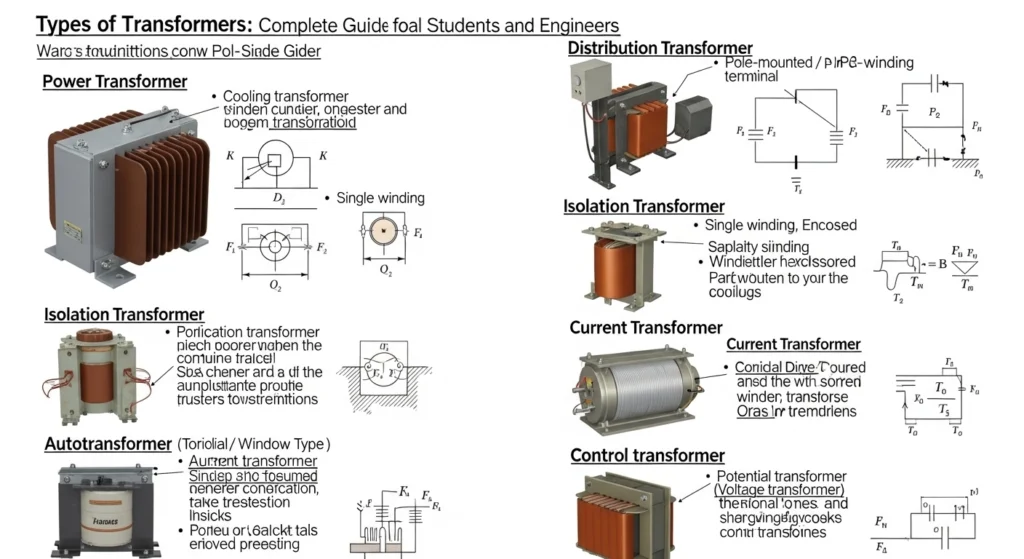
Power Transformer
- Used in transmission network
- High voltage and high power
- Installed in substations
Distribution Transformer
- Used near consumer areas
- Lower voltage levels
- Smaller size compared to power transformer
Instrument Transformer
Used for measurement and protection.
- Current Transformer (CT)
- Potential Transformer (PT)
These reduce high current or voltage to safe levels for meters and relays.
Based on Cooling Method
Oil-Immersed Transformer
- Windings immersed in oil
- Oil provides cooling and insulation
- Used in large power systems
Dry-Type Transformer
- Air-cooled
- Used indoors
- Low maintenance
Based on Phases
Single-Phase Transformer
- Used in homes
- Small load applications
Three-Phase Transformer
- Used in industries
- High power applications
Based on Special Purpose
Auto Transformer
- Single winding
- Smaller size
- Used in voltage regulation
Isolation Transformer
- Provides electrical isolation
- Used for safety
Understanding the difference between power transformer and distribution transformer is important for exams and practical field work.
Main Components of a Transformer
Every transformer has important parts.
Core
- Made of laminated silicon steel
- Provides magnetic path
- Reduces losses
Primary Winding
- Connected to input supply
- Produces magnetic field
Secondary Winding
- Delivers output voltage
- Receives induced voltage
Insulation
- Prevents short circuits
- Increases safety
Transformer Oil (in oil type)
- Cooling medium
- Insulation support
Tank and Bushings
- Tank protects internal parts
- Bushings allow safe external connections
Advantages of Transformers
Here are the main transformer advantages and disadvantages. First, advantages:
- Efficient voltage conversion
- No moving parts
- Low maintenance
- High efficiency (up to 98%)
- Reliable and long life
- Essential for power transmission
Real-world benefit: Without transformers, long-distance power transmission would be impossible.
Disadvantages / Limitations
- Works only with AC
- Heavy and bulky (large units)
- Oil leakage risk (oil type)
- Initial cost can be high
- Efficiency reduces under light load
Engineers must consider these factors during selection.
Types of Transformers Applications
Types of transformers applications are wide in modern systems.
Home Applications
- Mobile chargers
- UPS systems
- Inverters
Industrial Applications
- Motor control
- Welding machines
- Heavy equipment
Power System Applications
- Voltage step-up in generation
- Voltage step-down in distribution
- Protection and measurement
Modern Technology
- Renewable energy systems
- Electric vehicle charging
- Data centers
Transformers are the backbone of electrical infrastructure.
Comparison Section
Difference Between Power Transformer and Distribution Transformer
| Feature | Power Transformer | Distribution Transformer |
| Location | Transmission station | Near consumers |
| Voltage Level | Very high | Medium to low |
| Load | Full load operation | Variable load |
| Size | Large | Smaller |
| Efficiency Focus | At full load | At all-day load |
This comparison helps in understanding application differences.
Selection Guide
Choosing the right transformer depends on:
- Required voltage level
- Power rating (kVA)
- Installation location
- Cooling method
- Budget
- Safety requirements
Tips for Beginners
- Always check load requirement first.
- Calculate future expansion load.
- Consider efficiency and losses.
- Follow local electrical standards.
Never select a transformer only based on price.
Common Problems & Solutions (FAQs)
Q1: Why does transformer overheat?
Due to overload or poor cooling.
Solution:
Reduce load and check cooling system.
Q2: Why is humming sound present?
Due to core vibration (magnetostriction).
Solution:
Check core tightening and mounting.
Q3: Why does oil level decrease?
Leakage or evaporation.
Solution:
Inspect tank and seals regularly.
Q4: What causes voltage drop?
Overloading or poor regulation.
Solution:
Check load balance and transformer rating.
Future Trends
The transformer industry is evolving.
Smart Transformers
- Digital monitoring
- Remote control systems
Eco-Friendly Insulating Fluids
- Biodegradable oils
- Reduced environmental risk
Compact Designs
- High power density
- Better materials
Integration with Renewable Energy
- Solar plants
- Wind farms
Future transformers will be smarter, safer, and more efficient.
Conclusion
Understanding the types of transformers is fundamental for every electrical student and engineer. Transformers change voltage levels efficiently and safely using the principle of electromagnetic induction. We discussed classification based on voltage, construction, application, cooling, and phase.
We also covered transformer working principle, types of transformers applications, and transformer advantages and disadvantages. Proper selection ensures system safety, reliability, and efficiency.
As a junior engineer, always focus on load calculation, cooling method, and safety standards before selecting a transformer. Mastering this topic will strengthen your knowledge in power systems and electrical engineering.