
Imagine turning on a ceiling fan in your home. Within seconds, the blades start rotating and cool air begins to circulate around the room. While most people focus on the rotating part of the fan, the actual work of producing the magnetic field that drives the rotation is done by another important component inside the motor — the stator.
The stator is one of the most critical parts of electrical machines such as motors, generators, and alternators. It is the stationary part that creates the magnetic field required for the machine to operate. Without a stator, electric motors would not be able to convert electrical energy into mechanical motion.
For electrical students, engineers, and technicians, understanding the stator working principle is fundamental to learning how electrical machines operate. The stator determines the efficiency, power output, and reliability of many devices used in homes, industries, and modern technologies.
In this article, you will learn what a stator is, how the stator working principle functions, its types, main components, advantages, disadvantages, and practical stator applications in electrical and mechanical systems.
What is Stator?
A stator is the stationary (non-rotating) part of an electrical machine such as an electric motor, generator, or alternator.
Its main function is to produce a magnetic field that interacts with the rotating part (rotor) to generate motion or electricity.
Simple Explanation
In simple terms, the stator remains fixed in place while the rotor rotates inside it. The stator contains windings or coils that produce a magnetic field when electrical current flows through them.
This magnetic field causes the rotor to rotate, which converts electrical energy into mechanical energy.
Practical Example
In an AC induction motor used in water pumps, the stator receives AC power. This power creates a rotating magnetic field that forces the rotor to spin, driving the pump.
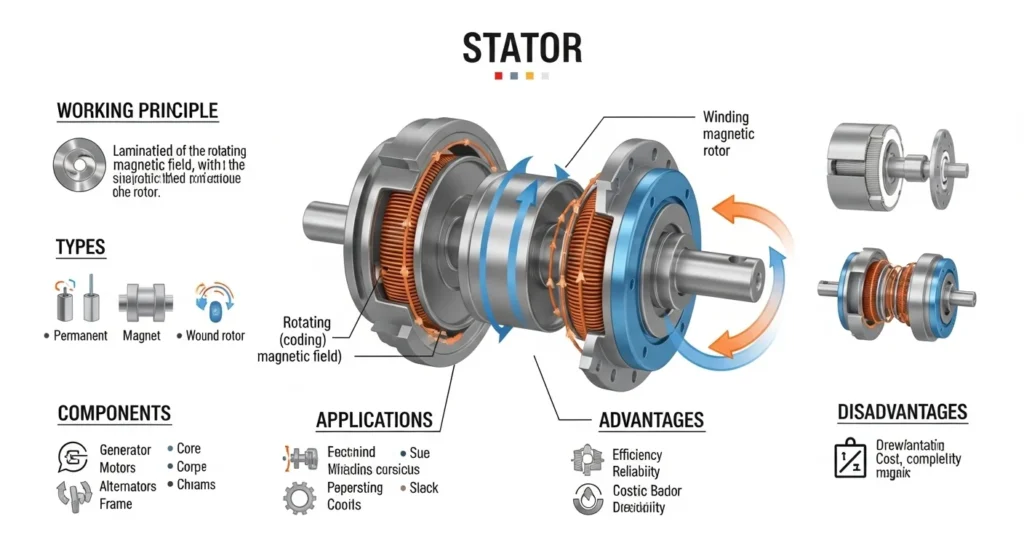
Stator Working Principle
The stator working principle is based on electromagnetic induction and magnetic field interaction.
When electrical current flows through the stator windings, it produces a magnetic field. This field interacts with the rotor to create motion or generate electricity.
Step-by-Step Operation
The stator operates through the following steps:
- Electrical power is supplied to the stator windings.
- Current flows through the copper coils.
- The coils produce a magnetic field around the stator.
- In AC machines, this magnetic field rotates continuously.
- The rotating magnetic field interacts with the rotor.
- The rotor begins to rotate due to electromagnetic forces.
Simple Analogy
Think of the stator like a magnetic track around a spinning object. As the magnetic field moves around the stator, it pushes the rotor and causes it to rotate.
Types / Classification of Stator
Stators can be classified based on the type of electrical machine or winding design.
Single Phase Stator
Single-phase stators are used in small electric motors.
Features:
- Operates with single-phase AC power
- Used in household appliances
- Common in fans and small pumps
Three Phase Stator
Three-phase stators are used in industrial motors and generators.
Features:
- Uses three-phase electrical supply
- Produces a strong rotating magnetic field
- Higher efficiency and power output
Laminated Stator
Laminated stators are made from thin steel sheets stacked together.
Features:
- Reduces energy losses
- Improves efficiency
- Common in modern motors and generators
Permanent Magnet Stator
In some machines, the stator contains permanent magnets instead of windings.
Features:
- High efficiency
- Used in electric vehicles and advanced motors
Main Components of a Stator
A stator contains several important parts that work together to produce the magnetic field.
Stator Core
The stator core is made of laminated steel sheets.
Function:
- Provides magnetic path
- Reduces energy losses due to eddy currents
Stator Windings
These are copper coils placed in slots of the stator core.
Function:
- Carry electrical current
- Generate magnetic field
Stator Slots
Slots are grooves inside the stator core where windings are placed.
Function:
- Hold the windings securely
- Maintain proper coil arrangement
Insulation Material
Insulation prevents electrical short circuits between coils and the core.
Function:
- Protects windings
- Improves electrical safety
Stator Frame
The frame is the outer structure that supports the stator.
Function:
- Provides mechanical protection
- Holds all stator components together
Advantages of Stator
The stator plays a critical role in electrical machines.
Stator advantages include:
- Produces a strong magnetic field
- Improves motor efficiency
- Provides stable machine operation
- Durable and reliable design
- Requires minimal maintenance
- Supports high power output in industrial machines
These advantages make stators essential in most electrical machines.
Disadvantages / Limitations
Although stators are reliable, they have some limitations.
Stator advantages and disadvantages must both be understood.
Stator Limitations
- Windings can overheat under heavy load
- Insulation may degrade over time
- Repairs can be complex
- Manufacturing requires precision
Proper cooling and maintenance help reduce these issues.
Stator Applications
Stators are used in many electrical and mechanical systems.
Home Applications
Common household devices using stators include:
- Ceiling fans
- Washing machines
- Refrigerators
- Air conditioners
Industrial Applications
In industries, stators are used in:
- Induction motors
- Industrial pumps
- Compressors
- Conveyor systems
These machines rely heavily on reliable stator performance.
Modern Technology Applications
Modern technology also uses stators in advanced machines such as:
- Electric vehicles
- Wind turbines
- Robotics systems
- High-efficiency generators
These stator applications demonstrate their importance in modern engineering.
Comparison Section
Difference Between Stator and Rotor
| Feature | Stator | Rotor |
|---|---|---|
| Position | Stationary part | Rotating part |
| Function | Produces magnetic field | Rotates due to magnetic field |
| Movement | Fixed | Rotating |
| Location | Outer part of machine | Inner part |
Understanding the difference between stator and rotor is essential for learning how electrical machines operate.
Selection Guide
Selecting the correct stator design is important when designing or repairing electrical machines.
Important Factors
- Motor power rating
- Voltage requirements
- Cooling design
- Winding type
- Material quality
Tips for Beginners
- Always follow manufacturer specifications.
- Choose high-quality insulation materials.
- Ensure proper cooling system design.
- Select laminated cores for better efficiency.
A well-designed stator improves machine performance and reliability.
Common Problems & Solutions
Why do stator windings overheat?
Overheating occurs due to excessive load or poor ventilation.
Solution:
- Reduce load
- Improve cooling system
Why does a stator produce noise?
Noise may occur due to loose laminations or magnetic vibration.
Solution:
- Tighten stator components
- Check mechanical alignment
Why does a motor stop working?
Stator winding failure or insulation damage may cause motor failure.
Solution:
- Inspect windings
- Repair or rewind stator coils
Why does a motor consume high current?
This may occur due to shorted stator windings.
Solution:
- Test insulation resistance
- Replace damaged windings
Future Trends
Electrical machine technology continues to evolve with new innovations.
High Efficiency Motors
Modern stator designs focus on reducing energy losses and improving efficiency.
Advanced Insulation Materials
New insulation technologies increase lifespan and thermal resistance.
Electric Vehicle Motors
Electric vehicles require compact and highly efficient stators.
Smart Monitoring Systems
Sensors are now used to monitor stator temperature and vibration in real time.
These developments will improve machine reliability and energy efficiency.
Conclusion
The stator is one of the most important components of electrical machines such as motors, generators, and alternators. It is the stationary part that produces the magnetic field required for machine operation. Without the stator, electrical energy could not be converted into mechanical motion effectively.
In this article, we discussed what a stator is, explained the stator working principle, and explored different stator types, components, and real-world stator applications. We also examined the stator advantages and disadvantages, along with troubleshooting tips and future technological developments.
For electrical students, engineers, and technicians, understanding stator design and operation is essential for working with electric motors and power generation systems. Proper stator design, maintenance, and monitoring can significantly improve machine performance, reliability, and efficiency in modern electrical engineering systems.