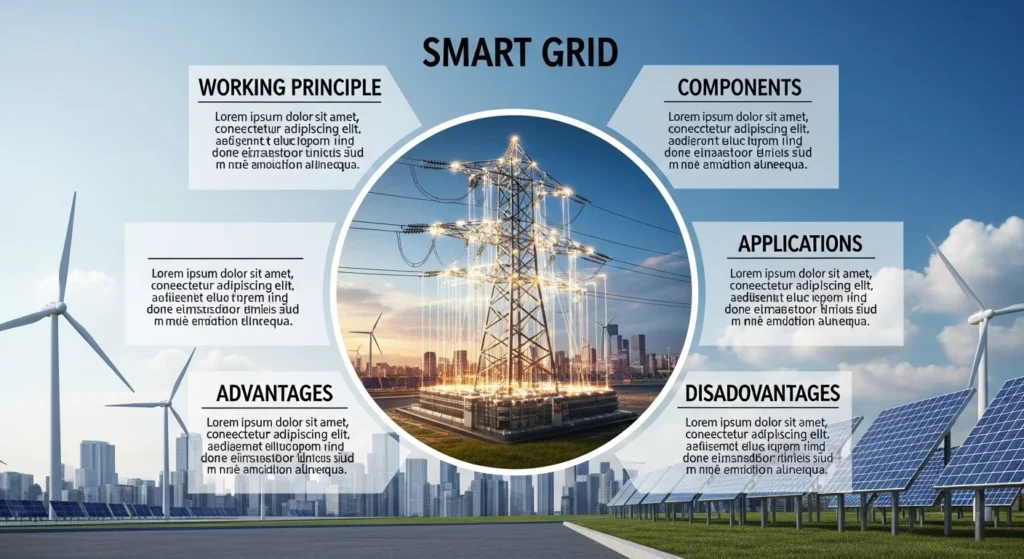

Imagine a city where electricity automatically adjusts based on demand. When people return home in the evening and switch on lights, fans, and appliances, the power system instantly balances the load without causing blackouts. If a fault occurs in one area, the system detects it immediately and redirects electricity through another route. This is the power of a Smart Grid.
Traditional electrical grids were designed decades ago. They mainly deliver electricity in one direction—from power plants to consumers. However, modern energy systems require something more flexible and intelligent. With renewable energy sources, electric vehicles, and increasing electricity demand, the traditional grid is often not efficient enough.
This is where the Smart Grid becomes important. A Smart Grid uses advanced communication, sensors, automation, and digital technology to monitor and manage electricity flow in real time.
In this article, electrical students, engineers, and beginners will learn the Smart Grid working principle, major components, types, Smart Grid applications, and the Smart Grid advantages and disadvantages. By the end, you will clearly understand how Smart Grids are transforming modern electrical power systems.
2. What is Smart Grid?
A Smart Grid is an advanced electrical power system that uses digital technology, communication networks, and automation to monitor, control, and optimize electricity generation, transmission, and distribution.
In simple terms, a Smart Grid is an intelligent electricity network that can automatically detect problems, balance power demand, and improve system efficiency.
Simple Explanation
Think of the Smart Grid like a smart traffic control system.
In a normal road system, traffic signals operate on fixed timings. But in a smart traffic system, sensors monitor vehicle flow and adjust signals automatically.
Similarly, a Smart Grid continuously monitors electricity flow and adjusts power supply based on real-time demand.
Practical Example
For example, if a neighborhood suddenly consumes more electricity, the Smart Grid automatically distributes additional power from other sources. If solar panels produce extra energy during the day, the system can send that electricity back into the grid.
This two-way communication makes Smart Grids more efficient than traditional power systems.
3. Smart Grid Working Principle
The Smart Grid working principle is based on communication, automation, and real-time monitoring of electricity networks.
Instead of one-way power flow, Smart Grids allow two-way communication between power producers and consumers.
Step-by-Step Working Principle
- Electricity Generation
- Power plants generate electricity.
- Renewable sources like solar and wind can also feed energy into the grid.
- Transmission System
- High-voltage transmission lines carry electricity over long distances.
- Sensors monitor voltage, current, and power quality.
- Smart Monitoring
- Sensors and smart meters collect real-time data about electricity usage.
- Communication Network
- Data is transmitted to control centers through communication networks.
- Automatic Control
- Software systems analyze the data.
- The grid automatically adjusts supply to match demand.
- Consumer Interaction
- Smart meters inform consumers about their electricity consumption.
Simple Analogy
Think of a Smart Grid like a smart water system.
- Sensors detect water pressure.
- Controllers adjust valves.
- The system balances water flow automatically.
Similarly, Smart Grids balance electricity flow across the entire network.
4. Types / Classification of Smart Grid Systems
Smart Grids can be classified based on their functionality and application.
Advanced Metering Infrastructure (AMI)
This system includes smart meters that record electricity usage in real time.
Features:
- Two-way communication between utility and consumer
- Accurate energy monitoring
- Better billing and energy management
Smart Distribution Grid
This type focuses on improving the distribution network.
Features:
- Automatic fault detection
- Self-healing power lines
- Load balancing
Renewable Integrated Smart Grid
This grid integrates renewable energy sources such as:
- Solar power
- Wind power
- Hydropower
It manages fluctuating power generation effectively.
Microgrid
A microgrid is a small localized Smart Grid.
Features:
- Can operate independently from the main grid
- Often used in campuses, industries, and remote areas
5. Main Components of a Smart Grid
A Smart Grid consists of several key components that work together.
1. Smart Meters
Smart meters measure electricity consumption and send data to the utility company in real time.
Function:
- Accurate billing
- Energy usage monitoring
2. Sensors and Monitoring Devices
Sensors detect important electrical parameters such as:
- Voltage
- Current
- Frequency
- Temperature
They help identify faults and abnormal conditions.
3. Communication Network
Communication systems connect all parts of the Smart Grid.
Examples include:
- Fiber optic networks
- Wireless communication
- Internet-based networks
4. Control Centers
Control centers analyze grid data and make decisions.
Functions:
- Load balancing
- Fault management
- Power distribution optimization
5. Energy Storage Systems
Energy storage technologies store extra electricity for later use.
Examples:
- Battery storage systems
- Pumped hydro storage
6. Advantages of Smart Grid
The Smart Grid advantages and disadvantages should be clearly understood by engineers and technicians.
Advantages
- Improves energy efficiency
- Reduces power outages
- Supports renewable energy integration
- Provides real-time electricity monitoring
- Enables better load management
- Reduces electricity losses in transmission
- Allows two-way power flow
- Helps consumers manage energy usage
Real-World Benefits
Smart Grids improve reliability, reduce energy waste, and support sustainable power systems.
7. Disadvantages / Limitations
Despite many benefits, Smart Grids also have certain limitations.
Limitations
- High installation cost
- Requires advanced communication infrastructure
- Cybersecurity risks due to digital systems
- Complex system management
- Requires skilled engineers and technicians
Utilities must carefully plan implementation to overcome these challenges.
8. Smart Grid Applications
There are many Smart Grid applications in modern power systems.
Home Applications
- Smart meters for monitoring electricity usage
- Smart appliances that operate during off-peak hours
Industrial Applications
- Energy management systems
- Load optimization in factories
Renewable Energy Systems
- Solar and wind integration
- Distributed energy generation
Electric Vehicles
Smart Grids support charging stations and manage EV charging demand.
Smart Cities
Smart Grids are essential for modern smart city infrastructure.
9. Comparison: Smart Grid vs Traditional Grid
| Feature | Smart Grid | Traditional Grid |
|---|---|---|
| Communication | Two-way communication | One-way communication |
| Monitoring | Real-time monitoring | Limited monitoring |
| Energy Sources | Supports renewable energy | Mainly centralized power plants |
| Fault Detection | Automatic detection | Manual detection |
| Efficiency | Higher efficiency | Lower efficiency |
Difference Between Smart Grid and Traditional Grid
The main difference between Smart Grid and traditional grid is the use of digital communication and automation. Smart Grids are intelligent, adaptive, and capable of managing complex power systems.
10. Selection Guide (For Utilities and Engineers)
Choosing the right Smart Grid solution depends on several factors.
Key Considerations
- Grid Size
- Small networks may use microgrids.
- Energy Sources
- Areas with renewable energy require advanced integration systems.
- Budget
- Smart Grid systems require significant investment.
- Communication Infrastructure
- Reliable communication networks are essential.
Tips for Beginners
- Start with smart metering systems.
- Gradually integrate automation and monitoring technologies.
- Ensure cybersecurity measures are in place.
11. Common Problems and Solutions
Q1: Why is Smart Grid implementation expensive?
Because it requires advanced sensors, communication systems, smart meters, and control infrastructure.
Q2: What is the biggest challenge of Smart Grids?
Cybersecurity and data protection are major concerns due to digital connectivity.
Q3: Can Smart Grids prevent power outages?
They cannot eliminate all outages but can detect faults faster and restore power quickly.
Q4: Are Smart Grids suitable for renewable energy?
Yes. Smart Grids are designed to integrate solar and wind power efficiently.
12. Future Trends in Smart Grid Technology
Smart Grid technology continues to evolve rapidly.
Artificial Intelligence Integration
AI systems can predict electricity demand and optimize power distribution automatically.
Advanced Energy Storage
New battery technologies will improve energy storage capacity.
Electric Vehicle Integration
Future grids will support millions of electric vehicle charging stations.
Blockchain in Energy Trading
Blockchain technology may allow consumers to sell excess solar power directly to neighbors.
Smart Cities Development
Smart Grids will become the backbone of modern smart cities.
13. Conclusion
The Smart Grid represents a major advancement in modern electrical power systems. Unlike traditional grids, Smart Grids use digital communication, sensors, and automation to monitor and control electricity flow in real time. This intelligent system improves reliability, reduces energy losses, and supports renewable energy integration.
Understanding the Smart Grid working principle, key components, and Smart Grid applications is essential for electrical students, engineers, and technicians. As global energy demand continues to grow, Smart Grids will play a critical role in building efficient, sustainable, and resilient power networks.
Although Smart Grid implementation requires significant investment and advanced technology, its long-term benefits are substantial. By improving energy efficiency and enabling smarter electricity management, Smart Grids are shaping the future of power systems.
For anyone working in electrical engineering, learning about Smart Grid technology is an important step toward understanding the future of modern energy infrastructure.