
Think about turning on your ceiling fan on a hot summer day. It starts spinning smoothly after a slight hum, powered by the single-phase electricity from your home outlet. This everyday appliance uses a single-phase induction motor – simple, reliable, and everywhere in our homes. Without it, fans, washing machines, and refrigerators would be much harder to run affordably.
Single-phase induction motors are crucial because most homes and small businesses get single-phase power. They provide mechanical power for light loads without needing expensive three-phase supply. Understanding them helps electrical students, engineers, technicians, and beginners design, install, repair, and troubleshoot common devices safely and efficiently.
In this article, you’ll learn what a single-phase induction motor is, its working principle, types, main components, advantages and disadvantages, applications, and practical tips. We’ll cover the single-phase induction motor working principle step-by-step, real-world uses, selection advice, common fixes, and future trends. By the end, you’ll handle these motors with confidence, whether fixing a fan or studying for exams.
Single Phase Motors
A single-phase motor is an electric motor that operates using single-phase AC power, which is the common electricity supply used in homes (usually 220–240 V in countries like Pakistan). These motors are widely used in household and small industrial applications because they can run directly from domestic power supply. ⚡
What is a Single-Phase Motor?
A single-phase motor is an AC motor that runs on single-phase power instead of three-phase power.
- Power Supply: Single Phase (1-Phase)
- Voltage: Usually 220–240 V
- Frequency: 50 Hz
Unlike three-phase motors, a single-phase motor cannot start on its own, so it needs auxiliary components like capacitors or starting windings.
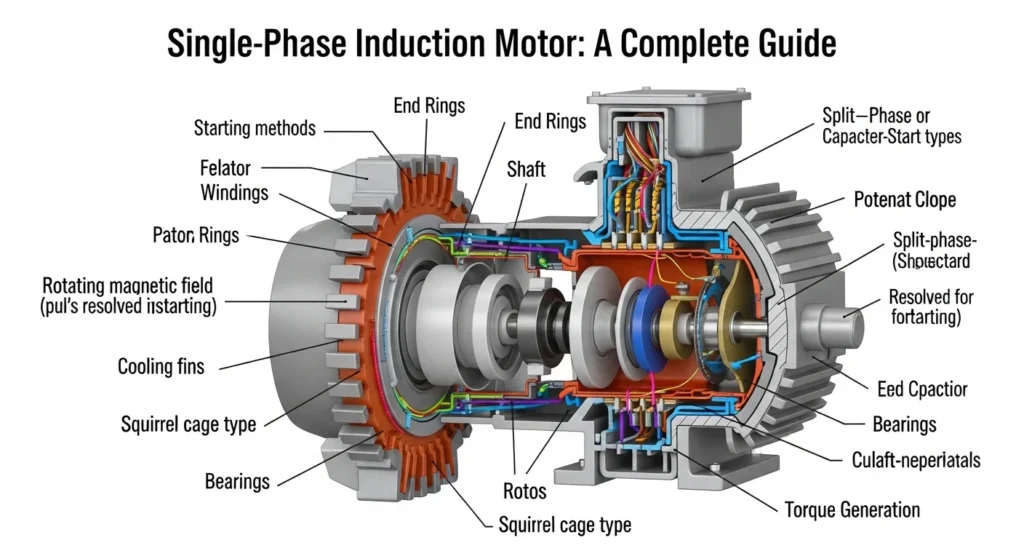
Main Parts of a Single-Phase Motor
- Stator – The stationary part containing the windings.
- Rotor – The rotating part inside the stator.
- Starting Winding – Helps start the motor.
- Run Winding – Keeps the motor running.
- Capacitor – Provides phase shift for starting torque.
- Centrifugal Switch – Disconnects the starting winding after startup.
Types of Single-Phase Motors
1. Split Phase Motor
- Uses starting winding + running winding
- Moderate starting torque
- Used in fans, blowers, grinders
2. Capacitor Start Motor
- Uses a large capacitor for starting
- High starting torque
- Used in air compressors, pumps, refrigerators
3. Capacitor Start Capacitor Run Motor
- Uses two capacitors (start + run)
- Very efficient and smooth operation
- Used in AC units, heavy pumps
4. Permanent Split Capacitor (PSC) Motor
- Uses one capacitor continuously
- Quiet operation
- Used in ceiling fans and HVAC systems
5. Shaded Pole Motor
- Simplest design
- Very low starting torque
- Used in small fans, exhaust fans, toys
Applications of Single-Phase Motors
Single-phase motors are commonly used in:
- Ceiling fans
- Water pumps
- Washing machines
- Refrigerators
- Air conditioners
- Mixers and grinders
- Small compressors
Advantages of Single-Phase Motors
✅ Simple construction
✅ Works on household power supply
✅ Low cost
✅ Easy maintenance
Disadvantages
❌ Lower efficiency than three-phase motors
❌ Low starting torque (in some types)
❌ Not suitable for heavy industrial loads
Example
If a motor rating is:
- 1 HP single-phase motor
- Voltage = 230 V
Power conversion:1 HP=746 Watts
So the motor uses approximately 746 W of electrical power.
✅ In simple words:
A single-phase motor is a motor designed to run on normal household electricity and is used in most home appliances.
What is Single-Phase Induction Motor?
A single-phase induction motor is an AC motor that runs on single-phase power supply. It converts electrical energy into mechanical rotation using electromagnetic induction.
In simple terms, it has a stator (stationary part) with windings and a rotor (rotating part) like a squirrel cage. Single-phase current alone doesn’t create a rotating field, so extra tricks start it. Once running, it keeps going smoothly.
A practical example: Your table fan. Plug it in, and the motor spins the blades. It uses single-phase power, starts with help from an extra winding or shading, and runs quietly for years with little maintenance.
Working Principle
The single-phase induction motor working principle relies on electromagnetic induction and a rotating magnetic field created with help.
Single-phase AC creates a pulsing field, not rotating. The rotor stays still at start because torques cancel out. To fix this, we make a temporary rotating field.
Analogy: Imagine pushing a swing. A single push back-and-forth does little, but timed pushes in sequence make it swing fully. Similarly, we add a phase shift.
Step-by-step:
- Power On: Single-phase AC flows in stator main winding, producing alternating flux.
- Starting Help: Auxiliary method (extra winding, capacitor, or shading) creates out-of-phase flux.
- Rotating Field: Combined fluxes make a weak rotating field, inducing current in rotor bars.
- Torque Production: Rotor current interacts with stator field, creating torque to start rotation.
- Running: Once spinning, main field induces rotor current; motor runs near synchronous speed with slip.
Bullet points for key points:
- No starting torque without auxiliary means.
- Double revolving field theory explains: pulsating field splits into two opposite rotations.
- Forward field produces useful torque; backward reduces it slightly.
This makes the motor run efficiently after starting.
Types / Classification
Single-phase induction motors classify by starting method.
Split-Phase Induction Motor
Uses resistance-start: auxiliary winding with high resistance, low inductance. Centrifugal switch disconnects it after start. Good for moderate torque like fans.
Capacitor-Start Induction Motor
Auxiliary winding with capacitor creates big phase shift. High starting torque. Switch removes capacitor after speed-up. Suits compressors, pumps.
Capacitor-Start Capacitor-Run Motor
Two capacitors: big for start, small for run. Both windings active always. Better efficiency, power factor. Used in hard-start loads.
Permanent-Split Capacitor (PSC) Motor
Single capacitor stays connected. Low starting torque but quiet, efficient run. Ideal for fans, blowers.
Shaded-Pole Induction Motor
Pole parts shaded by copper ring create phase delay. No moving parts, simple. Lowest torque, for small fans, toys.
Main Components
Stator: Outer frame with laminated core, main and auxiliary windings. Produces magnetic field.
Rotor: Squirrel-cage type – aluminum/copper bars shorted by rings. Rotates from induced currents.
Centrifugal Switch: In split/capacitor-start types. Opens at 75-80% speed to disconnect auxiliary.
Capacitor: In capacitor types. Shifts phase for starting torque.
Bearings: Support shaft, reduce friction.
Housing: Protects internals, mounts motor.
Fan Blades/Shaft: Output for mechanical work.
These parts make the motor durable and simple.
Advantages
- Low Cost: Cheaper to build and buy than three-phase.
- Simple Design: Fewer parts, easy repair.
- Runs on Home Power: No need for three-phase supply.
- Compact Size: Fits small appliances well.
- Reliable for Light Loads: Long life with minimal care.
- Quiet Operation: Especially PSC types.
These single-phase induction motor advantages and disadvantages show why they’re popular domestically.
Disadvantages / Limitations
Not self-starting – needs auxiliary help.
Low starting torque in some types (shaded-pole weakest).
Lower efficiency and power factor than three-phase.
Higher losses, heats more under load.
Limited power (usually under 1-2 HP).
Noisy starting in split-phase types.
Applications
In homes: Ceiling fans, exhaust fans, washing machines, refrigerators, mixers, vacuum cleaners.
Industry: Small pumps, blowers, conveyors, tools in workshops.
Modern tech: Air conditioners, electric drills, record players, printers.
Renewables: Small wind turbine auxiliaries.
Portable devices: Hair dryers, blenders.
Comparison Section
Single-phase vs three-phase induction motors differ in supply and performance. Table:
| Feature | Single-Phase Induction Motor | Three-Phase Induction Motor |
| Power Supply | Single-phase | Three-phase |
| Self-Starting | No (needs auxiliary) | Yes |
| Starting Torque | Low to moderate | High |
| Efficiency | Lower | Higher |
| Power Rating | Up to ~2 HP | Higher (up to hundreds HP) |
| Cost | Lower | Higher |
| Applications | Home appliances | Industry, heavy loads |
The difference between single-phase and three-phase induction motor is clear: single for light, home use; three for powerful, industrial.
Selection Guide
Match to load: Light (fan) – shaded-pole or PSC; heavy start (compressor) – capacitor-start.
Power needs: Check HP rating on nameplate.
Starting torque: High for pumps – capacitor types.
Budget: Split-phase cheapest; PSC efficient.
Environment: Enclosed for dust; open for cooling.
For beginners: Start with PSC fan motors – simple, safe.
Check voltage (220V common), speed, mounting.
Common Problems & Solutions
Q: Motor hums but doesn’t start?
A: Bad capacitor or stuck switch. Test/replace capacitor; clean switch.
Q: Overheats quickly?
A: Overload or blocked ventilation. Reduce load; clean vents.
Q: Noisy operation?
A: Worn bearings. Lubricate or replace.
Q: Low speed under load?
A: Wrong type or failing winding. Upgrade to higher torque type.
Q: Smells burning?
A: Overheated windings. Stop use; repair or replace motor.
These tips prevent bigger issues.
Future Trends
Single-phase motors shift to efficient alternatives like ECM (electronically commutated motors) and BLDC for better efficiency.
VFDs add variable speed to induction types.
Permanent magnet designs replace some for appliances.
Energy standards push higher IE ratings.
Smart controls integrate IoT for monitoring.
Overall, focus on energy savings and variable speed.
Conclusion
Single-phase induction motors power countless home and small devices with simple, reliable design. We’ve covered the working principle, types, components, advantages and disadvantages, applications, and more.
As a senior electrical engineer, I’ve repaired hundreds – the basics never change. Juniors, practice on old fans or kits to see principles live.
Keep learning; motors evolve with efficiency demands. Master this, and you’ll excel in electrical work.