
Imagine a large industrial machine in a factory that must run at a precise speed to produce high-quality products. If the motor speed fluctuates even slightly, the entire manufacturing process may be affected. In such situations, engineers often use a Separately Excited DC Motor because it offers accurate control over speed and performance.
DC motors are widely used in industries, laboratories, and modern automation systems. Among different types of DC motors, the Separately Excited DC Motor is known for its excellent speed control and flexible operation. Unlike other DC motors, this motor uses an independent power source for its field winding, which makes it easier to adjust and regulate its performance.
Understanding the Separately Excited DC Motor working principle, components, and applications is very important for electrical students, engineers, and technicians. This motor is commonly studied in electrical engineering courses and frequently used in advanced industrial systems.
In this article, you will learn the complete concept of the Separately Excited DC Motor, including its working principle, types, components, applications, advantages and disadvantages, comparison with other DC motors, troubleshooting tips, and future technological developments.
What is a Separately Excited DC Motor?
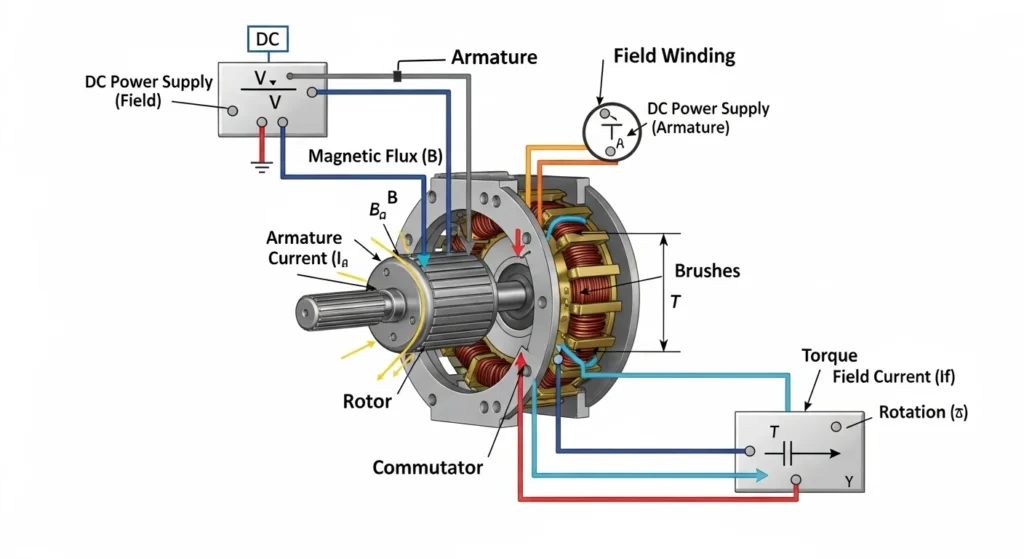
A Separately Excited DC Motor is a type of DC motor in which the field winding and armature winding are supplied by two separate power sources.
In most DC motors, the field winding receives power from the same source as the armature. However, in a separately excited motor, the field current is controlled independently. This design allows engineers to adjust the magnetic field strength and control the motor speed more precisely.
Simple Explanation
In simple words, a Separately Excited DC Motor uses two power supplies:
- One supply powers the armature winding
- Another supply powers the field winding
Because both supplies are independent, the motor speed can be easily controlled.
Practical Example
Separately excited DC motors are often used in:
- Steel rolling mills
- Electric test equipment
- Industrial automation systems
For example, in a steel rolling mill, the motor must maintain constant speed even when the load changes. The separately excited motor provides stable and controllable performance in such situations.
Separately Excited DC Motor Working Principle
The Separately Excited DC Motor working principle is based on the interaction between magnetic fields and electric current.
When current flows through a conductor placed inside a magnetic field, a mechanical force is produced. This force causes the conductor to move, which creates rotational motion in the motor.
Step-by-Step Working Process
- Field supply is applied
The external DC source supplies current to the field winding. This creates a magnetic field around the stator.
- Armature supply is applied
Another DC source supplies current to the armature winding.
- Magnetic interaction occurs
The armature conductors carry current and interact with the magnetic field produced by the field winding.
- Electromagnetic force is generated
Due to this interaction, an electromagnetic force acts on the conductors.
- Armature starts rotating
The generated force causes the armature to rotate, producing mechanical motion.
Simple Analogy
Think of the motor like a bicycle. The field winding acts like the road that guides direction, while the armature current acts like the pedaling force. When both work together, motion is produced.
Types / Classification of Separately Excited DC Motor
Separately excited motors can be classified based on control methods and applications.
Speed Controlled Separately Excited Motor
In this type, the field current is adjusted to control motor speed.
- Increasing field current reduces speed
- Decreasing field current increases speed
This type is widely used in industrial speed control systems.
Voltage Controlled Separately Excited Motor
Here, the armature voltage is varied while the field current remains constant.
- Higher armature voltage increases speed
- Lower voltage reduces speed
This method is commonly used in precision industrial equipment.
Main Components
A Separately Excited DC Motor consists of several important components that work together to produce rotation.
Field Winding
The field winding produces the magnetic field necessary for motor operation. It is powered by a separate DC supply.
Armature
The armature is the rotating part of the motor. It contains conductors that carry current and interact with the magnetic field.
Commutator
The commutator converts alternating current inside the armature into direct current at the output.
Brushes
Brushes provide electrical contact between the stationary circuit and the rotating armature.
Shaft
The shaft transfers mechanical power from the motor to the connected machine.
Frame or Yoke
The frame provides structural support and protects internal motor components.
Advantages
The Separately Excited DC Motor advantages and disadvantages are important for engineers when selecting motors.
Advantages include:
- Excellent speed control
- High efficiency in variable speed applications
- Stable performance under varying loads
- Easy adjustment of field current
- Suitable for research and industrial testing
- Good torque characteristics
These benefits make the motor ideal for precision industrial machines.
Disadvantages / Limitations
Despite its advantages, the Separately Excited DC Motor also has some limitations.
- Requires two separate power supplies
- Higher installation cost
- More complex control system
- Requires regular maintenance of brushes and commutator
- Larger size compared to some modern motors
Because of these factors, engineers sometimes choose other motor types for simpler applications.
Separately Excited DC Motor Applications
The Separately Excited DC Motor applications are mainly found in industries where accurate speed control is required.
Industrial Applications
- Steel rolling mills
- Paper manufacturing machines
- Textile machinery
- Printing presses
Laboratory Applications
- Electrical machine testing
- Research experiments
- Speed control studies
Modern Technology Applications
- Electric traction systems
- Industrial automation
- Robotics and motion control systems
These motors are widely used where stable and controllable operation is essential.
Comparison with Other DC Motors
Understanding the difference between separately excited DC motor and shunt motor helps engineers choose the right motor.
| Feature | Separately Excited DC Motor | DC Shunt Motor |
|---|---|---|
| Power Supply | Field and armature have separate supply | Same power supply |
| Speed Control | Excellent | Good |
| Complexity | More complex | Simpler |
| Cost | Higher | Lower |
| Applications | Industrial precision systems | General machinery |
This comparison shows that separately excited motors provide better control but require more complex systems.
Selection Guide
Choosing the right motor depends on several factors.
Consider Speed Control Requirements
If the application requires precise speed control, a Separately Excited DC Motor is a good option.
Evaluate Power Supply Availability
Since this motor requires two power sources, ensure the electrical system can support it.
Check Load Characteristics
Machines with variable load conditions benefit from separately excited motors.
Maintenance Capability
These motors require periodic maintenance. Choose them only if proper maintenance facilities are available.
Common Problems & Solutions
Why is the motor not starting?
Possible causes include:
- No armature voltage
- Faulty field supply
- Worn brushes
Solution: Check power connections and replace damaged brushes.
Why is motor speed unstable?
This may happen due to:
- Fluctuating field current
- Poor electrical connections
Solution: Stabilize the field supply and inspect wiring.
Why is the motor overheating?
Common reasons include:
- Overloading
- Poor ventilation
- Excessive current
Solution: Reduce load and ensure proper cooling.
Future Trends
Electrical motor technology continues to evolve.
Digital Motor Control
Modern controllers use microprocessors to regulate motor speed more precisely.
Integration with Automation
Separately excited motors are increasingly used in automated production systems.
Energy Efficient Designs
New designs aim to reduce energy consumption and improve motor efficiency.
Smart Monitoring Systems
Advanced sensors now allow real-time monitoring of motor temperature, speed, and performance.
These innovations will improve the reliability and efficiency of DC motors in future industries.
Conclusion
The Separately Excited DC Motor is an important type of DC motor known for its precise speed control and reliable performance. By using separate power supplies for the field winding and armature, engineers can adjust the magnetic field and regulate motor speed accurately.
Understanding the Separately Excited DC Motor working principle, components, and applications helps electrical students and technicians build a strong foundation in electric machine technology. Although the motor requires a more complex power supply system and regular maintenance, its benefits make it highly valuable for industrial and research applications.
The Separately Excited DC Motor advantages and disadvantages must be carefully considered when selecting a motor for a specific task. With advancements in automation and digital motor control, this motor will continue to play an important role in modern electrical engineering systems.
Learning these concepts will help beginners develop deeper knowledge of DC machines and prepare them for advanced electrical engineering applications.