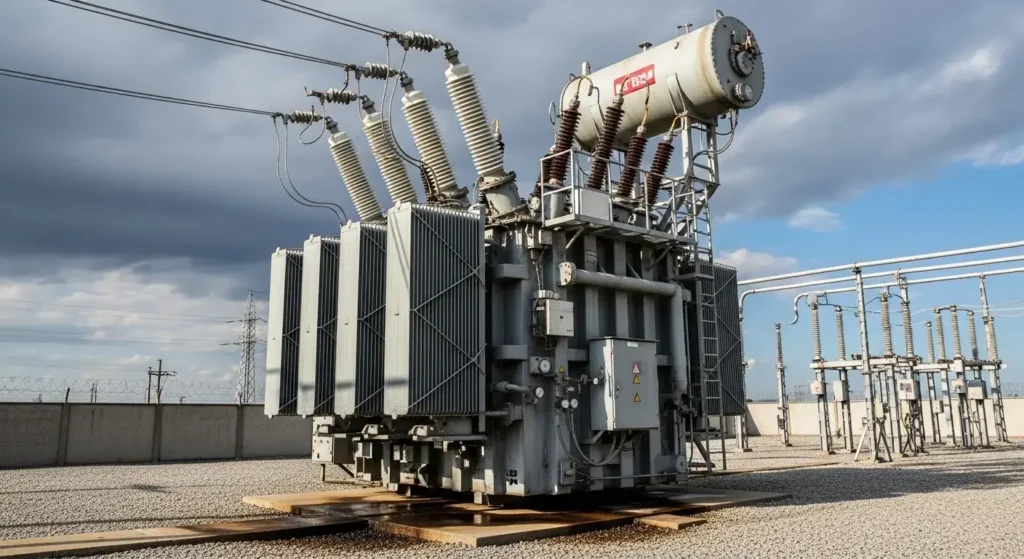

Imagine standing near a large electrical substation outside a city. You see huge metal tanks with cooling fins and thick cables connected to transmission lines. These heavy machines operate day and night, silently ensuring that electricity travels hundreds of kilometers before reaching homes and industries. These machines are called Power Transformers.
Without power transformers, long-distance electricity transmission would not be possible. They increase voltage for efficient transmission and reduce it for safe distribution. As electrical engineers and technicians, understanding transformer technology is not optional — it is fundamental.
In this article, you will learn the Power Transformer working principle, types, construction, applications, advantages and disadvantages, and the difference between power transformer and distribution transformer. I will explain everything in clear, practical language, just like a senior engineer guiding a junior in a substation environment.
2. What is Power Transformer?
A Power Transformer is a high-capacity electrical transformer used in transmission networks to step up or step down voltage levels efficiently.
Simple Explanation
It transfers electrical energy from one circuit to another through electromagnetic induction. Its main purpose is to change voltage levels while keeping power nearly constant.
Practical Example
At a power plant, electricity may be generated at 11kV. Before transmitting it over long distances, a power transformer increases the voltage to 132kV or higher. Higher voltage means lower current, which reduces transmission losses.
Similarly, at receiving substations, voltage is stepped down for distribution.
3. Power Transformer Working Principle
The Power Transformer working principle is based on electromagnetic induction.
When alternating current flows in the primary winding, it produces a changing magnetic field. This magnetic field induces voltage in the secondary winding.
Step-by-Step Working
- AC Supply Applied to Primary
- Alternating current flows through primary winding.
- Magnetic Flux Creation
- Magnetic field develops in transformer core.
- Flux Linking Secondary
- Magnetic flux passes through secondary winding.
- Voltage Induction
- EMF induced in secondary winding.
- Voltage Transformation
- Output voltage depends on turns ratio.
Voltage Formula
V1/V2=N1/N2
Where:
V = Voltage
N = Number of turns
Easy Analogy
Think of it like a bicycle gear system:
- More gear teeth = higher speed.
- Fewer teeth = lower speed.
In transformers, more turns = higher voltage.
4. Types / Classification of Power Transformer
Power transformers are classified based on application and construction.
4.1 Step-Up Power Transformer
- Increases voltage.
- Used at generating stations.
- Reduces transmission losses.
4.2 Step-Down Power Transformer
- Decreases voltage.
- Used at substations.
- Supplies distribution networks.
4.3 Oil-Immersed Transformer
- Windings submerged in insulating oil.
- Oil provides cooling and insulation.
- Most common in substations.
4.4 Dry-Type Transformer
- Air-cooled.
- Used in indoor applications.
- Safer for commercial buildings.
4.5 Three-Phase Power Transformer
- Used in transmission systems.
- Handles large power loads.
Each type supports different Power Transformer applications.
5. Main Components of Power Transformer
Understanding components is critical for substation engineers.
5.1 Core
Made of laminated silicon steel.
Provides low-reluctance magnetic path.
5.2 Primary Winding
Connected to input supply.
5.3 Secondary Winding
Delivers transformed voltage.
5.4 Transformer Oil
Provides insulation and cooling.
5.5 Conservator Tank
Stores excess oil during expansion.
5.6 Breather
Prevents moisture entry into oil.
5.7 Radiators
Dissipate heat.
5.8 Tap Changer
Adjusts voltage ratio.
5.9 Buchholz Relay
Gas-operated protection device.
Each component ensures safe and efficient operation.
6. Power Transformer Advantages and Disadvantages
Advantages
- High efficiency (above 98%)
- Reliable long-distance transmission
- Low maintenance
- Long operational life
- Handles very high voltage
- Stable voltage transformation
These Power Transformer advantages and disadvantages must be considered during planning.
7. Disadvantages / Limitations
- High initial cost
- Large size and heavy weight
- Requires regular oil testing
- Risk of oil leakage
- Installation requires skilled personnel
Despite limitations, they are essential in power systems.
8. Power Transformer Applications
Power Transformer applications are mainly in transmission systems.
8.1 Generating Stations
Step-up voltage before transmission.
8.2 Transmission Substations
Voltage regulation between grid levels.
8.3 Industrial Power Supply
Heavy manufacturing plants.
8.4 Renewable Energy Plants
Wind and solar grid integration.
8.5 Interconnection of Grids
Voltage matching between systems.
They are backbone equipment of national grids.
9. Comparison Section
Difference Between Power Transformer and Distribution Transformer
| Feature | Power Transformer | Distribution Transformer |
|---|---|---|
| Application | Transmission network | Distribution network |
| Load Operation | Full load | Variable load |
| Efficiency Focus | Maximum at full load | Maximum at partial load |
| Rating | High MVA | Lower kVA |
| Installation | Substation | Near consumer area |
The main difference between distribution transformer and power transformer is load handling and application level.
10. Selection Guide
Selecting a Power Transformer requires careful evaluation.
1. Voltage Rating
Based on transmission level.
2. Power Rating (MVA)
Depends on load demand.
3. Cooling Method
ONAN, ONAF, etc.
4. Insulation Class
Suitable for system voltage.
5. Tap Changer Type
On-load or off-load.
6. Protection System
Relay coordination required.
Beginners must understand load forecasting before selection.
11. Common Problems & Solutions
Q1: Why does transformer overheat?
Reason: Overloading or cooling failure.
Solution: Reduce load and check radiators.
Q2: Why is oil level low?
Reason: Leakage or evaporation.
Solution: Inspect tank and refill.
Q3: Why does voltage fluctuate?
Reason: Tap changer issue.
Solution: Inspect tap mechanism.
Q4: What causes humming sound?
Reason: Core vibration.
Solution: Check core clamping.
Q5: What is insulation failure?
Reason: Aging or moisture.
Solution: Regular oil testing.
Preventive maintenance increases lifespan.
12. Future Trends
Transformer technology continues evolving.
Smart Transformers
Integrated digital monitoring.
Online Condition Monitoring
Real-time oil and temperature sensors.
Eco-Friendly Oils
Biodegradable insulating fluids.
Compact High-Capacity Designs
Space-saving substations.
Grid Modernization
Integration with smart grids.
Future power systems will rely on intelligent transformer monitoring.
13. Conclusion
A Power Transformer is one of the most critical components in electrical transmission systems. It enables efficient long-distance power transfer by stepping voltage up or down with high efficiency. Understanding the Power Transformer working principle, construction, types, and applications is essential for every electrical engineer.
Although it requires high investment and maintenance, its reliability and efficiency make it indispensable. Knowing the difference between distribution transformer and power transformer helps in correct system planning.
As a future engineer, focus on understanding transformer ratings, cooling systems, and protection schemes. Strong fundamentals in transformer technology will strengthen your career in power systems and substation engineering.