
Imagine electricity traveling from a power station to your home through long transmission lines. The power plant generates thousands of kilowatts of energy, but by the time electricity reaches your house, a small portion of that energy has already been lost along the way. This loss happens because electrical conductors, wires, and equipment are not perfectly efficient.
These energy losses may seem small, but in large power systems they can result in significant wasted energy and increased operational costs. For power companies and electrical engineers, understanding how and why these losses occur is extremely important.
This is where the power loss formula becomes useful. Engineers use this formula to calculate how much electrical power is lost in transmission lines, cables, transformers, and electrical circuits.
For electrical students, technicians, and engineers, learning the power loss formula is essential for designing efficient electrical systems. It helps reduce energy waste, improve system performance, and ensure safe operation of electrical equipment.
In this article, you will learn the power loss formula, its working principle, different types of power losses, real-world power loss formula applications, and the power loss formula advantages and disadvantages. The goal is to explain this important concept clearly and practically.
2. Power Loss Formula
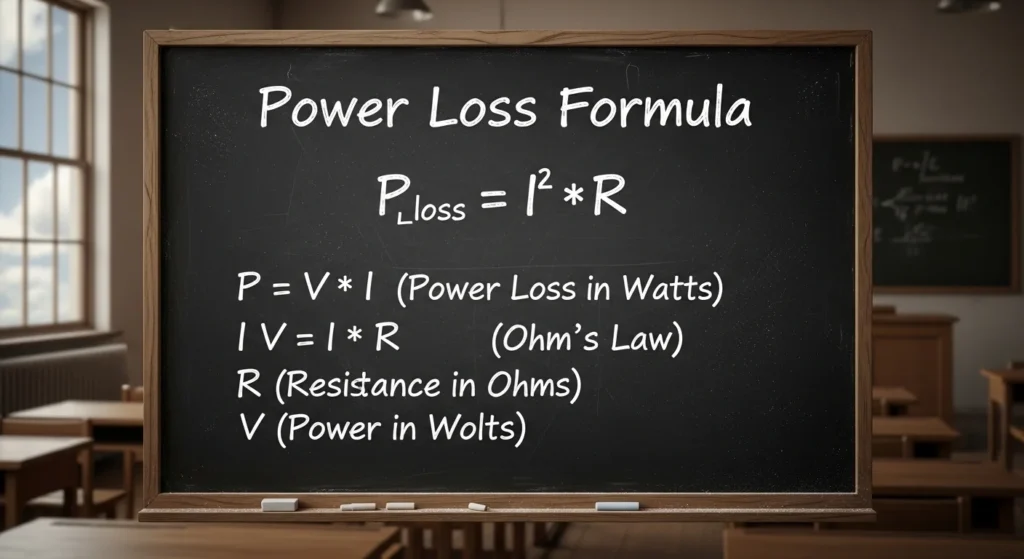
The most common formula for power loss in electrical circuits is:
P=I2R
Where:
- P = Power loss (Watts)
- I = Current (Amperes)
- R = Resistance (Ohms)
This formula shows that power loss increases with the square of the current. That means if current doubles, the power loss becomes four times greater.
Other Power Loss Formulas
Power loss can also be calculated using other electrical relationships.
Using Voltage and Current
P=VI
Where:
- P = Power (Watts)
- V = Voltage (Volts)
- I = Current (Amperes)
Using Voltage and Resistance
P=RV2
Where:
- P = Power (Watts)
- V = Voltage (Volts)
- R = Resistance (Ohms)
Example of Power Loss
Suppose:
- Current = 10 A
- Resistance = 2 Ω
Using the formula:
Power Loss = I2R
= 102×2
= 100×2
= 200 Watts
So 200 W power is lost as heat in the conductor.
Why Power Loss is Important
Power loss is important in electrical engineering because it affects:
- Transmission line efficiency
- Energy consumption
- Heating of wires
- Electrical system performance
Engineers try to reduce power loss by:
- Using high voltage transmission
- Using low resistance conductors
- Reducing current in long transmission lines
✅ Simple Rule:
Higher current → More power loss
Lower resistance → Less power loss
The power loss formula is a mathematical equation used to calculate how much electrical power is lost in a circuit due to resistance.
The most common formula used to calculate power loss is:
Power Loss (P) = I²R
Where:
- P = Power loss (Watts)
- I = Current flowing through the conductor (Amperes)
- R = Resistance of the conductor (Ohms)
This formula shows that power loss increases with the square of the current flowing through a conductor.
Simple Explanation
Whenever electric current flows through a wire, the wire’s resistance converts a small portion of electrical energy into heat. This heat represents energy that is lost from the system.
Practical Example
Suppose a transmission line carries 10 amps of current and has 2 ohms resistance.
Using the power loss formula:
P = I²R
P = (10)² × 2
P = 100 × 2
P = 200 Watts
This means 200 watts of energy are lost as heat in the conductor.
3. Power Loss Formula Working Principle
The power loss formula working principle is based on the relationship between current, resistance, and heat generation.
When electric current flows through a conductor, electrons move through the material. As these electrons move, they collide with atoms inside the conductor.
These collisions create heat energy, which results in power loss.
Step-by-Step Process
- Current Flow
Electrical current flows through a conductor. - Resistance in Conductor
The conductor opposes the flow of electrons due to its resistance. - Electron Collisions
Moving electrons collide with atoms in the conductor. - Heat Generation
These collisions convert electrical energy into heat. - Energy Loss
The generated heat represents power loss.
Simple Analogy
Imagine water flowing through a narrow pipe. Friction between water and the pipe walls reduces the water pressure. Similarly, resistance in electrical conductors reduces electrical energy.
4. Types / Classification of Power Loss
Power losses in electrical systems can be classified into several types.
Resistive Loss (I²R Loss)
Resistive loss is the most common type of power loss in electrical circuits.
It occurs due to the resistance of conductors.
Characteristics
- Occurs in wires and transmission lines
- Directly related to current flow
- Calculated using the power loss formula
Core Loss
Core loss occurs in transformers and electrical machines.
It happens due to magnetic effects in the iron core.
Types of Core Loss
- Hysteresis loss
- Eddy current loss
Dielectric Loss
Dielectric loss occurs in insulating materials used in cables and electrical equipment.
This type of loss increases with voltage and frequency.
Mechanical Loss
Mechanical losses occur in rotating electrical machines such as generators and motors.
These losses include:
- Friction loss
- Windage loss
5. Main Components Affecting Power Loss
Several factors influence power loss in electrical systems.
Current (I)
Higher current increases power loss significantly because loss depends on the square of current.
Resistance (R)
Resistance depends on the material, length, and cross-sectional area of the conductor.
Conductor Length
Longer transmission lines have higher resistance, which increases power loss.
Conductor Material
Copper and aluminum are commonly used because they have low resistance.
Temperature
Higher temperatures increase resistance, which increases power loss.
6. Advantages of Using the Power Loss Formula
The power loss formula advantages and disadvantages should be understood clearly. The advantages include:
- Helps engineers calculate energy loss accurately
- Assists in designing efficient power systems
- Improves energy management
- Reduces electricity waste
- Helps optimize transmission line design
- Useful for troubleshooting electrical circuits
Using the power loss formula allows engineers to design systems that deliver electricity more efficiently.
7. Disadvantages / Limitations
Despite its usefulness, the power loss formula also has some limitations.
- It mainly applies to resistive losses
- It assumes constant resistance
- It does not directly include reactive power effects
- Real systems may involve additional losses
Because of these limitations, engineers often use additional formulas and advanced analysis methods.
8. Power Loss Formula Applications
There are many practical power loss formula applications in electrical engineering.
Transmission Lines
Power companies use the formula to estimate energy loss during electricity transmission.
Electrical Wiring
Engineers use it to design efficient building wiring systems.
Transformer Design
The formula helps determine losses in transformer windings.
Motor Systems
Power loss calculations help improve motor efficiency.
Renewable Energy Systems
Wind and solar plants use power loss calculations to optimize power delivery.
9. Comparison Section
Difference Between Power Loss Formula and Power Formula
| Feature | Power Loss Formula | Power Formula |
|---|---|---|
| Purpose | Calculates energy loss | Calculates electrical power |
| Equation | P = I²R | P = VI |
| Application | Transmission lines and conductors | General electrical systems |
| Output | Heat loss | Useful electrical power |
Understanding the difference between power formula and power loss formula is important for electrical calculations.
10. Selection Guide
When designing electrical systems, engineers must minimize power loss.
Use Low-Resistance Conductors
Materials such as copper reduce electrical resistance.
Increase Voltage
High-voltage transmission reduces current and therefore reduces power loss.
Reduce Transmission Distance
Shorter lines reduce resistance and energy loss.
Use Proper Conductor Size
Larger conductor cross-sectional areas reduce resistance.
These techniques help improve the efficiency of power systems.
11. Common Problems & Solutions
Q1: Why does power loss increase with current?
Because the formula includes the square of current (I²), even small increases in current can greatly increase power loss.
Q2: How can power loss be reduced?
Power loss can be reduced by using high voltage transmission, thicker conductors, and low-resistance materials.
Q3: Why do transmission lines operate at high voltage?
High voltage reduces current flow, which significantly reduces I²R losses.
Q4: Why do wires get hot?
Heat occurs because electrical resistance converts part of electrical energy into thermal energy.
12. Future Trends in Power Loss Reduction
Electrical engineers are developing new technologies to reduce energy losses.
Smart Power Grids
Smart grids use advanced monitoring systems to reduce energy waste.
High Voltage DC Transmission
HVDC systems reduce power loss over long distances.
Superconductors
Superconductors can carry electricity with almost zero resistance.
Advanced Conductors
New materials are being developed with lower resistance and higher efficiency.
These technologies will help reduce global energy losses and improve electrical system efficiency.
13. Conclusion
The power loss formula is one of the most important concepts in electrical engineering. It helps engineers calculate the amount of electrical energy lost due to resistance in conductors and electrical systems.
In this article, we explored the power loss formula working principle, different types of power losses, practical power loss formula applications, and the power loss formula advantages and disadvantages. We also discussed ways to reduce energy losses and improve electrical system efficiency.
For electrical students, engineers, and technicians, understanding power loss calculations is essential for designing efficient power transmission systems. As electrical networks continue to expand worldwide, minimizing energy loss will remain a key challenge for engineers.
Learning and applying the power loss formula is an important step toward building more efficient and sustainable electrical systems.