
Imagine living in an apartment during a hot summer where installing a traditional wall-mounted air conditioner is not allowed. The room becomes uncomfortable, especially during the afternoon heat. In such situations, many people use a Portable Air Conditioner to quickly cool the room without permanent installation.
Portable air conditioners have become increasingly popular because they are easy to install, movable, and suitable for temporary cooling needs. Unlike fixed air conditioning systems, these units can be placed anywhere in the room and moved from one location to another. For renters, small offices, and temporary workspaces, portable AC systems provide a practical and flexible cooling solution.
For electrical students, engineers, and technicians, understanding portable air conditioners is important because these systems combine refrigeration technology with compact design and simple installation. Knowing their operation helps in troubleshooting, maintenance, and proper system selection.
In this article, you will learn the portable air conditioner working principle, its types, main components, advantages and disadvantages, and practical applications. By the end, you will clearly understand how portable AC systems work and when they are the best cooling option.
What is a Portable Air Conditioner?
A Portable Air Conditioner is a compact air conditioning unit designed to cool a room without permanent installation. The entire cooling system is contained in a single movable unit that can be placed on the floor.
The unit draws warm air from the room, removes heat using a refrigeration cycle, and releases the hot air outside through an exhaust hose connected to a window.
In simple terms, a portable air conditioner works like a small movable version of a traditional air conditioner.
Practical Example
Consider a rented apartment where installing a split air conditioner is not possible. A portable AC can be placed near a window, connected to an exhaust hose, and used immediately for cooling.
Portable air conditioners are commonly used in:
- Small apartments
- Temporary offices
- Computer rooms
- Dormitories
- Rental homes
Because of their mobility and simple installation, portable AC units are very convenient for temporary cooling needs.
Portable Air Conditioner Working Principle
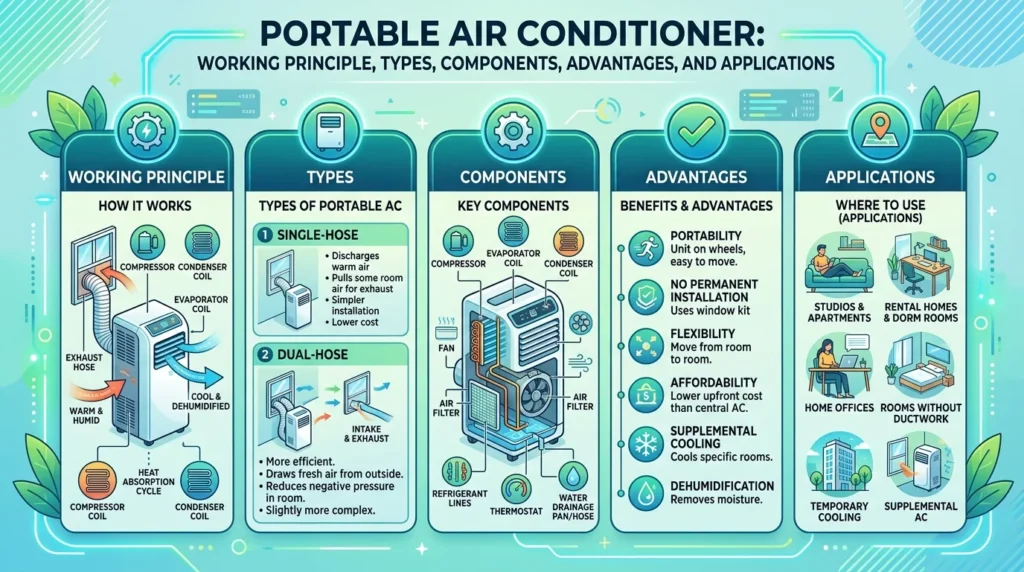
The portable air conditioner working principle is based on the refrigeration cycle used in most cooling systems. The system removes heat from indoor air and transfers it outside.
The process involves four main stages: evaporation, compression, condensation, and expansion.
Step-by-Step Working Process
- Air Intake
The portable AC draws warm air from the room using an internal fan.
- Cooling in the Evaporator Coil
The air passes over the evaporator coil containing cold refrigerant.
The refrigerant absorbs heat from the air, cooling it.
- Cool Air Distribution
The cooled air is blown back into the room through the front vents.
- Refrigerant Compression
The refrigerant gas moves to the compressor where its pressure and temperature increase.
- Heat Removal
The hot refrigerant passes through the condenser coil where heat is released.
- Exhaust of Hot Air
The hot air generated during the cooling process is expelled outside through an exhaust hose connected to a window.
- Expansion Process
The refrigerant passes through an expansion valve which reduces its pressure and temperature.
- Cycle Repeats
The refrigerant returns to the evaporator and the cooling cycle continues.
Simple Analogy
Think of a portable air conditioner like a heat pump inside a movable box. It removes heat from the room and pushes that heat outside through a hose.
Types / Classification of Portable Air Conditioners
Portable air conditioners can be classified based on their design and airflow system.
Single Hose Portable Air Conditioner
This is the most common type of portable AC.
The unit uses one hose to exhaust hot air outside the room.
Features
- Simple installation
- Lower cost
- Suitable for small rooms
However, single hose systems may draw some warm air from outside due to negative pressure inside the room.
Dual Hose Portable Air Conditioner
Dual hose portable AC systems use two separate hoses.
One hose draws fresh air from outside, while the other expels hot air.
Features
- More efficient cooling
- Faster temperature reduction
- Better performance in larger rooms
Portable Air Conditioner with Heat Pump
Some portable AC systems include a heat pump function.
This allows the unit to provide both cooling and heating.
Features
- Year-round usage
- Energy-efficient heating option
- Suitable for moderate climates
Portable Evaporative Air Conditioner
These units combine air cooling with water evaporation.
They are often called air coolers, but their cooling capacity is lower than refrigerant-based portable AC systems.
Main Components
A portable air conditioner contains several important components that perform the cooling process.
Compressor
The compressor increases the pressure and temperature of the refrigerant gas.
It is the main driving component of the refrigeration cycle.
Evaporator Coil
The evaporator coil absorbs heat from indoor air.
As warm air passes over this coil, the refrigerant inside absorbs heat and cools the air.
Condenser Coil
The condenser coil releases the absorbed heat outside the room through the exhaust hose.
Expansion Valve
The expansion valve controls refrigerant flow and reduces pressure before the refrigerant enters the evaporator coil.
Fan (Blower)
Fans circulate air through the evaporator and condenser coils.
They help move cool air into the room and push hot air outside.
Exhaust Hose
The exhaust hose is a flexible pipe that carries hot air from the AC unit to the outside environment.
Air Filters
Air filters remove dust and particles from the air before it enters the cooling system.
Water Collection Tank
Some portable AC units collect condensed water in a tank that must be emptied periodically.
Advantages
Understanding the portable air conditioner advantages and disadvantages is important when choosing a cooling system.
Advantages
- Easy installation with no permanent setup required
- Portable design allows movement between rooms
- Ideal for rented apartments or temporary spaces
- No major wall drilling required
- Suitable for small and medium rooms
- Can be stored easily when not in use
Disadvantages / Limitations
Despite many benefits, portable air conditioners also have limitations.
- Higher noise levels compared to split AC systems
- Limited cooling capacity for large spaces
- Requires a window for exhaust hose installation
- Water tank may need regular emptying
- Occupies floor space inside the room
Understanding these limitations helps users choose the right cooling solution.
Portable Air Conditioner Applications
There are many portable air conditioner applications in homes and commercial environments.
Residential Applications
- Apartments
- Bedrooms
- Rental homes
- Dorm rooms
Commercial Uses
- Small offices
- Temporary workspaces
- Server rooms
Industrial and Technical Uses
- Cooling electronic equipment
- Workshops
- Temporary cooling during maintenance work
Portable AC systems are particularly useful where permanent installation is not possible.
Comparison: Portable Air Conditioner vs Split Air Conditioner
Many people want to understand the difference between portable air conditioner and split air conditioner.
| Feature | Portable Air Conditioner | Split Air Conditioner |
|---|---|---|
| Installation | No permanent installation | Permanent wall installation |
| Mobility | Movable | Fixed |
| Cooling Capacity | Small to medium rooms | Medium to large rooms |
| Noise Level | Higher | Lower |
| Cost | Usually lower initial cost | Higher installation cost |
| Efficiency | Lower efficiency | Higher efficiency |
This comparison helps users determine which system best suits their needs.
Selection Guide
Choosing the right portable air conditioner requires several important considerations.
Room Size
Check the cooling capacity measured in BTU. Larger rooms require higher BTU ratings.
Hose Type
Dual hose systems provide better efficiency than single hose models.
Energy Efficiency
Choose models with higher energy efficiency ratings to reduce electricity costs.
Noise Level
If the AC will be used in a bedroom or office, select a low-noise model.
Drainage System
Some models offer automatic evaporation, reducing the need to empty water tanks.
Portability
Look for units with wheels and compact designs for easy movement.
These tips help beginners select the correct portable AC system.
Common Problems & Solutions
Why is the portable air conditioner not cooling properly?
Possible causes:
- Dirty air filters
- Incorrect room size for the AC capacity
- Blocked exhaust hose
Solution: Clean filters and ensure proper ventilation.
Why is water leaking from the unit?
Possible reasons:
- Full water tank
- Blocked drainage system
Solution: Empty the tank and check the drainage system.
Why is the AC making loud noise?
Possible causes:
- Loose internal parts
- Dirty fan blades
Solution: Inspect internal components and clean the fan.
Why does the room remain warm?
Possible causes:
- Poor window sealing around exhaust hose
- Large room size
Solution: Improve window sealing and ensure correct AC capacity.
Future Trends
Portable air conditioner technology continues to evolve.
Future developments may include:
- Smart Wi-Fi control systems
- Energy-efficient inverter compressors
- Eco-friendly refrigerants
- Improved noise reduction technology
- Advanced air purification features
These innovations will make portable AC systems more efficient and user-friendly.
Conclusion
Portable air conditioners provide a flexible and convenient cooling solution for situations where permanent air conditioning installation is not possible. These compact systems contain all the major components of a traditional air conditioner in a single movable unit.
Understanding the portable air conditioner working principle, components, and system operation helps electrical students and technicians properly install and maintain these systems. Although portable AC units may not match the efficiency of larger HVAC systems, they are extremely useful for temporary cooling, rented homes, and small spaces.
By learning about the portable air conditioner advantages and disadvantages, types, and applications, beginners can confidently choose the right unit for their needs. As technology continues to improve, portable air conditioners will become more efficient, quieter, and more environmentally friendly.