
Imagine a small village where electricity from the national grid is not available. People use solar panels and batteries to power their homes. In contrast, a modern city house may also use solar panels, but it is still connected to the main power grid. Both systems use solar energy, yet they work in very different ways.
This is where the concept of Off-Grid vs On-Grid Solar becomes important. Solar energy systems are designed in different configurations depending on whether they are connected to the utility grid or operate independently.
Understanding the difference between off-grid and on-grid solar systems is essential for electrical students, engineers, technicians, and beginners who want to work in renewable energy or design solar installations.
In this article, you will learn the Off-Grid vs On-Grid Solar working principle, types, components, advantages and disadvantages, applications, and practical selection tips. By the end, you will clearly understand which system is suitable for homes, industries, and remote areas.
2. What is Off-Grid vs On-Grid Solar?
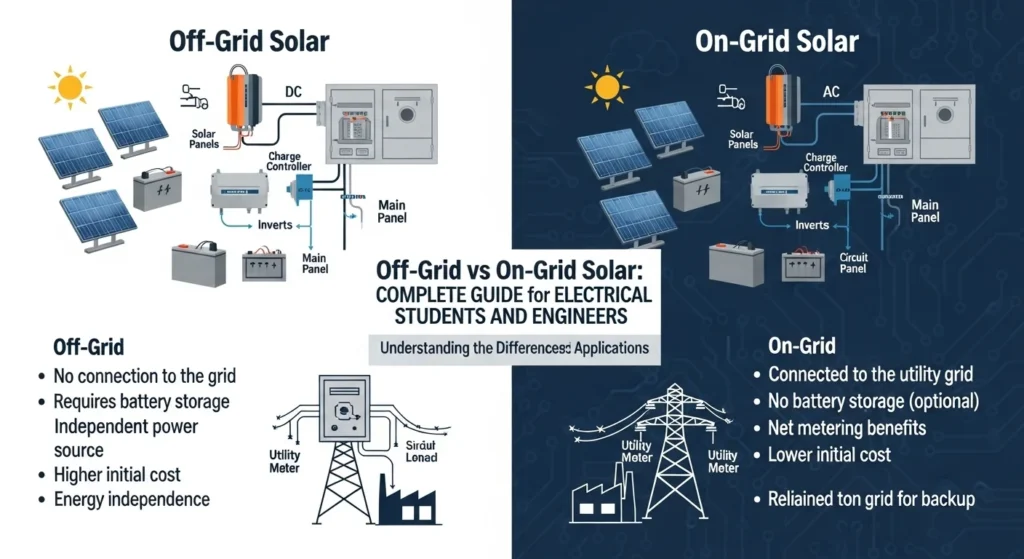
Off-Grid vs On-Grid Solar refers to two different types of solar power systems based on their connection to the electricity grid.
- On-Grid Solar System is connected to the public electricity grid.
- Off-Grid Solar System works independently without any connection to the grid.
Simple Explanation
A solar system generates electricity using sunlight. However, the way this electricity is stored or supplied depends on the system type.
- On-grid systems send extra electricity to the utility grid.
- Off-grid systems store extra electricity in batteries.
Practical Example
- A house in a city connected to the utility grid uses an on-grid solar system.
- A remote farmhouse without electricity supply uses an off-grid solar system.
Both systems use solar panels, but their operation and components are different.
3. Off-Grid vs On-Grid Solar Working Principle
To understand the Off-Grid vs On-Grid Solar working principle, it is helpful to follow the energy flow step by step.
Step-by-Step Working
- Solar Panels Capture Sunlight
- Solar panels convert sunlight into DC electricity.
- Inverter Converts DC to AC
- Most appliances use AC power.
- The inverter converts DC electricity into AC electricity.
- Power Distribution
- Electricity is supplied to home appliances.
- Extra Energy Handling
- In on-grid systems, extra electricity goes to the grid.
- In off-grid systems, extra energy charges batteries.
Simple Analogy
Think of electricity like water:
- On-grid system: Water flows to the city water network when extra is available.
- Off-grid system: Extra water is stored in a storage tank.
4. Types / Classification
Solar systems are mainly classified into three categories.
On-Grid Solar System
An on-grid solar system is connected directly to the public electricity grid.
Features
- No battery storage required
- Excess power exported to the grid
- Lower installation cost
Example
A residential rooftop solar system connected to the utility company.
Off-Grid Solar System
An off-grid solar system works completely independent of the utility grid.
Features
- Uses battery storage
- Suitable for remote areas
- Fully independent energy system
Example
Solar system used in mountain villages or remote farms.
Hybrid Solar System
A hybrid system combines both on-grid and off-grid features.
Features
- Connected to the grid
- Includes battery backup
- Provides power during outages
5. Main Components
Both solar systems use several important electrical components.
Solar Panels
Solar panels convert sunlight into DC electricity using photovoltaic cells.
Solar Inverter
The inverter converts DC power from solar panels into usable AC electricity.
Battery Bank
Batteries store extra electricity in off-grid and hybrid systems.
Charge Controller
This device regulates voltage and protects batteries from overcharging.
Net Meter
Used in on-grid systems to measure electricity sent to and received from the grid.
Mounting Structure
Supports and secures solar panels on rooftops or ground installations.
6. Advantages
Advantages of On-Grid Solar
- Lower installation cost
- No batteries required
- Reduced electricity bills
- High system efficiency
- Easy maintenance
Advantages of Off-Grid Solar
- Works without utility power
- Ideal for remote areas
- Energy independence
- Protection from power outages
- Reliable power supply
7. Disadvantages / Limitations
Disadvantages of On-Grid Solar
- Does not work during grid outages
- Requires grid connection approval
- No power storage
Disadvantages of Off-Grid Solar
- High installation cost
- Battery maintenance required
- Limited energy storage
- System design is more complex
Understanding these Off-Grid vs On-Grid Solar advantages and disadvantages helps engineers select the right system.
8. Off-Grid vs On-Grid Solar Applications
Solar energy systems are widely used in many sectors.
Residential Applications
- Rooftop solar systems
- Home backup power
- Rural electrification
Industrial Applications
- Factory energy supply
- Solar-powered manufacturing plants
- Industrial microgrids
Commercial Applications
- Shopping malls
- Office buildings
- Hotels and hospitals
Remote Applications
- Telecommunication towers
- Weather stations
- Remote villages
These examples show the wide range of Off-Grid vs On-Grid Solar applications in modern energy systems.
9. Comparison: Off-Grid vs On-Grid Solar
| Feature | On-Grid Solar | Off-Grid Solar |
|---|---|---|
| Grid Connection | Connected to utility grid | Not connected |
| Battery Storage | Usually not required | Required |
| Cost | Lower | Higher |
| Power During Outage | Not available | Available |
| Installation Complexity | Simple | More complex |
| Best Use | Cities and towns | Remote locations |
This table clearly explains the difference between off-grid and on-grid solar systems.
10. Selection Guide
Choosing the right solar system depends on several factors.
Location
- Urban areas → On-grid system
- Remote areas → Off-grid system
Budget
- On-grid systems are cheaper.
- Off-grid systems require batteries, increasing cost.
Power Reliability
If power outages are frequent, hybrid or off-grid systems may be better.
Energy Needs
Calculate total daily energy consumption before selecting a system.
Available Space
Ensure enough roof or ground space for solar panels.
These simple steps help beginners select the correct solar configuration.
11. Common Problems & Solutions
Problem 1: Solar system not producing enough power
Solution:
Clean solar panels and check for shading.
Problem 2: Battery draining quickly
Solution:
Check battery capacity and replace old batteries.
Problem 3: Inverter shutting down
Solution:
Verify wiring connections and load limits.
Problem 4: Low solar efficiency
Solution:
Adjust panel angle and ensure proper sunlight exposure.
Problem 5: Net meter not recording exported power
Solution:
Check inverter settings and grid connection.
12. Future Trends
Solar energy technology is improving rapidly.
Smart Solar Systems
AI-based monitoring and smart energy management systems are being developed.
Better Battery Technology
Advanced lithium batteries provide longer life and faster charging.
Solar Microgrids
Small local grids powered by solar energy will supply electricity to remote communities.
Integration with Electric Vehicles
Solar charging stations for electric vehicles are becoming common.
These innovations will make solar energy more efficient, reliable, and affordable in the future.
13. Conclusion
Understanding Off-Grid vs On-Grid Solar systems is essential for anyone working in electrical engineering or renewable energy. Both systems use solar panels to convert sunlight into electricity, but their design and operation differ significantly.
On-grid systems are ideal for urban areas because they connect to the utility grid and reduce electricity bills. Off-grid systems, on the other hand, are perfect for remote locations where grid electricity is unavailable.
When selecting a solar system, factors such as location, budget, power needs, and reliability must be carefully considered. By understanding the Off-Grid vs On-Grid Solar working principle, applications, and advantages and disadvantages, engineers and technicians can design efficient and reliable solar installations.
Solar power will continue to grow as one of the most important clean energy solutions for the future.