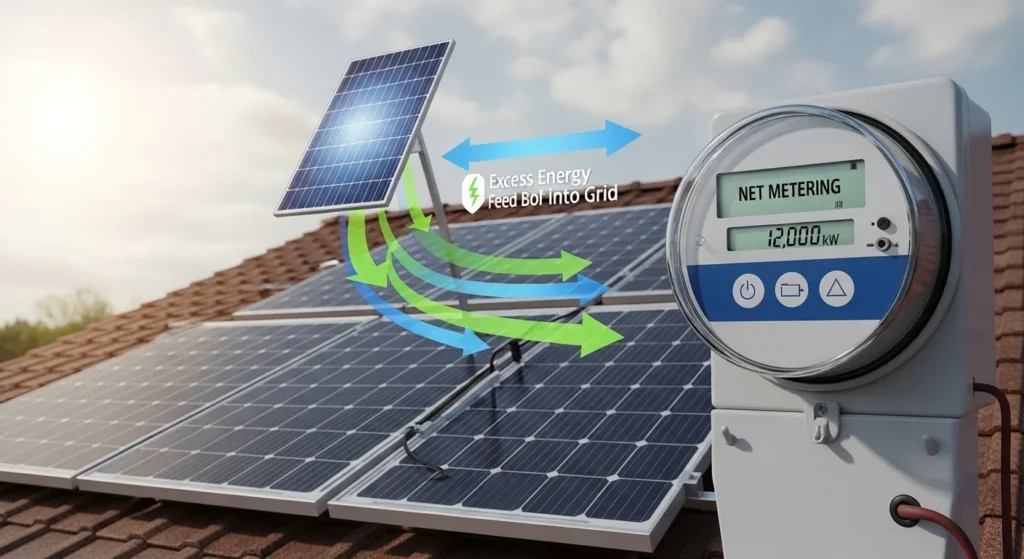

Imagine you install solar panels on your house roof. During the day, your solar system produces more electricity than you use. Instead of wasting that extra energy, it flows back to the utility grid. At night, when your panels are not producing power, you take electricity from the grid again. At the end of the month, you only pay for the “net” difference.
This system is called Net Metering.
Net metering is becoming increasingly important as solar energy systems grow worldwide. It allows consumers to become small power producers while staying connected to the grid. For electrical students, engineers, and technicians, understanding net metering is essential because it combines renewable energy, grid systems, protection, and billing concepts.
In this article, you will learn the net metering working principle, types, main components, net metering applications, and net metering advantages and disadvantages. We will also explain the difference between net metering and gross metering, selection guidelines, common issues, and future trends.
Let’s start with the basics.
2. What is Net Metering?
Net metering is a billing and energy management system that allows consumers who generate their own electricity (usually using solar panels) to export excess power to the utility grid and receive credit for it.
Simple Explanation
In simple words, net metering means:
- When you produce extra electricity, you send it to the grid.
- When you need electricity, you take it from the grid.
- You pay only for the difference (net energy).
Practical Example
Suppose your solar system generates 500 units (kWh) in one month.
Your home consumes 600 units.
You export 200 units to the grid during the day and import 300 units at night.
Your net consumption = 600 – 500 = 100 units.
You pay only for 100 units.
That is the basic idea behind net metering.
3. Net Metering Working Principle
The net metering working principle is based on bidirectional energy flow measurement.
Let’s understand step by step.
Step 1: Solar Power Generation
- Solar panels convert sunlight into DC electricity.
- An inverter converts DC into AC power.
Step 2: Power Supply to Local Load
- The generated AC power first supplies your home loads.
- Appliances use solar power directly.
Step 3: Export to Grid
- If generation is more than consumption,
- The excess power flows back to the grid.
A bidirectional meter records exported energy.
Step 4: Import from Grid
- When solar production is low (evening or cloudy days),
- You draw power from the grid.
The meter records imported energy separately.
Step 5: Net Energy Calculation
At the end of billing cycle:
Net Energy = Imported Units – Exported Units
If export is higher, credit may be carried forward.
Easy Analogy
Think of net metering like a water tank connected to the city supply.
- When your tank overflows, water goes back.
- When your tank is empty, you take water.
- You pay only for what you actually use overall.
4. Types / Classification of Net Metering
Net metering systems are classified based on policy and technical arrangement.
Standard Net Metering
- Energy export is adjusted against import.
- Most common system.
- Credits are calculated monthly.
Virtual Net Metering
- Used for multiple users.
- One solar plant shares energy credits among several consumers.
- Common in apartment buildings.
Aggregate Net Metering
- One consumer has multiple meters.
- Solar generation from one location offsets loads at other locations.
Gross Metering (Related Concept)
- All generated energy is exported to grid.
- Consumer buys electricity separately.
Understanding the difference between net metering and gross metering is important for engineers.
5. Main Components of Net Metering System
A proper net metering system requires several key components.
1. Solar Panels
- Convert sunlight into DC electricity.
2. Solar Inverter
- Converts DC into AC.
- Synchronizes with grid voltage and frequency.
3. Bidirectional Energy Meter
- Measures both import and export energy.
- Essential for billing.
4. Protection Devices
- Circuit breakers
- Surge protection devices
- Isolators
Ensure safe operation.
5. Distribution Board
- Connects solar system with main supply.
6. Utility Grid Connection
- Allows two-way energy flow.
Each component must be selected carefully for safe and reliable operation.
6. Net Metering Advantages and Disadvantages
Advantages
- Reduces electricity bills
- Encourages renewable energy use
- Reduces load on national grid
- Provides return on investment
- Environment-friendly
- Low maintenance cost
Disadvantages / Limitations
- Depends on government policies
- Initial installation cost is high
- Solar generation depends on weather
- Grid voltage fluctuations may affect system
- Export limits may apply
Understanding net metering advantages and disadvantages helps in project planning.
7. Net Metering Applications
Net metering applications are growing rapidly.
Residential Homes
- Rooftop solar systems
- Reduced monthly bills
Commercial Buildings
- Offices
- Shopping malls
- Schools
Industrial Use
- Small and medium industries
- Warehouses
Agricultural Sector
- Solar water pumps
- Farm buildings
Net metering supports clean energy adoption across sectors.
8. Comparison Section
Let us understand the difference between net metering and gross metering.
| Feature | Net Metering | Gross Metering |
|---|---|---|
| Energy Usage | Self-consumption first | All energy exported |
| Billing Method | Pay for net units | Separate buy and sell |
| Savings | High | Depends on tariff |
| Grid Dependency | Partial | Full |
| Consumer Benefit | Better for small users | Policy dependent |
This table clearly explains the difference between net metering and gross metering.
9. Selection Guide
Choosing the right net metering system requires proper planning.
1. Load Analysis
- Check monthly electricity consumption.
- Design solar capacity accordingly.
2. Roof Space Availability
- Ensure sufficient shadow-free area.
3. Grid Approval
- Follow local utility guidelines.
4. Inverter Capacity
- Match with panel rating.
5. Protection and Safety
- Proper earthing system
- Correct breaker rating
Always design the system slightly below sanctioned load limit.
10. Common Problems & Solutions
Q1: Why is exported energy not recorded?
- Faulty meter
- Incorrect wiring
Check meter configuration and CT connections.
Q2: Why is inverter not synchronizing with grid?
- Voltage mismatch
- Frequency fluctuation
Verify grid parameters.
Q3: Why is system shutting down frequently?
- Overvoltage issue
- Loose connections
Inspect protection settings.
Q4: Why are savings lower than expected?
- Wrong system sizing
- Shading on panels
Recalculate load and inspect site conditions.
Regular inspection improves performance.
11. Future Trends in Net Metering
Net metering is evolving with smart grid technology.
Smart Meters
- Real-time energy monitoring
- Accurate billing
Battery Integration
- Store excess solar energy
- Reduce grid dependency
Dynamic Tariff Systems
- Time-of-use pricing
- Better energy management
AI-Based Monitoring
- Performance analysis
- Fault prediction
The future of net metering is more digital and intelligent.
12. Conclusion
Net metering is a smart and efficient system that allows consumers to generate electricity and reduce their energy bills. It works on the principle of two-way energy flow measurement and billing adjustment.
We discussed the net metering working principle, types, components, and net metering applications. We also covered net metering advantages and disadvantages and the difference between net metering and gross metering.
As a junior engineer, always focus on correct load calculation, inverter selection, protection coordination, and compliance with grid standards. Net metering combines renewable energy with practical electrical engineering.
Understanding this system will strengthen your knowledge in modern power systems and sustainable energy technologies.