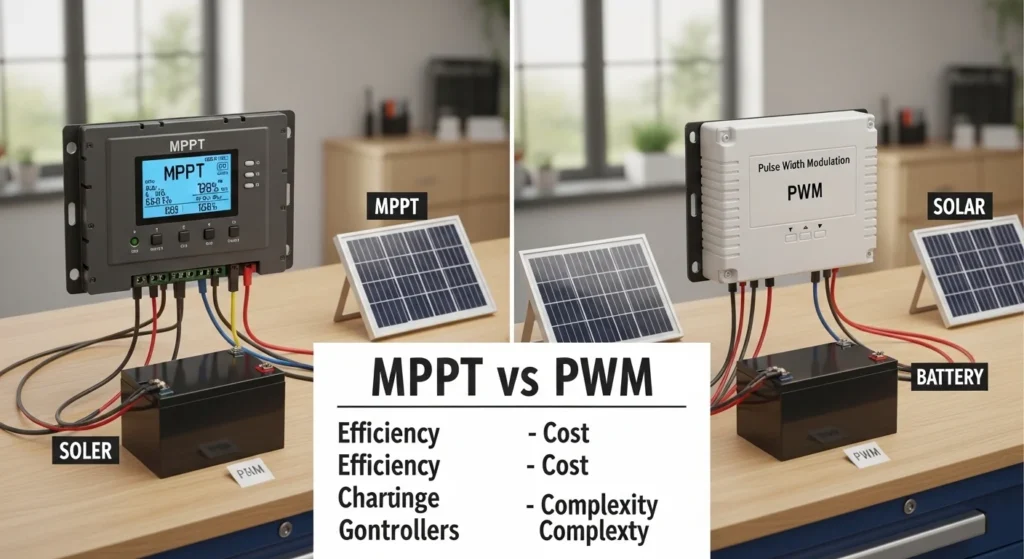

Imagine a small home solar system installed on the roof of a house. During the day, solar panels produce electricity, and that energy must be stored safely in batteries for use at night. However, if the charging process is not controlled properly, the batteries can become overcharged, overheated, or damaged.
This is where solar charge controllers become extremely important. Two of the most common types used in solar power systems are MPPT and PWM charge controllers. Choosing the right one can significantly affect the efficiency and performance of a solar system.
Many beginners in solar energy often ask about the difference between MPPT and PWM and which controller is better for their solar installation.
In this guide, we will clearly explain MPPT vs PWM, their working principle, components, advantages and disadvantages, and practical applications. This article is written especially for electrical students, technicians, engineers, and beginners who want to understand solar charge controllers in a simple and practical way.
By the end of this guide, you will know how these controllers work and how to select the right one for your solar system.
2. What is MPPT vs PWM?
The term MPPT vs PWM refers to a comparison between two types of solar charge controllers used in photovoltaic systems.
Both devices regulate the voltage and current coming from solar panels before charging the battery.
Simple Explanation
- PWM (Pulse Width Modulation) is a simple and traditional solar charge controller.
- MPPT (Maximum Power Point Tracking) is a more advanced and efficient controller.
Both controllers protect batteries from:
- Overcharging
- Deep discharge
- Voltage fluctuations
Practical Example
Consider a solar panel producing 18 volts, while the battery requires 12 volts.
- A PWM controller reduces the voltage by wasting extra energy.
- An MPPT controller converts the extra voltage into additional current, increasing charging efficiency.
This difference explains why MPPT controllers are usually more efficient in modern solar systems.
3. MPPT vs PWM Working Principle
Understanding the MPPT vs PWM working principle helps beginners see why these two controllers behave differently.
PWM Working Principle
PWM stands for Pulse Width Modulation.
This controller connects the solar panel directly to the battery and controls the charging current using switching pulses.
Step-by-Step Operation
- Solar panel generates DC electricity.
- PWM controller connects panel to battery.
- The controller rapidly switches on and off.
- This switching controls battery charging.
- Battery voltage gradually rises to full charge.
Simple Analogy
A PWM controller works like a water tap that opens and closes quickly to control water flow.
MPPT Working Principle
MPPT stands for Maximum Power Point Tracking.
It uses advanced electronics to track the maximum power output of solar panels.
Step-by-Step Operation
- Solar panels generate electricity.
- MPPT controller measures panel voltage and current.
- It calculates the maximum power point.
- A DC-DC converter adjusts voltage and current.
- Extra voltage is converted into additional charging current.
Simple Analogy
Think of MPPT like a smart gearbox in a car that automatically adjusts power for maximum efficiency.
4. Types / Classification
Although MPPT and PWM are already types of charge controllers, they can also be classified further.
Types of PWM Controllers
Standard PWM Controller
Basic controllers used in small solar systems.
Features:
- Simple design
- Low cost
- Easy installation
Temperature Compensated PWM Controller
These controllers adjust charging voltage based on battery temperature.
Benefits:
- Protects battery health
- Improves charging accuracy
Types of MPPT Controllers
Standalone MPPT Controller
Used in off-grid solar systems with battery storage.
Hybrid MPPT Controller
Used in systems that combine solar panels with grid power or generators.
Smart MPPT Controller
Modern controllers with:
- LCD displays
- Bluetooth monitoring
- Mobile apps
5. Main Components
Both MPPT and PWM controllers share several core components.
Microcontroller
Acts as the brain of the charge controller.
Functions:
- Controls charging process
- Processes sensor data
Voltage Sensors
Measure solar panel voltage and battery voltage.
Current Sensors
Monitor charging current flowing into the battery.
Switching Circuit
Uses electronic switches such as MOSFETs to regulate current flow.
DC-DC Converter (MPPT Only)
MPPT controllers include a DC-DC converter that changes voltage levels while maintaining power efficiency.
Display or Monitoring Interface
Shows system data such as:
- Battery voltage
- Charging current
- Solar power output
6. MPPT vs PWM Advantages
Understanding MPPT vs PWM advantages and disadvantages helps engineers select the right controller.
Advantages of PWM Controllers
- Low cost
- Simple design
- Reliable operation
- Easy installation
- Suitable for small solar systems
Advantages of MPPT Controllers
- Higher efficiency (up to 30% more energy)
- Better performance in cold weather
- Works with higher voltage panels
- Faster battery charging
- Ideal for large solar systems
7. Disadvantages / Limitations
Both technologies have limitations.
PWM Disadvantages
- Lower efficiency
- Energy loss from voltage mismatch
- Limited system flexibility
- Not suitable for large solar arrays
MPPT Disadvantages
- Higher cost
- More complex design
- Requires proper configuration
- Slightly higher maintenance
Despite the higher price, MPPT controllers are often preferred for larger systems.
8. MPPT vs PWM Applications
There are many MPPT vs PWM applications depending on system size and budget.
Home Solar Systems
Small home installations often use PWM controllers because they are affordable.
Off-Grid Solar Systems
Remote homes and cabins typically use MPPT controllers for better energy efficiency.
Solar Street Lighting
PWM controllers are common in small solar lighting systems.
Industrial Solar Installations
Large solar plants and commercial systems use MPPT controllers.
Telecommunications Towers
Remote telecom towers depend on MPPT for reliable battery charging.
9. Comparison: MPPT vs PWM
Understanding the difference between MPPT and PWM is easier with a comparison table.
| Feature | MPPT Controller | PWM Controller |
|---|---|---|
| Efficiency | Very high | Moderate |
| Cost | Expensive | Low cost |
| Technology | Advanced | Simple |
| Energy Conversion | Converts extra voltage to current | Wastes extra voltage |
| System Size | Best for large systems | Best for small systems |
| Charging Speed | Faster | Slower |
This table clearly shows the key differences between the two technologies.
10. Selection Guide
Choosing the right controller depends on several factors.
System Size
Small solar systems can use PWM controllers.
Large solar systems benefit from MPPT technology.
Budget
PWM controllers are cheaper.
MPPT controllers cost more but deliver higher efficiency.
Solar Panel Voltage
If solar panel voltage is much higher than battery voltage, MPPT is better.
Installation Environment
Cold climates often benefit from MPPT controllers because solar panels produce higher voltage.
Energy Demand
High power demand systems should use MPPT controllers.
11. Common Problems & Solutions
Problem 1: Battery not charging
Possible causes:
- Loose wiring
- Incorrect controller settings
Solution: Check connections and configuration.
Problem 2: Controller overheating
Possible causes:
- Poor ventilation
- Overloaded system
Solution: Improve airflow and reduce load.
Problem 3: Low charging efficiency
Possible causes:
- Dirty solar panels
- Incorrect controller type
Solution: Clean panels and verify controller selection.
Problem 4: Display not working
Possible causes:
- Power supply issue
- Internal fault
Solution: Restart system or check controller fuse.
12. Future Trends
Solar technology is improving rapidly, and charge controllers are evolving.
Smart Solar Controllers
Modern controllers include:
- Mobile monitoring apps
- Wireless communication
- Remote diagnostics
AI-Based Energy Optimization
Artificial intelligence can help optimize solar energy usage.
Integration with Smart Homes
Future solar systems will integrate charge controllers with home energy management systems.
Improved Battery Technology
New battery technologies will require smarter and more advanced MPPT controllers.
13. Conclusion
The comparison of MPPT vs PWM is very important for anyone working with solar energy systems. Both controllers play a critical role in protecting batteries and managing solar power efficiently.
PWM controllers are simple, affordable, and suitable for small solar systems. However, MPPT controllers provide higher efficiency and better energy utilization, especially in large installations.
Understanding the MPPT vs PWM working principle, applications, and advantages and disadvantages helps engineers design better solar systems. Selecting the correct controller improves system performance, increases battery life, and maximizes solar energy output.
As solar technology continues to grow worldwide, advanced charge controllers like MPPT will play an increasingly important role in modern renewable energy systems.