
Imagine a construction site where workers need electricity to operate drilling machines, lighting systems, and welding equipment. However, the location has no permanent power supply. In such situations, a mobile generator becomes the perfect solution. It can be easily transported to the site and provide instant electrical power wherever it is needed.
Mobile generators play a very important role in modern electrical systems. They are widely used in construction projects, outdoor events, emergency services, and remote areas where grid electricity is not available. Because they are portable and flexible, they help maintain continuous power supply in many industries.
For electrical students, engineers, technicians, and beginners, understanding Mobile Generator Types is essential. It helps them learn how portable power systems work and how to select the right generator for different applications.
In this article, you will learn:
- What a mobile generator is
- The mobile generator working principle
- Different Mobile Generator Types
- Main components used in mobile generators
- Mobile generator advantages and disadvantages
- Common mobile generator applications
- Comparison with stationary generators
- How to select the right mobile generator
This guide explains the topic in simple language, just like a senior electrical engineer explaining it to a junior technician.
2. What is a Mobile Generator?
A mobile generator is a portable electricity generator designed to produce electrical power and can be easily transported from one location to another.
Simple Definition
A mobile generator is a power generation unit mounted on wheels, a frame, or a vehicle so it can be moved easily to different places.
Simple Explanation
Unlike stationary generators that remain fixed in one location, mobile generators are designed for mobility. They often include wheels, trailers, or handles so users can transport them easily.
These generators can run on different fuels such as:
- Diesel
- Petrol
- Natural gas
- Hybrid systems
Practical Example
For example, during a power outage at an outdoor event, a mobile generator can provide electricity for:
- Lighting systems
- Sound equipment
- Food stalls
- Security cameras
Because of their portability, mobile generators are widely used in both residential and industrial environments.
3. Mobile Generator Working Principle
The mobile generator working principle is similar to that of any electrical generator. It converts mechanical energy into electrical energy using electromagnetic induction.
Step-by-Step Working Process
- Fuel Supply
- Fuel such as diesel or petrol is supplied to the engine.
- Engine Operation
- The engine burns fuel to produce mechanical power.
- Alternator Rotation
- The engine rotates the alternator shaft.
- Magnetic Field Creation
- The alternator creates a magnetic field inside the stator and rotor.
- Electricity Generation
- Mechanical energy is converted into electrical energy.
- Power Output
- The generated electricity is supplied to connected devices.
Simple Analogy
A mobile generator works like a small power plant on wheels. The engine acts as the driving force, and the alternator produces electricity.
Important Feature
Because it is mobile, the generator frame includes:
- Wheels or trailer mounting
- Protective frame
- Control panel
This allows easy transportation and quick setup.
4. Types / Classification of Mobile Generators
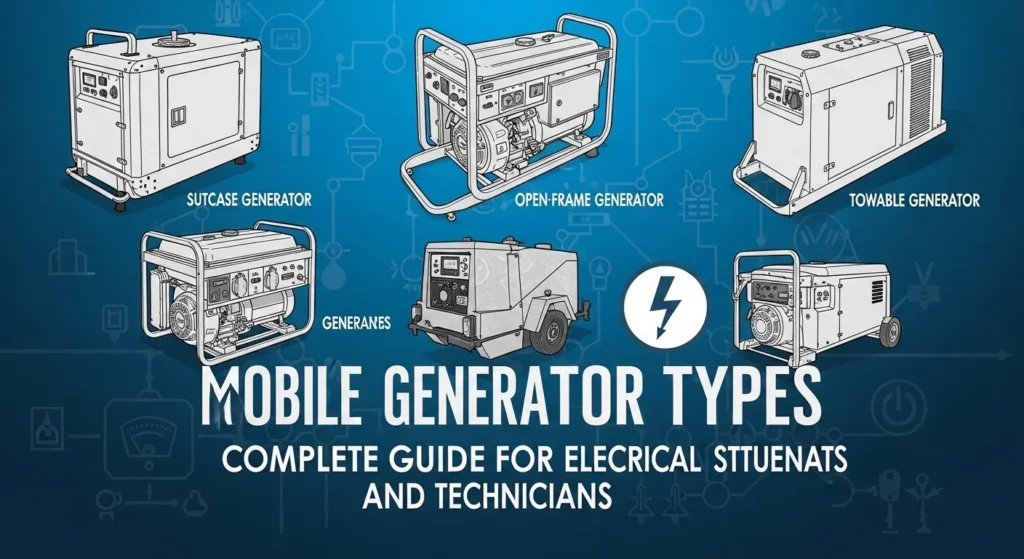
There are several Mobile Generator Types, classified mainly by fuel type, size, and technology.
4.1 Diesel Mobile Generators
Diesel generators are widely used for heavy-duty applications.
Features
- High power capacity
- Long operating time
- Strong engine performance
Typical Uses
- Construction sites
- Industrial projects
- Mining operations
Advantages
- High efficiency
- Reliable for continuous operation
4.2 Petrol Mobile Generators
Petrol generators are usually smaller and designed for light-duty applications.
Features
- Lightweight design
- Easy startup
- Lower initial cost
Typical Uses
- Homes
- Small businesses
- Outdoor activities
4.3 Inverter Mobile Generators
Inverter generators produce clean and stable electricity using electronic technology.
Features
- Advanced electronic control
- Low noise operation
- High efficiency
Typical Uses
- Sensitive electronics
- Computers
- Medical devices
4.4 Gas Mobile Generators
Gas generators use fuels such as LPG or natural gas.
Features
- Environmentally friendly
- Lower emissions
- Quiet operation
Typical Uses
- Residential backup systems
- Restaurants
- Hotels
4.5 Trailer-Mounted Mobile Generators
These generators are mounted on trailers for easy transportation.
Features
- Large power capacity
- Suitable for large projects
- Easy towing by vehicles
Typical Uses
- Large construction sites
- Emergency response operations
- Disaster relief
5. Main Components of Mobile Generators
Understanding the main parts helps technicians operate and maintain mobile generators effectively.
1. Engine
The engine provides mechanical energy to rotate the alternator.
Common engine fuels include:
- Diesel
- Petrol
- Gas
2. Alternator
The alternator converts mechanical energy into electrical energy.
Key Parts
- Rotor
- Stator
- Magnetic field system
3. Fuel System
The fuel system supplies fuel to the engine.
Components
- Fuel tank
- Fuel pump
- Fuel filter
4. Control Panel
The control panel allows operators to control and monitor the generator.
Functions
- Start and stop control
- Voltage monitoring
- Overload protection
5. Cooling System
Generators generate heat during operation.
Cooling systems include:
- Radiator
- Cooling fan
- Coolant system
6. Frame and Wheels
The frame supports the generator structure.
Function
- Provides portability
- Protects internal components
6. Mobile Generator Advantages
Understanding mobile generator advantages and disadvantages helps users make informed decisions.
Advantages
- Portable power supply
- Quick installation
- Useful in remote areas
- Reliable backup power
- Flexible usage
- Easy transportation
- Supports emergency power needs
Mobile generators provide power wherever electricity is required.
7. Mobile Generator Disadvantages
Despite many benefits, mobile generators also have limitations.
Disadvantages
- Fuel consumption cost
- Limited power capacity for small units
- Requires regular maintenance
- Noise generation
- Exhaust emissions
Proper maintenance and proper usage help reduce these issues.
8. Mobile Generator Applications
There are many mobile generator applications in modern electrical systems.
1. Construction Sites
Power for tools, lighting, and equipment.
2. Outdoor Events
Used in:
- Concerts
- Weddings
- Festivals
3. Emergency Services
Used by:
- Hospitals
- Disaster response teams
- Fire departments
4. Remote Locations
Power supply for areas without electricity.
5. Film Production
Used for powering lighting and camera equipment.
9. Comparison: Mobile Generator vs Stationary Generator
Understanding the difference between mobile generator and stationary generator helps engineers select the right system.
| Feature | Mobile Generator | Stationary Generator |
|---|---|---|
| Mobility | Portable | Fixed location |
| Installation | Quick setup | Permanent installation |
| Applications | Temporary power | Long-term power backup |
| Power Capacity | Small to medium | Medium to very large |
| Flexibility | High | Low |
Mobile generators are best for temporary and portable power needs.
10. Selection Guide: How to Choose the Right Mobile Generator
Selecting the right generator depends on several important factors.
1. Power Requirement
Calculate the total electrical load before selecting the generator.
2. Fuel Type
Choose fuel based on availability and cost.
- Diesel for heavy-duty use
- Petrol for small portable units
- Gas for cleaner operation
3. Noise Level
Choose a low-noise generator if it will be used in residential areas.
4. Portability
Consider generator size and weight.
5. Budget
Include costs such as:
- Purchase price
- Fuel consumption
- Maintenance
Beginners should start with small generators before using large industrial units.
11. Common Problems & Solutions
1. Generator Not Starting
Possible causes
- Low fuel
- Dead battery
- Clogged fuel filter
Solution
Check fuel supply and battery condition.
2. Low Voltage Output
Possible causes
- Faulty alternator
- Overloaded generator
Solution
Reduce load and inspect alternator.
3. Overheating
Possible causes
- Cooling system failure
- Excessive load
Solution
Check radiator and reduce load.
4. Excessive Noise
Possible causes
- Loose parts
- Damaged exhaust system
Solution
Tighten components and inspect muffler.
12. Future Trends in Mobile Generators
Generator technology is continuously evolving.
1. Hybrid Mobile Generators
Modern generators combine:
- Solar panels
- Battery storage
- Diesel generators
This reduces fuel consumption.
2. Smart Generator Monitoring
Advanced generators now include:
- Remote monitoring
- Automatic alerts
- Mobile app control
3. Low-Emission Generators
Manufacturers are developing generators with:
- Cleaner engines
- Reduced emissions
- Higher efficiency
These technologies will improve performance and environmental safety.
13. Conclusion
Mobile generators are essential power solutions for locations where electricity is not easily available. Their portability and flexibility make them ideal for construction sites, emergency services, outdoor events, and remote areas.
In this article, we explored Mobile Generator Types, including diesel, petrol, inverter, gas, and trailer-mounted generators. We also discussed the mobile generator working principle, main components, advantages, disadvantages, and practical applications.
Understanding these systems helps electrical students and technicians select the right generator for different situations. As technology advances, mobile generators will become more efficient, environmentally friendly, and intelligent.
Learning about portable power systems prepares future electrical professionals to handle real-world power challenges effectively.